
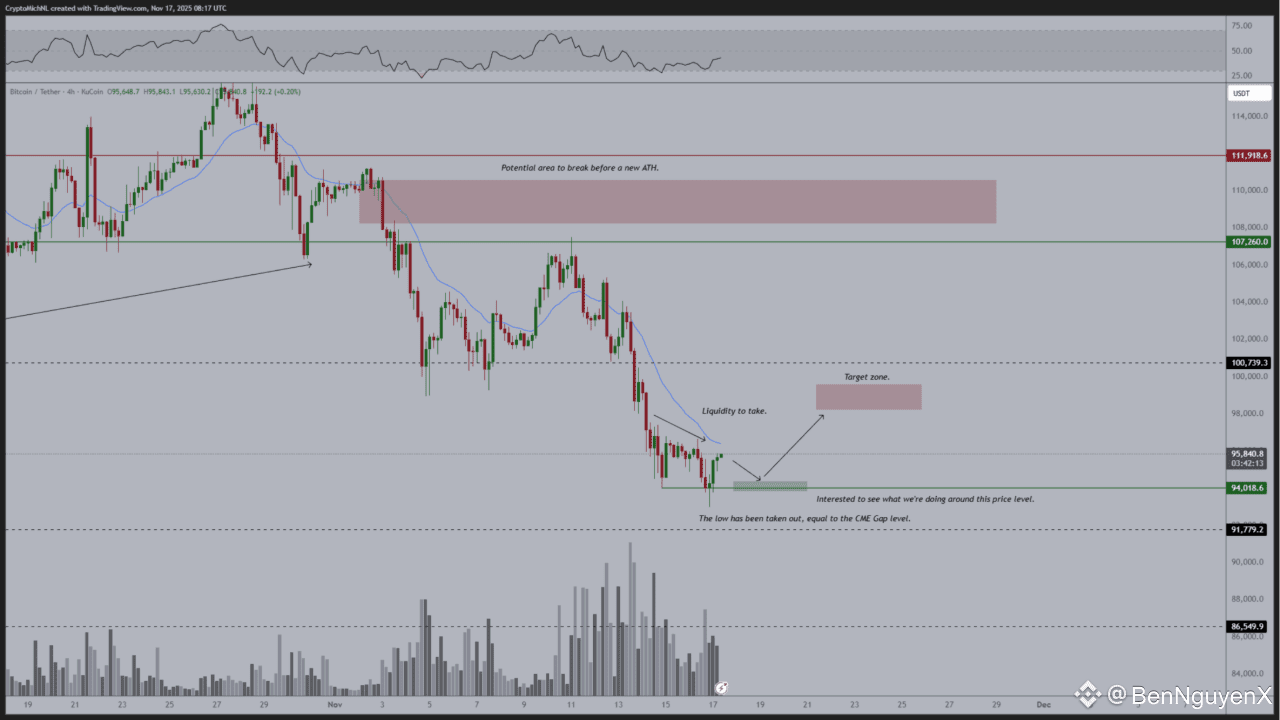
An extreme wave of fear is engulfing the crypto market, as the Fear & Greed Index just hit a mark of 9 points - the lowest since July 2022, a dark time after the collapse of Terra/Luna.
The collapse of $BTC regarding the area $93,000 has triggered a liquidation of 565 million USD in 24 hours. But behind this panic, the on-chain data is telling a more complex story.
📜 Part 1 - Context: "Macro" Storm and Money Flow Out of ETFs
The drop did not happen randomly. It was triggered by a series of negative factors:
U.S. stocks dive: The crypto market sharply declines following the sell-off of major U.S. stock indices.
FED throws a cold splash of water: Expectations for the FED to cut interest rates in December have dropped from 60% to only 43%, reducing the appeal of risky assets.
ETF outflows: The Bitcoin Spot ETFs in the U.S. have recorded three consecutive weeks of outflows, with a total of 1.11 billion USD flowing out from November 10 to 14. BlackRock's IBIT fund leads with 532.41 million USD withdrawn.
🧠 Part 2 - In-Depth Analysis: The Battle Between "Short-Term Players" and "Long-Term Whales"
So who is selling the most? On-chain data from CryptoQuant has pointed out the main culprits.
"The main culprit" is the short-term holders.
Their Profit/Loss Ratio (SOPR) has repeatedly fallen below 1, indicating they are selling at a loss, creating a selling spiral.
Data also shows that coins under three months old account for a large portion of the selling volume.
What about long-term holders?
Although they have also increased selling since September, this pattern is consistent with ordinary mid-cycle profit-taking behavior, rather than a massive distribution like at cycle peaks.
Notably, the Realized Cap of Bitcoin continues to rise, indicating that new capital is still flowing into the market despite falling prices.
🏁 Conclusion:
The market is in a polarized state. The panic and sell-off mainly come from short-term traders using high leverage. Meanwhile, long-term investors remain relatively calm.
Technically, $BTC is retesting the important support zone of $94,000 - $95,000, which is also the opening price range for 2025. Successfully protecting this area will be key to preventing a deeper correction. History shows that after reaching extreme fear in mid-2022, the market needed several months to recover. This time, whether the scenario repeats will depend on the bulls' ability to defend this last fortress.