
The cryptocurrency market remains sluggish. Since November, the price of Ethereum has dropped by nearly 40% from its peak, with continuous net outflows from ETFs. In this round of systemic retreat, the leading Ethereum treasury company BitMine has become a focus, as Peter Thiel's Founders Fund has halved its holdings in BMNR, while Cathie Wood's ARK Invest and JPMorgan have chosen to increase their positions against the trend.
The capital's torn attitude has put BitMine's '5% alchemy' on trial: 3.56 million ETH, 3 billion in unrealized losses, mNAV dropping to 0.8. As one of the last strongholds for Ethereum buying pressure, how much longer can BitMine keep buying? Is there a value mismatch? After the DAT flywheel stalled, who will take over ETH?
First, how long can BitMine's 5% alchemy funds hold on?
As the second-largest cryptocurrency treasury company after MicroStrategy, BitMine planned to buy tokens equivalent to 5% of Ethereum's total supply in the future. On November 17, BitMine announced that its Ethereum holdings had reached 3.56 million coins, accounting for nearly 3% of the circulating supply, halfway to the long-term target of 6 million coins. In addition, the company currently holds approximately $11.8 billion in crypto assets and cash, including 192 bitcoins, $607 million in uncollateralized cash, and 13.7 million shares of Eightco Holdings.
Since launching a large-scale coin accumulation plan in July, BitMine has become a focal point in the market. During that time, the company's stock price rose in sync with the price of Ethereum, and the story of 'using coins to lift market value' was regarded by investors as a new model in the crypto field.
However, as the market cools and liquidity tightens, market sentiment begins to reverse. The drop in Ethereum's price makes BitMine's aggressive buying pace seem even riskier. Based on an average buying price of $4,009, BitMine's unrealized losses are nearing $3 billion. Although Chairman Tom Lee has repeatedly stated his bullish outlook on Ethereum and indicated he will continue to accumulate at lower levels, investors' focus has shifted from 'how much more can be bought' to 'how much longer can it hold.'
Currently, BitMine's cash reserves are approximately $607 million, and the company's funding mainly comes from two channels.
First, there are the returns from crypto assets. BitMine relies on immersive cooling Bitcoin mining and consulting services to generate short-term cash flow while laying out Ethereum staking to pursue long-term returns. The company states that its held ETH will be staked to generate approximately $400 million in net revenue.
Next is secondary market financing. The company has initiated an ATM stock sales plan, which allows it to sell new shares for cash at any time without presetting price or scale. So far, the company has issued hundreds of millions of dollars in stock and attracted funding from several institutions, including well-known firms like ARK, JPMorgan, and Fidelity. Tom Lee stated: When institutions buy BMNR in large amounts, this funding will be used to purchase ETH.
By accumulating ETH and creating revenue through a dual-driven approach, BitMine attempts to reshape the logic of corporate capital allocation, but changes in the market environment are undermining the stability of this model.
In terms of stock price, BitMine (BMNR) is under certain pressure, having fallen about 80% from its July peak, with a current market value of approximately $9.2 billion, below its ETH holding value of $10.6 billion (based on ETH at $3,000), and mNAV has dropped to 0.86. This discount reflects the market's concerns about the company's unrealized losses and the sustainability of its funds.
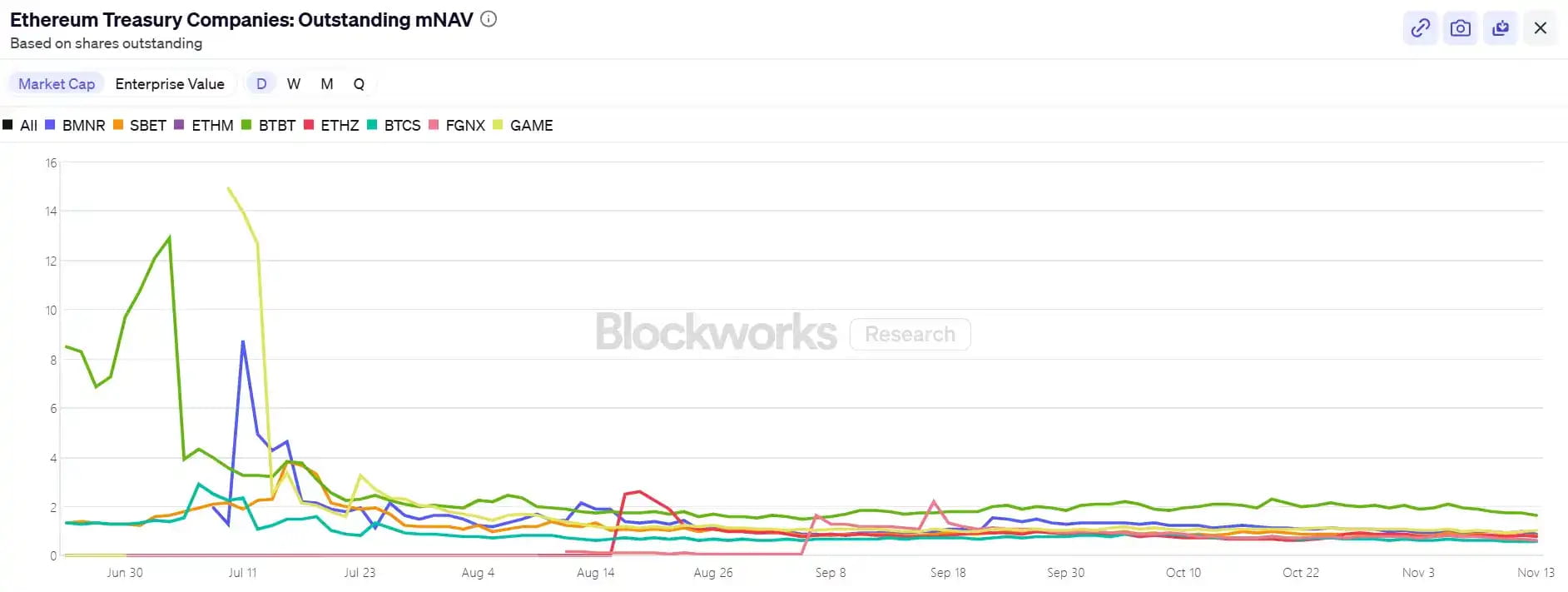
Second, the last straw for ETH prices: three visible purchasing powers fully diverging and the retreat of staking.
From a macro perspective, the Federal Reserve has released hawkish signals, and the probability of a rate cut in December has decreased, leading to overall weakness in the crypto market and a significant decline in risk appetite.
Currently, ETH has dipped to $3,000, more than 30% lower than the August peak of $4,900. This round of adjustment has refocused the market on a key question: if the power that supported prices previously came from treasury companies and institutional accumulation, then after the buying pressure retreats, who will take over?
Among the visible market forces, the three main buying sides—ETFs, treasury companies, and on-chain funds—are showing different directions of divergence.
Firstly, the inflow trend of funds related to Ethereum ETFs has noticeably slowed down. Currently, the total ETF holdings are approximately 6,358,600 ETH, accounting for 5.25% of the total supply. According to SoSoValue data, as of mid-November, the total net assets of Ethereum spot ETFs are approximately $18.76 billion, and the net outflow this month has significantly exceeded the inflow, with a single-day capital outflow as high as $180 million. Compared to the continuous net inflow phase from July to August, the fund curve has shifted from a steady increase to a volatile decline.
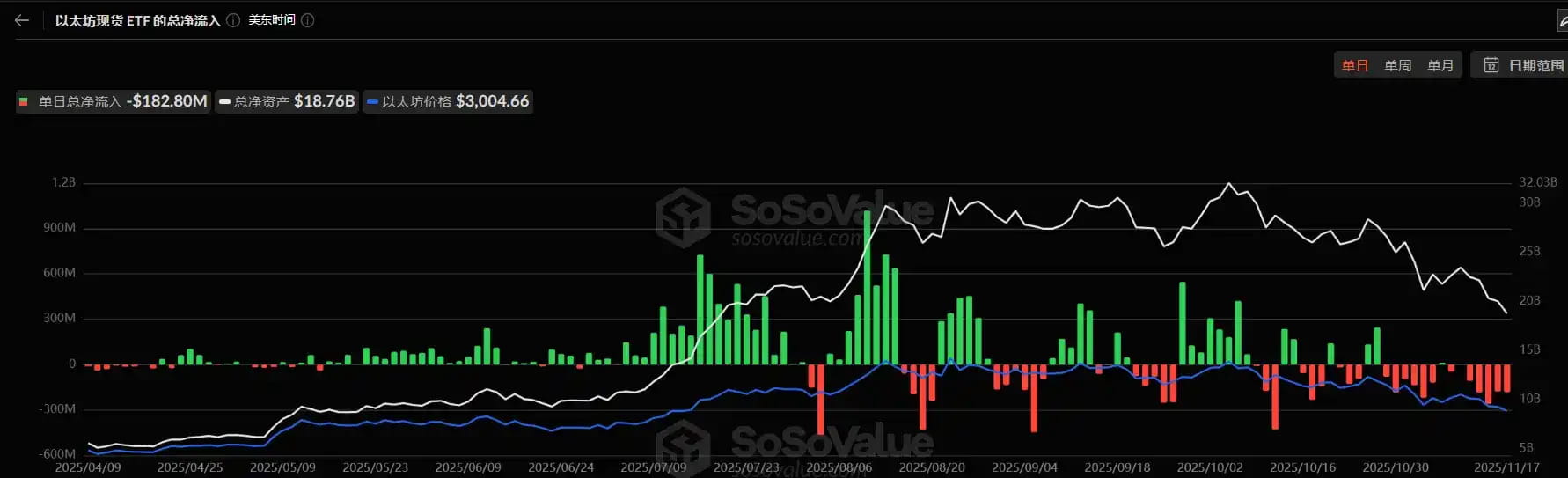
This decline not only weakens the potential buying power but also reflects that market confidence has not completely recovered from the rhythm of the collapse. ETF investors usually represent medium to long-term allocated funds, and their withdrawal means that traditional financial channels' incremental demand for Ethereum is slowing down. When ETFs no longer provide upward momentum, they may actually amplify volatility in the short term.
Secondly, digital asset treasury (DAT) companies are also entering a phase of divergence. Currently, the total strategic reserves of treasury companies for Ethereum amount to 6.2393 million ETH, accounting for 5.15% of the supply. The pace of accumulation has noticeably slowed in recent months, with BitMine nearly becoming the only major player still making large-scale purchases. In the past week, BitMine increased its holdings by 67,021 ETH, continuing to execute a buy-on-dips strategy; SharpLink has not continued purchasing since acquiring 19,300 ETH on October 18, with a total cost of approximately $3,609, and it is currently in an unrealized loss position.
In contrast, some small and medium-sized treasury companies are being forced to shrink. ETHZilla sold about 40,000 ETH at the end of October to repurchase shares, attempting to narrow the discount range and stabilize the stock price by selling a portion of ETH.
This divergence means that the treasury industry is moving from general expansion to structural adjustment. Leading companies can still maintain buying power with funds and confidence, while small and medium-sized companies are trapped in liquidity constraints and debt servicing pressures. The baton of the market has shifted from broad incremental buying to a few 'lone warriors' still possessing capital advantages.
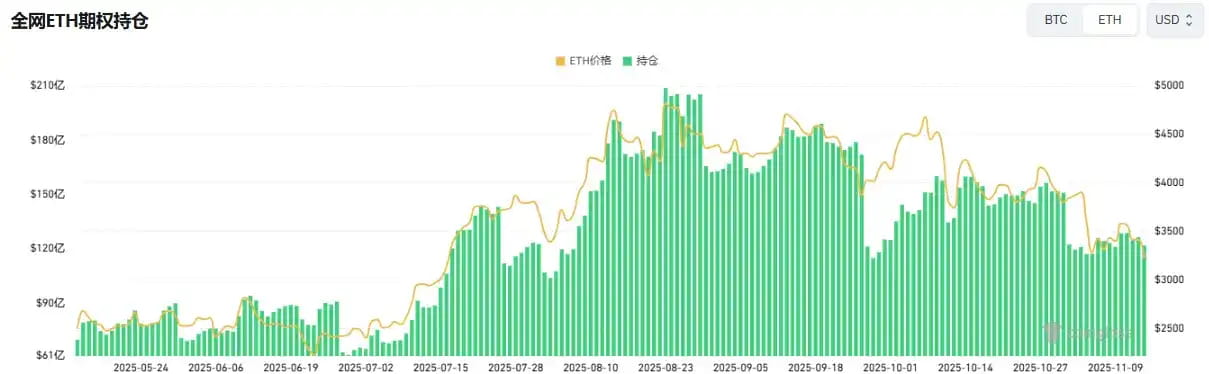
On the on-chain level, the short-term funding leaders are still the whales and high-frequency addresses, but they do not constitute a price support force. Recently, friends who insisted on being long on ETH have been continuously liquidated, which has somewhat undermined trading confidence. According to Coinglass data, the total open interest of ETH contracts has nearly halved since the peak in August, and leveraged funds are rapidly contracting, indicating that liquidity and speculative enthusiasm are both cooling down.
In addition, recently, Ethereum ICO wallet addresses that have been dormant for over 10 years have been activated and started transferring out. Glassnode data reports that long-term holders (addresses holding for more than 155 days) are currently selling approximately 45,000 ETH daily, equivalent to about $14 million. This is the highest selling level since 2021, indicating a weakening of current bullish power.
Arthur Hayes, co-founder of BitMEX, recently stated that even though dollar liquidity has contracted since April 9, ETF inflows and DAT purchases have allowed Bitcoin to rise, this state has now ended. The basis is not rich enough to sustain institutional investors' continued purchases of ETFs, and most DATs are trading at discounts below mNAV, causing investors to now avoid these derivative securities.
Ethereum is no different; moreover, its staking ecosystem is also showing signs of retreat. Beaconchain data shows that the number of daily active validators for Ethereum has declined by about 10% since July, reaching the lowest level since April 2024. This is the first significant drop since the network transitioned from a proof-of-work (PoW) consensus mechanism to a proof-of-stake (PoS) consensus mechanism in September 2022.
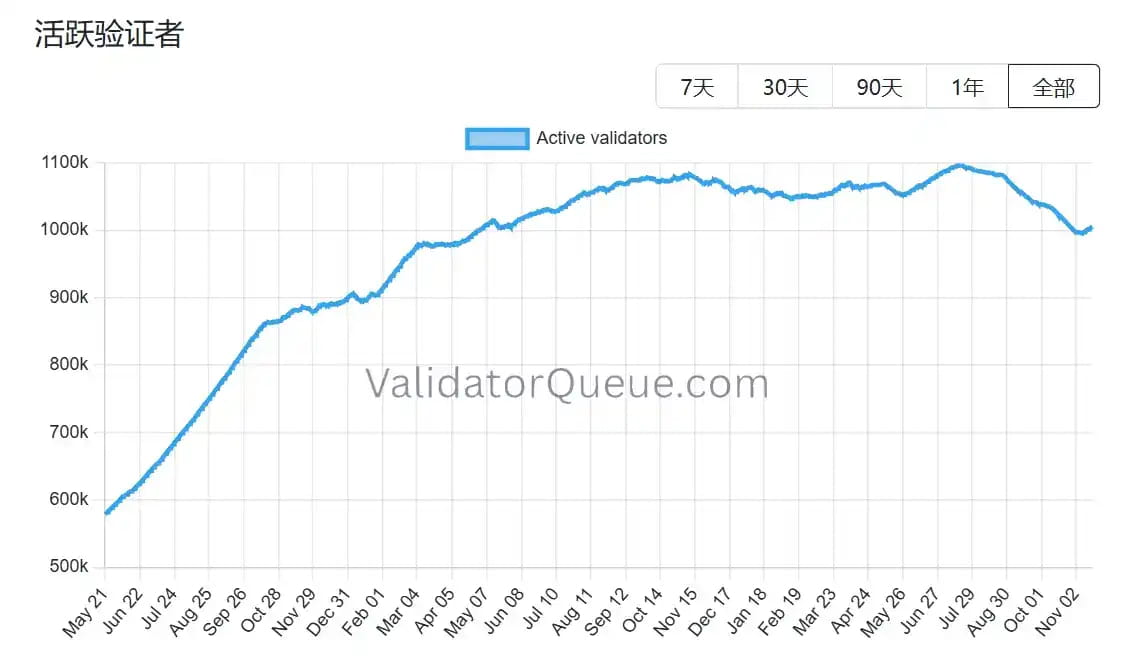
The reasons for the decline mainly come from two aspects:
Firstly, this year's Ethereum bull market has led to an unprecedented increase in validators exiting the queue, as staking operators rush to cancel staking to realize profits.
Secondly, the decline in staking yields and the rise in borrowing costs have made leveraged staking unprofitable. Currently, Ethereum's annualized staking yield is approximately 2.9% APR, far below the historical high of 8.6% set in May 2023.
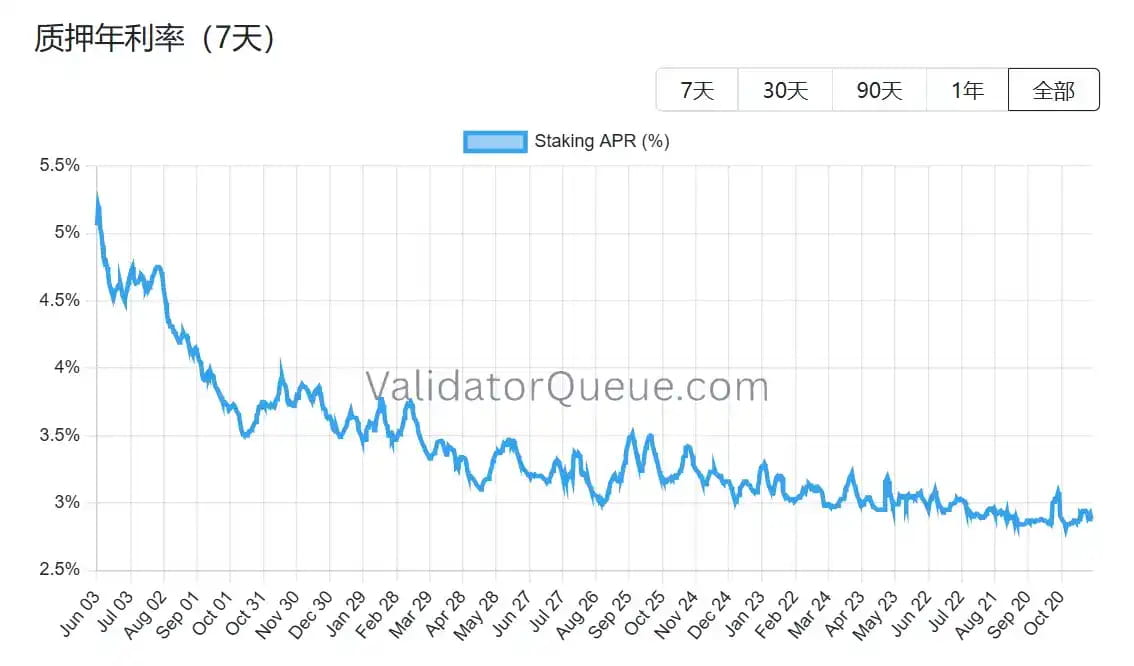
In the context of three main buying paths being pressured simultaneously and the retreat of the staking ecosystem, Ethereum's next phase of price support faces structural tests. Although BitMine is still buying, it is nearly fighting alone; if even BitMine, this last pillar, cannot buy, what the market will lose is not just a stock or a wave of funds, but possibly the foundational belief of the entire Ethereum narrative.
Third, is there a value misalignment in BitMine?
After discussing the funding chain and the retreat of buying pressure, a more fundamental question arises: Is BitMine's story really over? The current pricing offered by the market clearly does not fully understand its structural differences.
Compared to MicroStrategy's path, BitMine chose a completely different approach from the beginning. MicroStrategy heavily relies on convertible bonds and preferred stocks for fundraising in the secondary market, with an annual interest burden of hundreds of millions of dollars, and its profitability relies on the unilateral rise of Bitcoin; BitMine, while diluting equity through new stock issuance, has almost no interest-bearing debt, while its held ETH contributes approximately $400-500 million in staking revenue each year, which is relatively rigid cash flow with much lower correlation to price fluctuations than Strategy's debt costs.
More importantly, this revenue is not the end. As one of the largest institutional-level ETH holders globally, BitMine can fully utilize staked ETH for restaking (earning an additional 1-2%), operating node infrastructure, locking in fixed returns through yield tokenization (e.g., around 3.5% certainty returns), and even issuing institutional-level ETH structured notes, which are operations that MicroStrategy's BTC holdings cannot achieve.
However, currently, BitMine (BMNR) has a market value in the U.S. stock market that is discounted by approximately 13% compared to its ETH holding value. Within the entire DAT sector, this discount is not the most exaggerated but is clearly lower than the historical pricing center for similar assets. Bear market sentiment amplifies the visual impact of unrealized losses, which somewhat obscures the value of revenue buffers and ecological options.
Recent institutional moves also seem to have captured this divergence. On November 6, ARK Invest increased its holdings by 215,000 shares ($8.06 million); JPMorgan held 1.97 million shares at the end of the third quarter. This is not blind bottom-fishing, but based on a judgment of long-term compounded growth in the ETH ecosystem. Once Ethereum's price stabilizes or experiences a mild rebound, the relative stability of returns may allow BitMine's mNAV repair path to be steeper than that of purely leveraged treasury.
Whether value misalignment truly exists is already on the table; the remaining question is when the market will be willing to pay for scarcity. The current discount represents both risk and the starting point of divergence. As Tom Lee said, the pain is temporary and will not change the supercycle of ETH. Of course, it may also not change BitMine's core role in this cycle.#ETH巨鲸增持

