
Cloud GPUs sold out, performance exceeded expectations; Jensen Huang's AI wave is reshaping the risk asset landscape in unprecedented ways. "Blackwell chip sales far exceeded expectations, cloud GPUs are sold out," said NVIDIA CEO Jensen Huang in the latest earnings report, providing reassurance to investors worried about an AI bubble and stirring waves across the entire risk asset market.
NVIDIA's latest quarterly report delivered impressive results with revenue of $57.01 billion, a 62% year-over-year growth, and its data center revenue surged to a historic high of $51.2 billion.
After the earnings report was released, NVIDIA's stock price rose by more than 6% in after-hours trading. However, in today's world where AI and the cryptocurrency market are increasingly interconnected, its impact extends far beyond the stock market.
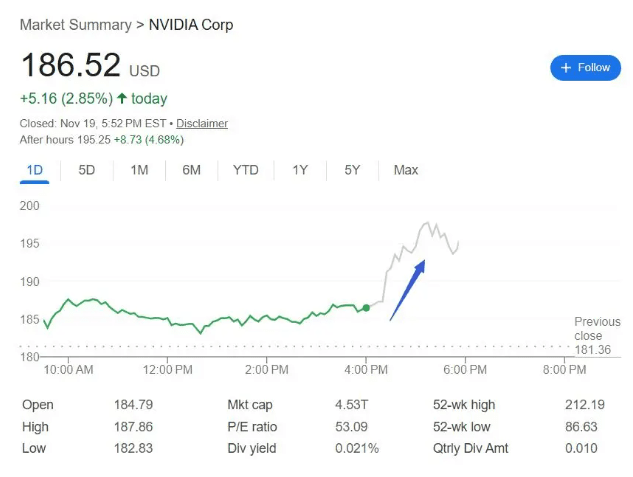
One, Comprehensive Performance Analysis: Revenue Growth Resurgence, Data Centers as the Engine
● NVIDIA's financial report was described by the market as a "surprise," not only because the data comprehensively exceeded expectations but also because it dispelled market concerns about the sustainability of demand for AI infrastructure.
● NVIDIA's revenue for the third quarter of fiscal year 2026 reached $57.01 billion, a year-on-year increase of about 62%, the first acceleration in revenue growth compared to the previous quarter since the fourth quarter of fiscal year 2024.
The year-on-year growth in the previous quarter was 56%, and there were concerns that the growth momentum might slow down, but NVIDIA has proven with actual performance that AI demand is still accelerating.
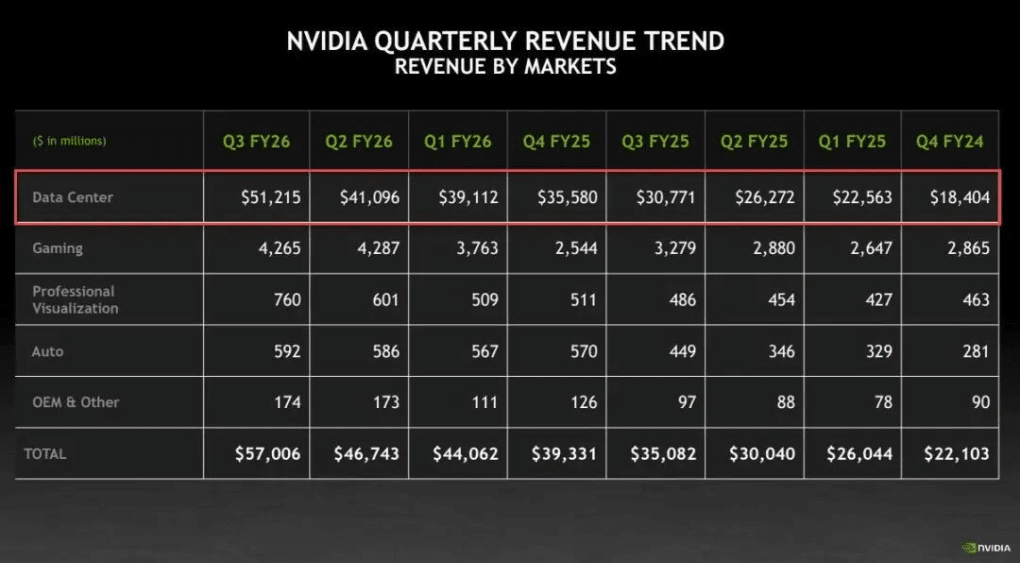
● The data center business has become the biggest highlight, contributing nearly 90% of revenue, with quarterly revenue of $51.2 billion, a year-on-year surge of 66% and a quarter-on-quarter increase of 24.6%. This performance clearly exceeded the analyst expectation of $49.34 billion, demonstrating the urgent need for global AI infrastructure construction.
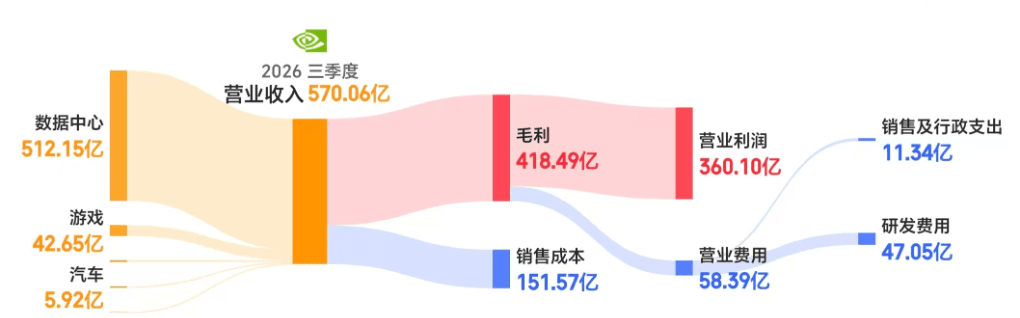
Two, Performance of Segmented Businesses: Slowing Growth in Gaming, Bright Spot in Visualization
From the perspective of various business segments,
● This quarter, NVIDIA's gaming and AI PC business revenue reached $4.3 billion, a year-on-year increase of 30%, but slightly below the analyst expectation of $4.42 billion.
● In contrast, the professional visualization business performed outstandingly, with revenue of $760 million, a year-on-year increase of 56%, far exceeding the expected $612.8 million.
● The automotive and robotics business generated $592 million in revenue, a year-on-year increase of 32%, below the expected $620.9 million, but still maintaining a robust growth trend.
In terms of profitability,
● NVIDIA's adjusted gross margin for the third quarter is 73.6%, slightly lower than the analyst expectation of 74.0%.
● However, the company's outlook for the fourth quarter is more optimistic, expecting gross margins to rise to 75.0%, which will be the first year-on-year increase in gross margins in six quarters.
Three, Strong Future Guidance: Blackwell Demand Far Exceeds Expectations
● Even more exciting for the market is NVIDIA's optimistic outlook for the future. The company expects fourth-quarter revenue to reach $65 billion (with a fluctuation of 2%), a year-on-year increase of over 65%, significantly higher than the analyst expectation of $61.98 billion.
● Jensen Huang emphasized during the earnings call, "The computational demands for training and inference continue to accelerate and are growing exponentially. We have entered a virtuous cycle of AI." He again refuted the theory of an AI bubble, stating that there are many claims about an AI bubble, "but from our perspective, it is completely different."
● NVIDIA CFO Colette Kress revealed that the company has secured chip orders worth $500 billion, including the next-generation Rubin chips that will begin mass production next year. She also mentioned an interesting phenomenon: the A100 GPUs shipped six years ago are still working at full capacity this year, reflecting the tightness of computing resources.
Four, Correlation in the Cryptocurrency Market: Resonance of Risk Asset Sentiment
NVIDIA's financial report can stir the nerves of the crypto market because in today's financial markets, tech stocks and cryptocurrencies have become "conjoined twins" of risk assets. The latest data shows that the 30-day correlation between Bitcoin and the NASDAQ 100 index has reached about 0.80, setting a new high since 2022.
● Industry insiders generally believe that Bitcoin's performance is increasingly resembling that of a "leveraged tech stock," surging in a bull market and being sold off simultaneously during times of heightened risk aversion, with the declines being amplified.
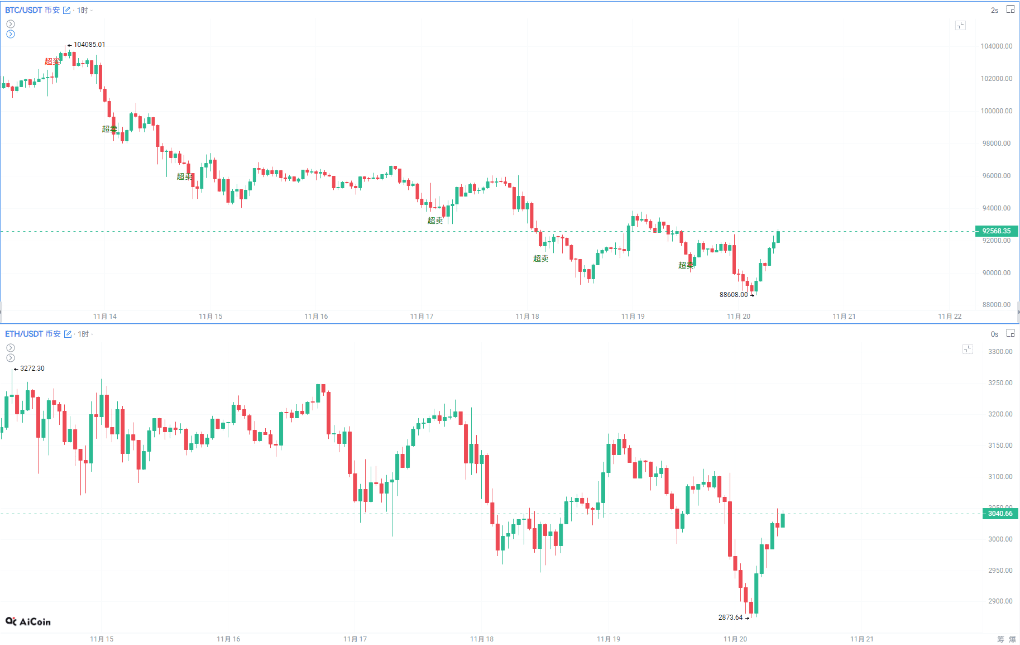
● Before NVIDIA's financial report was released, the crypto market had just experienced a "bloodbath": Bitcoin briefly fell below $90,000, and Ethereum breached the $2,900 mark.
● Behind this synchronized decline lies a dual "blow" formed by investor panic over the "AI bubble" and uncertainty regarding the Federal Reserve's monetary policy.
Five, On-Chain Data Verification: Surge in Stablecoin Supply
NVIDIA's AI wave is influencing the crypto market not just on an emotional level, but is also generating real capital flows.
● Q3 2025 witnessed a historic surge in the issuance of stablecoins, with total supply expanding by $45 billion, nearing $300 billion. This growth is primarily driven by platforms like Ethereum and Tron, indicating that a large amount of capital is preparing to flood into various digital assets.
● Meanwhile, AI-related cryptocurrencies were also directly affected. When news of NVIDIA's cooperation with companies like OpenAI emerged, tokens like (FET) and Render (RNDR) typically saw rises. This correlation is particularly evident when NVIDIA announces important news, indicating the crypto market has sharply recognized NVIDIA as a bellwether in the AI field.
Six, OpenAI Joins Forces to Lead Transformation
NVIDIA's cooperation with OpenAI has recently deepened further.
● According to reports, NVIDIA has signed a letter of intent to invest up to $100 billion in OpenAI for deploying at least 10GW of NVIDIA systems. Jensen Huang commented that this cooperation is "the next leap towards a new intelligent era."
● OpenAI CEO Sam Altman pointed out that "computing power infrastructure will become the cornerstone of the future economy," indicating a high level of importance both sides place on AI computing capabilities.
This deep collaboration not only strengthens NVIDIA's strategic position in the AI field but also provides infrastructure support for the entire AI and crypto ecosystem.
Seven, Finding Opportunities Amid Volatility
● Despite NVIDIA's strong performance, the market remains concerned about the future. Wharton School professor Jeremy Siegel recently stated, "AI is revolutionary, but that doesn't mean valuations can detach from fundamentals."
This perspective somewhat characterizes the current contradictory emotions of investors: they are firmly convinced about the future of AI but are also worried that last year's gains have exhausted future growth.
● For crypto investors, Ryan Rasmussen and others from Bitwise Asset Management remain optimistic, believing that when the market is at an extreme of "fear," it is the "perfect opportunity" for investors to build existing positions or enter the market.
● Standard Chartered's Head of Digital Asset Research, Geoffrey Kendrick, pointed out in a recent research report: The current Bitcoin pullback is a healthy adjustment within the cycle; if it can hold the $100,000 range, Bitcoin will form new structural support.
NVIDIA's financial report is like a timely rain, alleviating market anxiety about the AI bubble. With its Blackwell architecture chips completely sold out and $500 billion in orders waiting to be fulfilled over the next few years, the prosperous cycle of AI infrastructure is far from over.
On Wall Street, analysts are reassessing the target prices of AI stocks; on-chain, crypto investors are closely monitoring the correlation between Bitcoin and tech stocks. Computing power is becoming the cornerstone of the digital economy, and what NVIDIA provides is the "shovels and picks" of this intelligent era.
A detailed analysis of NVIDIA's earlier financial report
Tech stocks, cryptocurrency, and gold are all suffering, with NVIDIA's financial report becoming the market's last lifeline - AiCoin https://www.aicoin.com/article/500995.html


