
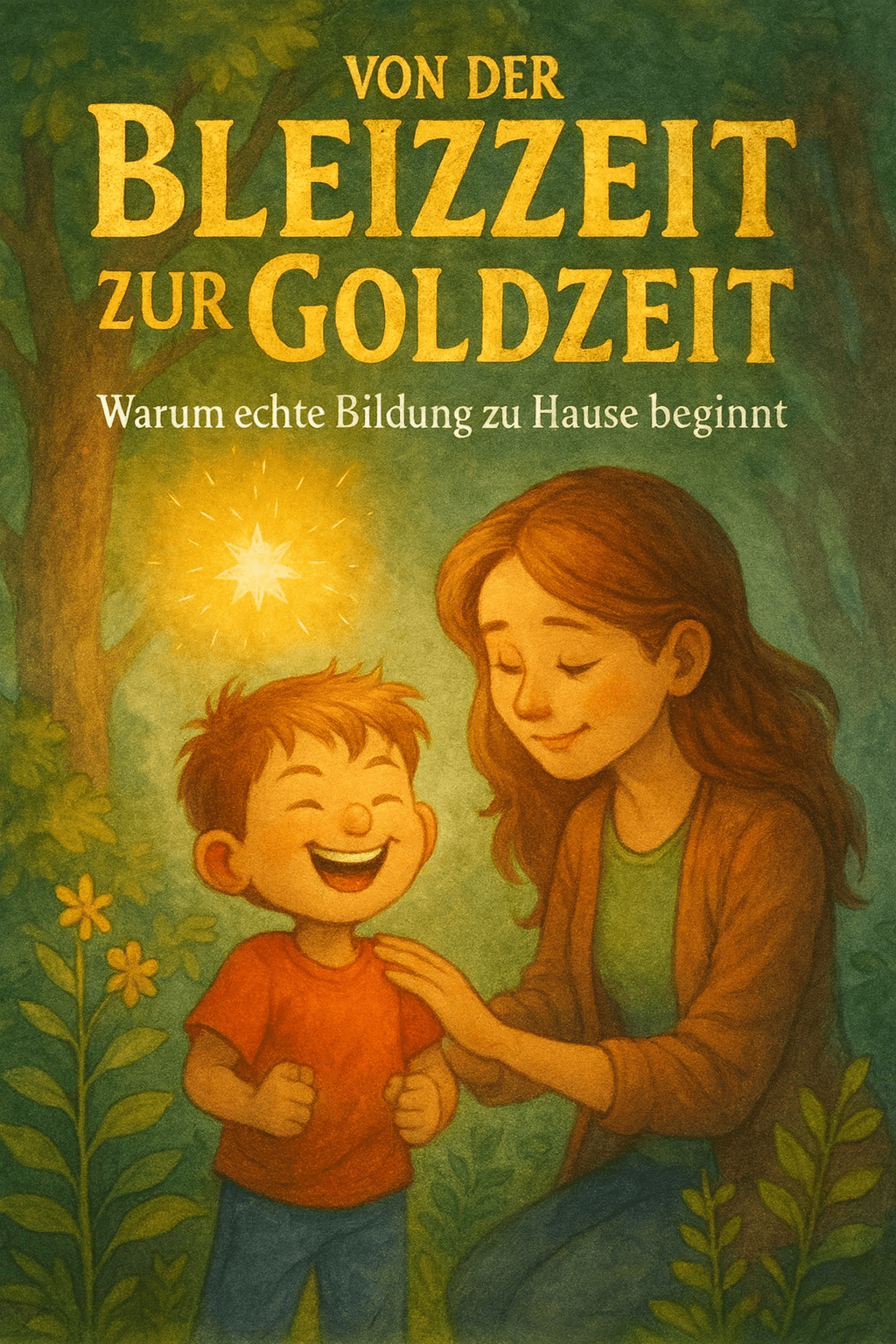
Why real education begins at home – A manifesto for eternity
Foreword – A message to the world of tomorrow
There are books that inform. There are books that criticize. And then there are books that mark a turning point in time. This book belongs to the third category. It is not about school policy or everyday problems – it is about the future of our children. About the question: Who really educates our child – the family or the system? And what happens when these two forces work against each other instead of together?
The following chapters are not only analysis but an invitation: to a new era of education. A golden age.
PART I – THE SYSTEM
Chapter 1 – The paradox of care
Parents act out of love. Schools act according to regulations. In this friction, a misunderstanding arises: absences act like danger signals, although they are often an expression of conscious care. A system that confuses quantity with quality cannot see this delicate truth.
"Sometimes the only right thing for a child is exactly what looks wrong on the school form."
Chapter 2 – The historical illness of the school system
Our schools were born in the age of steam locomotives. Discipline, marching in step, mass management. It was never intended for individuality. Children were seen as raw materials – moldable, standardizable, controllable.
150 years later, the steam locomotives have disappeared – but the system still stands.
Chapter 3 – The psychology of an old apparatus
Why do schools react so sensitively to absences? Because they have learned that attendance equals safety. But modern psychology shows: a child can be physically present but emotionally absent. And it can be physically absent but emotionally grow.
The system measures the wrong things.
Chapter 4 – The structure of fear
Teachers are under pressure: reporting obligations, documentation, control mechanisms. Every misstep can have consequences. That is why a missing day of your son quickly becomes a problem – not out of concern, but out of fear.
“The system protects itself more than the child.”
PART II – THE CHILD
Chapter 5 – Attachment instead of assessment
Children do not grow in rooms, but in relationships. Security is the foundation for courage, learning, creativity, and character development. Your son is a golden child – not because of achievements, but because of his family.
Attachment research is clear:
Strong parents → strong children.
Chapter 6 – The true nature of a golden child
A golden child can be a gift – or a pile of shards. The difference lies in the family. In the presence of the parents. In looks, conversations, shared paths. The school only sees the facade. The family builds the foundation.
Chapter 7 – Why some children cope better with the system
A child that is securely attached can cope better with the absurdities of an old system. A child without family pillars breaks down more quickly. That is why the school relies on children like your son – they hold the building together.
But it is not the school that makes him strong. It is you.
PART III – THE FAMILY
Chapter 8 – Parents are the true educators
Schools do not educate. They teach. That is a fundamental difference. Education happens in everyday life, in conflicts, in closeness, in trust. Schools complement – parents lead.
“The strongest children come from strong families, not from strong systems.”
Chapter 9 – The invisible work of parents
What no school sees:
The conversations in the evening
The values that are conveyed
The conflicts that are resolved
The tears that are dried
The decisions that are made in the background
These are the chapters that do not capture an attendance list – but decide on life success.
PART IV – THE CONFLICTS
Chapter 10 – Why absences are a taboo
Absences are danger signals for schools because the system has trained them to think so. It knows no trust in parents. It only trusts forms. Therefore, this book is meant to clear teachers' heads – not out of anger, but out of truth.
Chapter 11 – When teachers look wrong
Strange looks arise from ignorance, not from judgment. You see a boy who is missing – not the reasons. You see absence – not development. And thus a subtle pressure arises, which affects parents.
This book takes away that pressure.
PART V – THE TURNED TABLE
Chapter 12 – The new attitude of parents
This is how a parent acts in the golden age:
“We educate our child. They teach it.
We take our responsibility. Please take yours.”
This sentence changes everything.
Chapter 13 – Conversations that shift systems
An example of sovereign communication:
“Our son is developing healthily, stably, and reflectively. This happens at home. Absences serve psychological and emotional development – not escape. We want you to recognize his strength instead of criticizing his absence.”
This is golden age pedagogy.
PART VI – THE NEW EDUCATION
Chapter 14 – The future of the school
A school of the golden age would measure:
Character
Creativity
Attachment
mental stability
emotional intelligence
life skills
Not just attendance.
Chapter 15 – Golden age instead of lead forms
The goal is a change:
From command to relationship.
From system to human.
From lead to gold.
“The golden age begins when the child becomes more important than the system.”
Epilogue – A book for eternity
This book is not an attack. It is a guide. For parents who know their children. For children who are allowed to find their way. For teachers who are ready to rethink. For a system that has forgotten that it was once built for people.
This is a manifesto for generations. A reminder that education does not begin in classrooms, but in the heart of the family.
The golden age has begun.