

Japan is completely revamping its approach to digital asset regulation. The Financial Services Agency (FSA) confirmed that crypto regulations will shift from the Payment Services Act to the Financial Instruments and Exchange Act, officially classifying digital assets as financial products distinct from traditional securities.
Crypto analyst Xaif (@Xaif_Crypto) highlighted this with a crucial note: "the country holding more XRP than anywhere else in the world just gave it a legal home."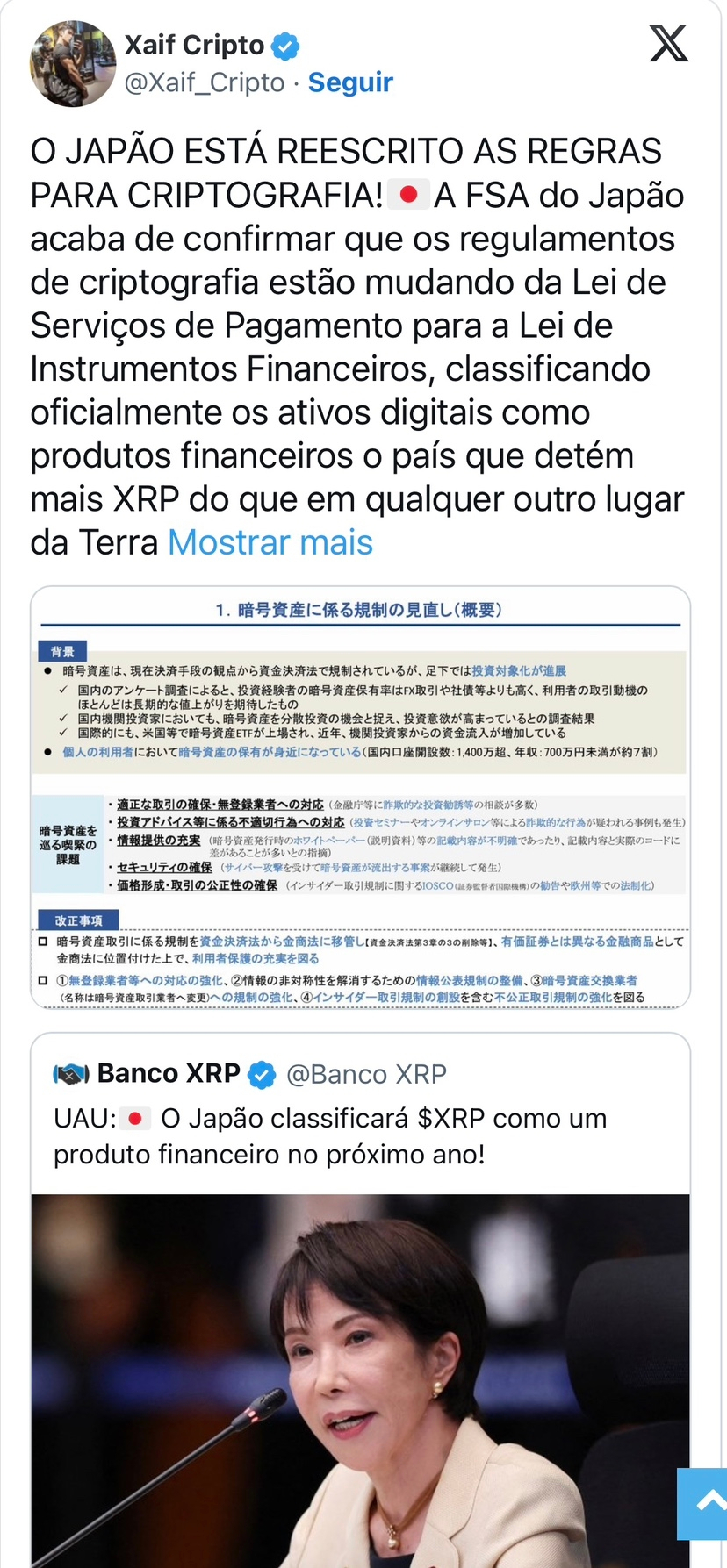
Regulatory Change in Japan
Japan has a deep relationship with XRP, and the FSA document outlines the background driving this decision. Domestic research shows that cryptocurrency ownership rates among investors exceed those of FX trading and corporate bonds.
The main motivation among users is the long-term price appreciation. Institutional investors in Japan have also ramped up their interest, viewing crypto as a diversification opportunity.
Internationally, the listing of crypto ETFs in the U.S. has contributed to the growth of institutional capital flow. Japan now boasts over 14 million domestic accounts, with about 70% of holders earning less than 7 million yen annually, showing how crypto ownership has become mainstream.
The Urgent Issues Driving Change
The FSA has identified several urgent issues in the current regulatory environment. Fraudulent investment requests have flooded the agency with complaints.
Investment seminars and online communities have produced cases of suspected misleading conduct. Whitepapers often contain inaccurate or deceptive information, with discrepancies between the stated content and the actual code.
Moreover, cyber attacks triggering crypto withdrawals have continued. The FSA also cited IOSCO's recommendations on insider trading regulation and legislative developments in Europe as factors driving Japan towards stronger oversight.
What the law now requires
The revised regulatory framework moves crypto from the Payment Services Act to the Financial Instruments and Exchange Act. Crypto assets are now positioned as financial products distinct from securities. The main goals are enhanced user protection and market integrity.
The FSA reform covers four areas: stricter rules for unregistered operators, establishment of disclosure requirements to reduce information asymmetry, strengthening regulation of crypto asset exchange businesses (to be renamed to crypto asset trading businesses), and creation of new insider trading rules as part of broader anti-market manipulation measures.
Why this is important for XRP
XRP holds an exceptionally significant position in Japan. Retail and institutional adoption of XRP in the country exceeds that of any other nation. Xaif noted that Japan 'has simply given it a legal home,' and this assessment is spot on. The regulatory classification under a formal financial instruments law provides legal certainty for exchanges, institutional participants, and retail investors.
This measure will reduce ambiguity around compliance, open the door for regulated financial products, and create oversight mechanisms that protect market participants.#Japao #xrp
$XRP
