
Bitcoin as a cryptocurrency - history, pricing factors, forecasts, and comparisons
Bitcoin (BTC) is not just the first cryptocurrency, but also a fundamental pillar of the modern digital economy. Since its launch in 2009, it has transformed from an experimental project into a global financial asset that influences politics, investments, technologies, and even geopolitics. This report examines all key aspects of Bitcoin: from technical architecture and history to current market trends, pricing factors, regulatory challenges, expert forecasts, and comparisons with other leading cryptocurrencies. Special attention is given to data analysis for the years 2024-2025, the impact of ETFs, mining, macroeconomic factors, as well as institutional demand and innovations in the Bitcoin ecosystem.
1. What is Bitcoin: a brief description, principles of operation, and role in the crypto ecosystem
1.1. Brief description and principles of operation
Bitcoin is a decentralized digital currency that operates without control from governments or central banks. Its foundation is blockchain - a distributed public ledger of transactions that ensures transparency, immutability, and data security. Each transaction is verified by a network of miners using the Proof of Work (PoW) consensus mechanism, which guarantees the absence of double spending and forgery12.
Bitcoin has a strictly limited supply - only 21 million coins. This creates a deflationary model that distinguishes it from fiat currencies, which can be printed in unlimited quantities. New coins are created through mining, and the reward for a block decreases every 210,000 blocks (approximately every 4 years) - this process is called halving34.
Transactions in Bitcoin are made between addresses generated based on a pair of public and private keys. The owner of the private key has full control over the funds in the corresponding address. Wallets are used to store keys - software (hot) or hardware (cold), each having its own advantages and risks1.
1.2. Role in the crypto ecosystem
Bitcoin became the first example of decentralized digital currency, inspiring the creation of thousands of other cryptocurrencies and the development of a whole industry of blockchain technologies. It performs several key functions in the crypto ecosystem:
Store of value: Bitcoin is often referred to as "digital gold" due to its limited supply and deflationary nature.
Payment system: Thanks to the Lightning Network and other Layer-2 solutions, Bitcoin is used for fast and cheap transactions.
Investment asset: Bitcoin has become part of the portfolios of institutional investors, pension funds, corporate treasuries.
Innovative platform: New technologies are developing based on Bitcoin - Taproot, Ordinals, Runes, DeFi on Stacks, etc.45.
2. Technical foundations: blockchain, Proof of Work, addresses, wallets
2.1. Blockchain and Proof of Work
Blockchain is a sequential chain of blocks, each containing a list of transactions, the hash of the previous block, and other metadata. Adding a new block occurs through solving a complex cryptographic problem (PoW) that requires significant computational resources. This ensures the security of the network, as altering already recorded blocks requires recalculating the entire chain, which is practically impossible12.
Proof of Work (PoW) is a consensus mechanism that ensures that only those who have expended significant resources on calculations can add a new block. Miners compete for the right to add a block, and the winner receives a reward in the form of new Bitcoins and transaction fees. The difficulty of the task is automatically adjusted every 2016 blocks to keep the average time between blocks around 10 minutes61.
2.2. Addresses, wallets, and cryptography
Each Bitcoin user has a pair of keys: a public key used to receive funds and a private key that signs transactions and confirms ownership. A Bitcoin address is a hash of the public key, providing an additional layer of security. Losing the private key means losing access to the funds, and its compromise poses a risk of asset loss14.
Wallets can be:
Hardware (cold) - physical devices that store keys offline, providing maximum security.
Software (hot) - applications or services that store keys online, convenient for everyday use but more vulnerable to attacks7.
3. Emission and halving mechanism
3.1. Emission chart and halvings
Bitcoin's emission is strictly limited by protocol: the maximum number of coins is 21 million. New coins appear as a reward for mining a block, which is halved every 210,000 blocks (approximately every 4 years). This phenomenon is called halving.
History of halvings:
• 28.11.2012 •
Reward up to 50 BTC
Reward after 25 BTC
Price at the time of halving $12.35
• 09.07.2016 •
Reward up to 25 BTC
Reward after 12.5 BTC
Price at the time of halving $650.63
• 11.05.2020 •
Reward up to 12.5 BTC
Reward after 6.25 BTC
Price at the time of halving $8,821.42
• 19.04.2024 •
Reward up to 6.25 BTC
Reward after 3.125 BTC
Price at the time of halving $64,968.87
The next halving is expected in March-April 2028, when the reward will decrease to 1.5625 BTC36.
3.2. Impact of halving on the market
Historically, halvings have been accompanied by accumulation periods followed by sharp price rallies. The reduction in issuance rates creates a supply scarcity that, with stable or rising demand, drives the price up. After the halving in 2024, this effect was amplified by institutional demand through ETFs, leading to new historical highs in 2025.
4. History of Bitcoin 2009-2025: chronology of key events
4.1. Key stages of development
2008: Publication of Satoshi Nakamoto's whitepaper "Bitcoin: A Peer-to-Peer Electronic Cash System".
January 3, 2009: Launch of the Bitcoin network, creation of the Genesis Block.
2010: First commercial transaction - buying pizza for 10,000 BTC (Bitcoin Pizza Day).
2011-2013: First exchanges, price growth to $1,000, first hacker attacks (Mt. Gox).
2017: Launch of futures on CBOE, CME; price reaches $20,000.
2021: El Salvador recognizes Bitcoin as official currency; price exceeds $68,000.
2024: Approval of the first spot ETFs in the USA, halving, new historical highs.
2025: Mass institutional adoption, corporate holdings, development of the Lightning Network, price exceeds $125,0008910.
4.2. Key events of recent years
January 2024: SEC approves spot Bitcoin ETFs, leading to record inflows of institutional capital.
April 2024: Halving, reward decreases to 3.125 BTC.
Summer 2025: Price reaches $124,000, Bitcoin's market dominance - 57%.
Fall 2025: Correction to $95,000-$105,000, increased volatility due to macroeconomic factors and capital rotation into altcoins811.
5. History of Bitcoin price: annual peaks and troughs 2009-2025
5.1. Price dynamics over the years
Year. Maximum. Minimum
2025. $125,245. $84,679
2024. $108,339. $39,800
2023. $42,500. $16,000
2022. $47,835. $16,547
2021. $68,789. $29,796
2020. $29,096. $3,850
2017. $19,892. $784
2013. $1,163. $13
2010. $0.40. $0.00
2009. $0.0041. $0.00
5.2. Major price cycles
2013-2017: Growth from <$200 to $20,000, the first mass "bull" market.
2018: Correction to $3,200, the "crypto winter".
2020-2021: New growth cycle, price exceeds $68,000.
2022: Drop to $16,000 due to macroeconomic shocks and the collapse of FTX.
2023-2025: Recovery, institutional demand, new highs over $125,000, then correction to $90,000-$110,000139.
6. Impact of regulations on Bitcoin: USA, EU, China, Ukraine
6.1. USA
In 2024-2025, the USA moved to a more crypto-friendly policy. Approval of spot ETFs, creation of a working group on digital assets, new bills (GENIUS Act), and the appointment of crypto-friendly officials contributed to institutional adoption. The SEC shifted its approach from "regulation by enforcement" to developing clear rules, which increased investor confidence1415.
6.2. European Union
The EU implemented the MiCA regulation (Markets in Crypto-Assets), which creates a unified regulatory framework for crypto assets. The transition period lasts until mid-2026, but companies must already comply with strict AML/KYC, transparency, and investor protection requirements. This promotes the legalization of cryptocurrencies but complicates operations for startups due to high compliance costs16.
6.3. China
China has completely banned mining and transactions with cryptocurrencies for banks and financial institutions since 2021, citing the fight against financial crimes, capital outflows, and economic stability. Despite the ban, underground mining and trading continue, but their volume has significantly decreased614.
6.4. Ukraine
In Ukraine, Bitcoin is recognized as an intangible asset, there is a procedure for declaring cryptocurrencies, and since 2021 a law on virtual assets has been adopted. Binance and other exchanges operate with the hryvnia, and Ukraine is among the top 10 countries by Bitcoin usage. The regulatory framework is gradually harmonizing with the European one14.
7. Key factors affecting the price of Bitcoin
7.1. Demand and supply
Limited supply: 21 million coins, of which over 19.9 million have already been mined. Scarcity is exacerbated by halvings and coin losses (estimates - up to 3 million BTC lost forever).
Demand: Increasing due to institutional adoption (ETFs, corporate treasuries), retail investors, and use in payments and value preservation.
Liquidity: Decrease in coins on exchanges, accumulation by whales and funds leads to price growth under stable demand111718.
7.2. ETF and institutional demand
The launch of spot ETFs in the USA (2024) was a turning point: over $54 billion in net investments, over 1.3 million BTC under ETF management (6.5% of the supply).
BlackRock IBIT - the largest ETF ($80-87 billion AUM), Fidelity, ARK, Grayscale also have significant assets.
ETF infrastructure provides stable demand, increases liquidity, reduces volatility, and makes Bitcoin accessible to traditional investors.
Corporate holdings: MicroStrategy (640,000 BTC), Tesla, Coinbase, Block, Marathon Digital, Metaplanet - together over 1 million BTC on company balances19910.
7.3. Mining, difficulty, costs
Mining cost: Increases due to rising difficulty, decreasing rewards (after halving 2024 - 3.125 BTC), rising electricity prices.
Mining geography: USA - 37.8% of global hash rate, Canada, Kazakhstan, Norway, Oman, Paraguay - new centers due to cheap energy.
Energy efficiency: New ASIC miners (Bitmain S21 XP Hyd, MicroBT M63S++) achieve 9.5-15.5 J/TH, reducing costs.
Impact of halving: Decreasing rewards increase cost of production, but high BTC price compensates for this for efficient miners.
Ecology: Increasing share of renewable energy, but CO2 emissions issues remain relevant2015.
7.4. Regulations and legal risks
Regulatory uncertainty: Changes in SEC, MiCA, FATF policy, local bans or restrictions can sharply affect price.
AML/KYC: Strengthening requirements for exchanges and custodians, fines for violations, increased compliance costs.
Lawsuits: SEC vs. Coinbase, Binance, Kraken - impact liquidity and trust.
Government reserves: The USA, Japan, Bhutan, El Salvador - accumulate BTC, affecting supply and market dynamics1421.
7.5. Macroeconomics and Fed rates
Fed policy: Rate cuts in September 2025 (by 25 b.p.) contributed to the growth of Bitcoin as an inflation hedge.
Inflation: High CPI rates drive demand for BTC as a hedge against the devaluation of fiat currencies.
Correlation with the stock market: In 2025, correlation with the S&P 500 reached 80%, indicating institutional integration.
Geopolitics: Ceasefire in Ukraine, stability in the world - contribute to risk assets, including Bitcoin2210.
7.6. On-chain metrics and analytics
Whale activity: Increase in wallets with >1,000 BTC, decrease in small holders during corrections.
Transaction volumes: Over $1.7 billion per day, over 54 million active addresses.
Exchange flows: Decrease in BTC on exchanges indicates accumulation, which is a bullish signal.
Glassnode, CoinMarketCap, TradingView - main tools for analyzing on-chain data, flows, liquidity, market sentiment2318.
8. Valuation and forecasting models: S2F, power-law, AI models
8.1. Stock-to-Flow (S2F)
S2F - a model that relates the stock of Bitcoin to the current flow of new coins. The higher the S2F, the higher the expected price. After the halving in 2024, the S2F for Bitcoin exceeds 115, which theoretically corresponds to a price of $366,000-$389,000, although the actual price lags behind the model due to market corrections and macroeconomic factors24.
8.2. Power-law, AI, and other models
Power-law: Predicts nonlinear price growth with decreasing liquid supply.
AI models: Use machine learning to analyze on-chain metrics, sentiment, macroeconomic data.
Multi-models: Combine S2F, power-law, technical and fundamental analysis to build price trajectory scenarios.
ARK Invest, PlanB, Strategy forecasts: Up to $1 million in 2030-2036 under optimistic scenarios, $300,000-$700,000 - consensus for 2030 24.
9. Medium and long-term forecasts: November 2025 - 2030
Technical analysis: RSI in neutral zone, MACD - bearish, but there are signs of overselling. Key support - $93,000, resistance - $115,000-$120,000. Expected consolidation with potential recovery to $105,000-$115,000 by the end of December 2025, if support is not broken2512.
9.2. Forecasts for 1 year, 2 years, 5 years
Period
Projected price (USD)
Source/Comment
1 year (2026)
$100,000 - $170,000
Binance, JPMorgan, LongForecast, FXClub
2 years (2027)
$130,000 - $200,000
LongForecast, FXClub, Gate.com
5 years (2030)
$122,000 - $1,000,000+
Binance, FXClub, ARK Invest, CoinPedia
Expert forecasts:
JPMorgan: $170,000 in 2026 (parity with gold), $94,000 - price "floor" (cost of mining).
Standard Chartered: $200,000 by the end of 2025.
ARK Invest: $710,000-$1.5 million in 2030 (bullish scenario).
VanEck: $180,000-$400,000 in 2026-2027.
Binance, CoinCodex: $122,000-$155,000 in 2030 (user consensus).
LongForecast: $81,000-$150,000 in 2026, $287,000 in 2027, $343,000 in 2028, $164,000 in 2029 (volatile scenario)2612.
10. Comparison of Bitcoin with other cryptocurrencies (Ethereum, Solana, Litecoin)
10.1. Comparison table of major cryptocurrencies (November 2025)
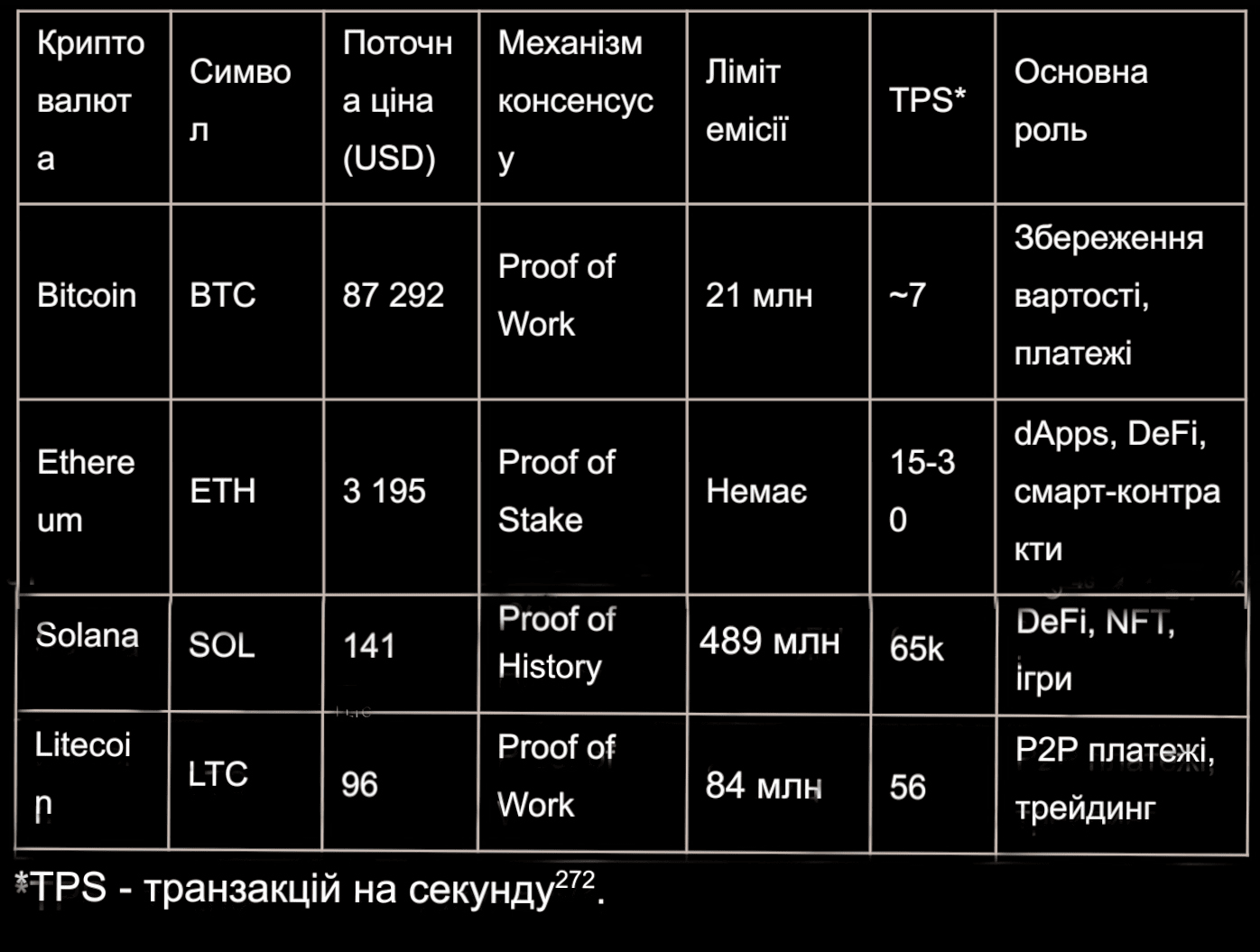
10.2. Key differences
Bitcoin: Most decentralized, highest security, deflationary model, limited functionality (only transactions).
Ethereum: Flexible platform for smart contracts, DeFi, NFT, transition to PoS reduced energy consumption but has no supply limit.
Solana: High speed and scalability, low fees, but risk of centralization and technical failures.
Litecoin: "Silver" to Bitcoin's "gold", faster blocks, lower fees, but smaller ecosystem and dependence on Bitcoin.
Conclusion: Bitcoin remains the benchmark for value preservation and a reserve asset, Ethereum is a platform for innovation, Solana is for fast DeFi/NFT, Litecoin is for cheap P2P payments. The choice depends on the investor's goals and risk profile228.
11. Technical innovations and ecosystem development: Lightning, Taproot
11.1. Lightning Network
The Lightning Network is a Layer-2 solution for scaling Bitcoin that allows for nearly instant and cheap transactions off the main blockchain. In 2025:
Over 1.5 million users, $1.5 billion trading volume.
Public capacity exceeded 5,000 BTC ($475-509 million).
Integration into the networks of Steak ‘n Shake, Block (Square), Cash App, BitGo, Unocoin.
Reduction of fees for businesses by 50% compared to cards.
Implementation of Taproot Assets - stablecoins (USDT) on Lightning, paving the way for multi-currency payments.
Technical updates: BOLT12, Splicing, Dual Funding, Channel Factories, Eltoo.
Main challenges: complexity for users, centralization of nodes, regulatory uncertainty, but the pace of adoption is increasing299.
11.2. Taproot, Ordinals, Runes
Taproot: Protocol update that enhances privacy, efficiency, and allows for more complex scripts.
Ordinals, Runes: Enable the creation of NFTs and tokens directly on Bitcoin, expanding the functionality of the network.
Stacks, DeFi: Development of DeFi on Bitcoin through Layer-2 solutions (Stacks), integration of smart contracts and tokenization of assets.
12. Use of Bitcoin in payments, countries (El Salvador), and corporate treasuries
12.1. Payments and countries
El Salvador: Since 2021, Bitcoin has been the official currency. However, according to the IMF, only 1.75% of remittances are made via crypto wallets, 97% of businesses do not accept BTC, and most users only use Chivo to receive bonuses. The project has raised the country's global recognition but has not led to widespread financial inclusion.
Other countries: Iran uses BTC to circumvent sanctions, Colorado and the canton of Zug accept taxes in Bitcoin, Japan recognizes BTC as a means of payment, while China has a complete ban65.
12.2. Corporate treasuries
MicroStrategy: 640,000 BTC ($61 billion), the largest corporate holder.
Tesla, Coinbase, Block, Marathon Digital: Hold from 8,000 to 52,000 BTC each.
Total BTC held by companies: over 1 million BTC, representing ~5% of the total supply.
Strategy: Use BTC as an inflation hedge, reserve asset, tool for attracting investors and increasing capitalization109.
13. Investment strategies and risk management (DCA, HODL, ETF)
13.1. DCA (Dollar-Cost Averaging)
Essence: Regular purchase of BTC for a fixed amount regardless of price.
Advantages: Reduces the impact of volatility, eliminates the emotional factor, suitable for long-term investors.
Recommendations: Automate purchases, stick to the plan even during corrections, diversify assets30.
13.2. HODL
Essence: Long-term storage of BTC regardless of market fluctuations.
Advantages: Historically provides the highest returns, minimizes the risk of loss due to panic selling.
Risks: High volatility, possible prolonged periods of stagnation, need for safe key storage31.
13.3. ETF
Advantages: Accessibility for traditional investors, regulation, no need to manage private keys.
Disadvantages: Management fees, lack of direct control over the asset, counterparty risks.
Role in the portfolio: It is recommended to allocate 1-10% of the portfolio to BTC depending on risk tolerance and investment goals1119.
14. Risks and uncertainties: technical, regulatory, macro
14.1. Technical risks
Quantum computing: Theoretically could break SHA-256, but modern research and the implementation of post-quantum algorithms reduce this risk in the next 10-15 years.
Centralization of mining: Growing role of large mining pools, migration of miners to countries with cheap energy.
Lightning Network: Centralization of nodes, complexity for users, security risks when using LSP529.
14.2. Regulatory risks
Changes in SEC, FATF, MiCA policy: May affect liquidity, availability, pricing.
Bans and restrictions: China, India, some EU countries - risk of losing markets.
AML/KYC: Increasing requirements, fines, closure of exchanges, rising compliance costs.
Government interventions: Seizures, tax changes, creation of state reserves of BTC1415.
14.3. Macroeconomic risks
Fed rate hikes: Decrease appetite for risk assets, lead to corrections.
Global recessions: Decrease demand for BTC as a risk asset.
Volatility: High share of derivatives, cascading liquidations, structural sensitivity to liquidity.
Correlation with the stock market: Increases systemic risk, especially during crises in traditional markets32.
15. Data sources and tools for analysis: CoinMarketCap, Glassnode, TradingView
CoinMarketCap: Global aggregator of prices, volumes, capitalization, market data.
Glassnode: Leading platform for on-chain analytics - whale metrics, exchange flows, network activity, P/L analysis, wallet clustering.
TradingView: Charts, technical analysis, indicators, signals for traders.
CryptoQuant, IntoTheBlock, Santiment: Additional services for deep market analysis, sentiment, liquidity, derivatives.
The Block, CoinGecko, Messari: Analytics, research, corporate holdings, ETFs, DeFi metrics239.
Conclusions
Bitcoin in 2025 is not just a digital currency, but a global financial asset integrating into the traditional economy through ETFs, corporate treasuries, payment systems, and innovative technologies. Its price is shaped by a complex interaction of supply scarcity, institutional demand, macroeconomic trends, regulatory changes, and technological innovations. While short-term volatility remains high, long-term forecasts from most experts remain bullish, with the potential to reach $150,000-$200,000 in 2026-2027 and $300,000-$1,000,000 in 2030.
Bitcoin continues to set the tone for the entire crypto market, remaining the benchmark for value preservation, innovation, and financial freedom. However, investors should consider all risks - technical, regulatory, macroeconomic - and use DCA, HODL, diversification, and modern analytical tools to make informed decisions.
Bitcoin is not just a technology or an investment, but a new paradigm of financial independence that continues to transform the global economy.
References
1. Bitcoin - what it is, how it works, and who created it?. https://probitcoin.com.ua/bitcoin.html
2. Bitcoin vs Ethereum: Differences, Use Cases, and Which is Best?. https://99bitcoins.com/guides-and-tutorials/bitcoin-vs-ethereum/
3. Bitcoin Halving Dates & History. https://charts.bitbo.io/halving-dates/
4. What is BTC: A comprehensive guide to the world's first cryptocurrency. https://www.gate.com/uk/crypto-wiki/article/what-is-btc-a-comprehensive-guide-to-the-world-s-first-cryptocurrency-20251114
6. Bitcoin - Wikipedia. https://uk.wikipedia.org/wiki/%D0%91%D1%96%D1%82%D0%BA%D0%BE%D1%97%D0%BD
7. Public vs. Private Key of Bitcoin: Guide 2025. https://phemex.com/ru/academy/public-key-vs-private-key
9. Growth and implementation of the Bitcoin ecosystem in 2025. https://dropstab.com/ua/research/crypto/bitcoin-ecosystem-in-2025-key-insights
5. Lightning Network 2025: Enterprise Adoption Cuts Fees 50%. https://aurpay.net/aurspace/lightning-network-enterprise-adoption-2025/
8. Bitcoin's Price History With Charts From 2009 To 2025 . https://www.bankrate.com/investing/bitcoin-price-history/
10. Bitcoin Supply, Demand, and Price Dynamics - MDPI. https://www.mdpi.com/1911-8074/18/10/570/pdf
11. The Impact of Bitcoin ETFs on BTC Price - Real Data Analysis. https://nftevening.com/bitcoin-etfs-impact/
12. Bitcoin (BTC) Price Prediction & Forecast 2025, 2026, 2027 ... - Binance. https://www.binance.com/en/price-prediction/bitcoin
13. Bitcoin Price History (2009 to 2025) - Data & Analysis.
