
Currently, Bitcoin's price has dropped to around $73,800, with a net outflow of about $2.8 billion in ETF funds over the last 10 days, spreading panic in the market. However, historical data shows that every major dip is a great opportunity for long-term investors to stack up. This article combines the latest on-chain data and institutional movements to provide three actionable strategies, helping you to navigate the market noise and turn a 'crash' into a 'discount season'.
1. What's the current situation? Let's check the real data first.
Don't let your emotions skew your judgment, let's take a look at the latest market update:
Price perspective: Bitcoin hit a low of $72,435 on May 29 and is now hovering in the $73,700-$74,000 range. From the high of $82,000 on May 15, this pullback has exceeded 10%.
From a funding perspective: this is the most dangerous signal. The US spot Bitcoin ETF has seen net outflows for 10 consecutive trading days, totaling about $2.8 billion, with BlackRock's IBIT seeing a single-day outflow of $68.2 million and Fidelity's FBTC seeing $31.95 million outflow. This is the longest period of fund withdrawal since the Bitcoin ETF was launched.
Emotional perspective: Polymarket predicts that the probability of Bitcoin reaching $100,000 by the end of the year has dropped to 34.5%. This means even the betting market isn't optimistic about the short-term trend.
Key support: $74,500 is the key defense line identified by veteran traders like Arthur Hayes. If this level fails, the next target could be the 52-week closing low of $62,872.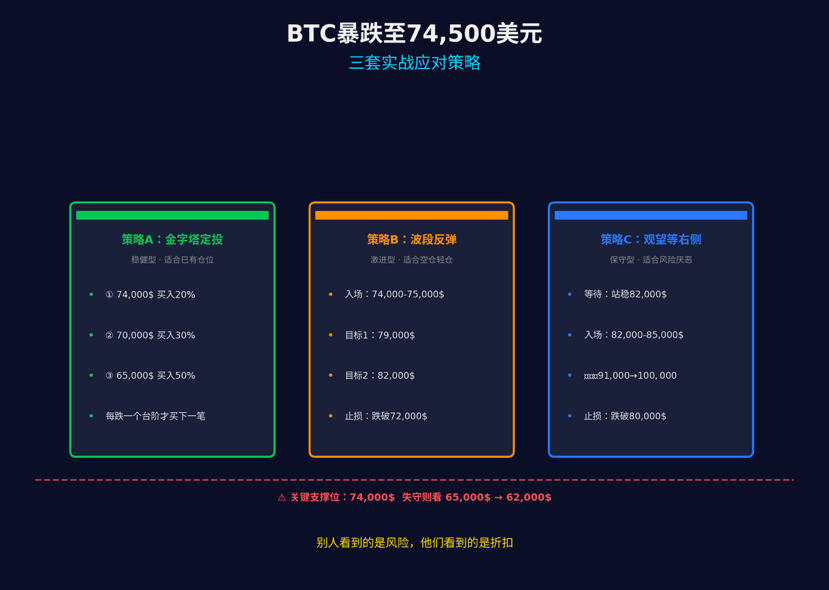
Two, why are some people 'secretly smiling' at this position?
The market always has a counterparty. When retail investors panic and cut losses, who's picking up the pieces?
First off, long-term holders have an average cost around $74,000. On-chain data shows that short-term holders (those holding for less than 3 months) have an average realization price of about $82,000, while mid-term holders have a lower cost. This indicates that the current price has put short-term speculators in the red, but long-term investors are still above their cost basis, with selling pressure mainly coming from the 'can't hold on' short-term funds.
Secondly, institutions aren't leaving; they're reallocating. Although ETF outflows are happening, Wall Street’s overall holdings remain at a high of $94.17 billion, accounting for 6.38% of Bitcoin's total market cap. This outflow feels more like risk rebalancing rather than a complete exit. Once the macro environment stabilizes, the speed at which these funds flow back will exceed your imagination.
Thirdly, macro liquidity is building up. Arthur Hayes points out that current market liquidity isn't relying on traditional QE but is injected through the US Treasury's bond repurchase plan. When the bond market volatility index (MOVE) breaks 140, policy intervention becomes almost inevitable. And the unpredictability of Trump's team is precisely the 'nutrient' for a high volatility market.
Three practical strategies: find your fit.
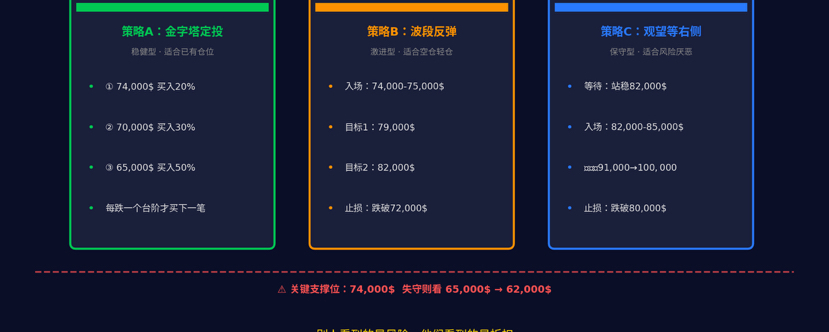
Strategy A: Conservative - 'Pyramid Dollar-Cost Averaging' (suitable for those with existing positions who don't want to miss out and also don't want to get heavily stuck).
Core logic: don’t guess the bottom, just buy 'cheap'.
Operation method:
• First buy: 20% of planned funds at $74,000. This is the current support level and also the cost zone for long-term holders.
• Second buy: if it drops to $70,000, buy another 30%. This position is near the low point from early April and represents strong support.
• Third buy: if it drops to $65,000, put in the remaining 50%. This is near the upper edge of the fluctuation range from the beginning of the year, and historical backtesting shows a high probability of rebound at this level.
Key discipline: buy the next position only after each drop, don’t try to catch the bottom early. If the price rebounds more than 10% above the purchase price, stop dollar-cost averaging and wait for the next pullback.
Strategy B: Aggressive - 'Swing Rebound Method' (suitable for those with no positions or light positions who want to bet on a short-term rebound).
Core logic: slowing ETF outflows = confirmation of short-term bottom.
Operation method:
• Entry signal: ETF net outflow below $100 million for three consecutive trading days, or a single day net inflow. This suggests that institutional selling pressure is exhausted.
• Entry range: between $74,000 and $75,000.
• Target price: first target $79,000 (5-month moving average resistance), second target $82,000 (cost price for short-term holders, where a lot of positions are stuck).
• Stop-loss level: below $72,000 and unable to close above, immediately stop loss. This means the support level has failed, potentially leading to deeper declines.
Position suggestion: invest no more than 30% of total capital, as this is left-side trading and carries higher risk.
Strategy C: Cautious - 'Wait for the right side' (suitable for risk-averse individuals who don’t want to endure volatility).
Core logic: don’t act until you see the rabbit, wait for trend confirmation.
Operation method:
• Wait for signals: daily closing price stabilizing above $82,000, accompanied by ETF net inflow for 3 consecutive days. This indicates institutional reinvestment and greatly increases the probability of a trend reversal.
• Entry range: $82,000-$85,000. Although higher than the current price, it offers stronger certainty.
• Target price: previous high of $91,000 (early January peak), and if broken, aim for the psychological level of $100,000.
• Stop-loss level: below $80,000 and unable to recover for 3 days.
Suitable for those with large capital, seeking certainty, and not concerned about losing a few points in the short term.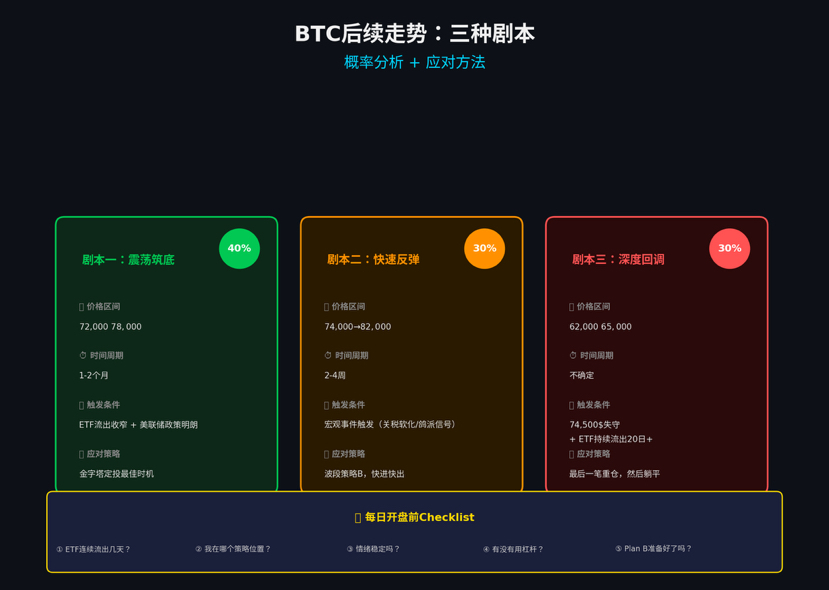
Four, forecasts for future trends: three scenarios.
Scenario one: consolidating at the bottom (probability 40%).
Price oscillates between $72,000 and $78,000 for 1-2 months, ETF outflows gradually narrow, and then as Fed policy clarifies (expectations for interest rate cuts rising in the second half of the year), it slowly climbs back above $80,000. This is the healthiest trend and the favorite 'discount time' for long-term investors.
Scenario two: quick rebound (probability 30%).
A macro event triggers (like a softening of Trump's tariff policies or dovish signals from the Fed), institutional funds quickly flow back, recovering $82,000 within 2-4 weeks. This trend suits aggressive players using Strategy B, but requires quick response capability.
Scenario three: deep correction (probability 30%).
If $74,500 is lost and ETF outflows continue for more than 20 trading days, the price could drop to the $62,000-$65,000 range. This is an important platform since August 2024 and the psychological accumulation price for many institutions. For players using Strategy A, this might be the 'last heavy buy' opportunity.
Five, a checklist to respond: ask yourself before the market opens each day.
1. Has the ETF been flowing out? Check the data; if it flows out for more than 5 days, be cautious. If it continues for more than 10 days, it’s nearing the bottom zone.
2. Where am I positioned? Compare with the three strategies above, clarify your current position and next operational point.
3. Is my emotional state stable? If I couldn't sleep last night and kept checking the charts, it means my position is too heavy; I need to reduce it to a level where I can sleep.
4. Are you using leverage? In the current volatility, any leverage over 2x is a suicidal move. Spot is king.
5. Are you ready with Plan B? If it drops below $72,000, will you stop loss or add to your position? Write it down beforehand and strictly execute it at market open.
The cruelest part of the market is: at the same price, some see a bottomless pit, while others see a staircase.
$74,000 Bitcoin in 2024 might be a high point, in 2025 it could be the norm, and by 2026, it might be considered low. Different time dimensions lead to completely different conclusions.
If you believe in Bitcoin's long-term value, then a short-term crash is just an opportunity to accumulate at a lower cost. If you're only looking to make a quick buck, then every fluctuation is your enemy.
Final piece of advice: don’t trade with money for living expenses, don’t use borrowed money to catch the bottom, and don’t substitute emotions for strategy. Living long is more important than making quick profits.#比特币走势分析 #BTC走势分析 #BTC☀ #比特币预测 #BTC🔥🔥🔥🔥🔥 $BTC


