

The U.S. government's Department of Government Efficiency (DOGE) has lost its centralized authority, eight months before it was scheduled to disband.
Founded by billionaire Elon Musk, the agency focused on reducing government administrative costs and combating bureaucracy. However, during its existence, it was primarily remembered for a series of high-profile scandals.
ForkLog explored the imprint this once ambitious project left on US history and how cryptocurrency plays into it.
How did it all start?
The idea of creating $DOGE first surfaced in August 2024 during an interview between Musk and Donald Trump. The entrepreneur offered to lead a special department to streamline the government, and the then-presidential candidate supported the initiative.
Musk soon posted an image of himself at a podium with the words "Department of Government Efficiency" and the acronym D.O.G.E. In the caption, the billionaire wrote, "Ready to serve."

In November 2024, President-elect Trump nominated Musk and entrepreneur Vivek Ramaswamy as the heads of the new federal agency. An executive order issued on January 20, 2025, established the temporary agency within the United States Digital Service (USDS). Its operations were scheduled to cease on July 4, 2026—the 250th anniversary of the Declaration of Independence.
$DOGE was not a Cabinet-level department, but was part of the Executive Office of the President.
Department staff were assigned to each government agency. They were responsible for terminating contracts, grants, and leases awarded by previous administrations, combating fraud, and reducing the number of government employees. According to Musk's optimistic estimate, the agency's activities could save up to $2 trillion in budget funds. https://youtu.be/sLiB1LUC4Fs?t=28
Ramaswamy, for his part, declared his readiness to eliminate entire federal agencies and reduce the number of employees by 75%. However, he almost immediately resigned from the team due to "differences in management approaches" with Musk.
Inside the kitchen
The department was located in the Eisenhower Executive Office near the White House. It was led by Amy Gleason, who had worked at the Digital Service during Trump's first term.
Musk was granted "special government employee" status for 130 days, essentially becoming an adviser to the federal government. He was granted expanded access to government resources without the obligation to disclose certain information.
DOGE's staff included approximately 50 people, a significant number of whom were former employees of Musk's companies (Tesla, SpaceX, and others). According to Wired, the team included several young engineers aged 19 to 24 with little or no government experience. The media dubbed them the "DOGE Kids." Despite revealing several names, the agency prioritized secrecy.

The team reported to Steve Davis, a longtime Musk adviser and CEO of The Boring Company, who played a key role in cutting costs at X and SpaceX.
As of February 4, 2025, #DOGE received $6.75 million in funding, nearly double the annual White House salary and expenses budget. By February 12, that amount had increased to $14.4 million.
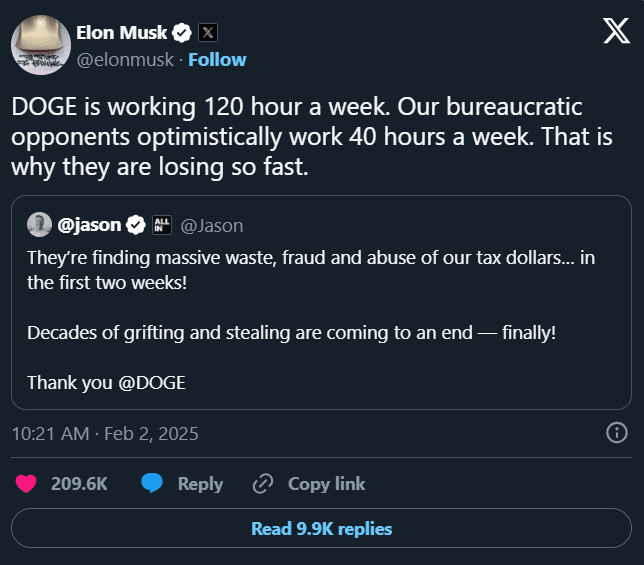
Media reports indicated that department employees literally lived in government building offices due to extreme work schedules—up to 120 hours a week.
Meme boost
According to a popular theory, the abbreviation DOGE is a reference to the cryptocurrency #Dogecoin , which Elon Musk has actively supported for many years. The coin's logo even briefly appeared on the agency's website, after which its price rose by 14%.
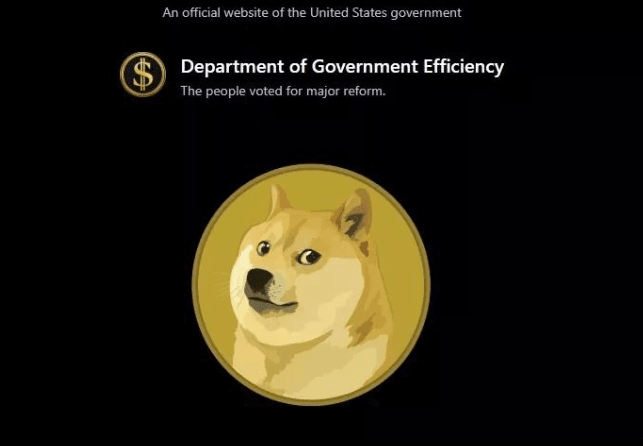
However, in public appearances, the billionaire explained the similarity of the names as pure coincidence: he chose it on the advice of online users because it was more attractive.
The department's leadership denied plans to integrate cryptocurrencies, but relied on the use of blockchain technology in its work.
According to Bloomberg, the digital ledger was proposed as a cost-effective way to track federal spending, protect data, process payments, and manage buildings. To this end, DOGE representatives held discussions with the leaders of several public blockchains.
In addition, #Маск called decentralized technologies "a useful tool for minimizing corruption."
However, critics believe that the confusion of the agency's abbreviation with the crypto brand in any case played the role of "viral PR."
Criticism and high-profile scandals
Control over financial data
As part of his activities, $DOGE gained access to U.S. Treasury Department systems, including critical Treasury infrastructure that processes tax refunds, Social Security benefits, pensions, and other government programs.
In February, 19 states filed a lawsuit over concerns about the legality of sharing so much personal data and the potential use of a third-party, open-source AI model to process it.
The judge issued a temporary injunction preventing DOGE from accessing Treasury records and ordered it to destroy any material downloaded from them after January 20, 2025.
A separate Senate letter to the Treasury Secretary noted that some department employees were able to read and modify system code.
In May, a number of DOGE agents were finally granted "full access" to Treasury Department systems after undergoing training in cybersecurity and sensitive data handling.
Interference with the grant system
DOGE took control of the publication of federal grants and temporarily restricted access to external users, delaying the publication of important funding competitions for health and social programs.
Following complaints from scientific communities and various social groups, the department's powers were significantly limited.
Mass layoffs
DOGE launched one of the largest layoff programs in the history of the federal government. The first target of these massive layoffs was the international aid agency USAID. Out of 10,000 employees, just under 300 remained. By the end of February, at least 83% of the agency's programs had been closed. The de facto liquidation of USAID was challenged in several courts.
A wave of dismissals swept through various federal agencies and ministries, beginning with employees on probation. Overall, the process was quite chaotic: instructions changed several times a week, notifications arrived overnight, and decisions were made without proper HR procedures. Some erroneous dismissal orders were overturned on appeal.
According to the latest OPM data, approximately 317,000 government employees will leave the government through 2025, with approximately 68,000 new hires.
Thus, since the beginning of Trump's second term, cuts have affected at least 12% of the 2.4 million federal civilian employees.
Errors in calculations
Media outlets have highlighted errors in DOGE's calculations of savings. One canceled contract, listed as worth $8 billion, actually cost $8 million. In another instance, DOGE calculated a contract worth $655 million three times, claiming non-existent savings of over $1.8 billion. Journalists also discovered canceled contracts whose terms had long since expired.
According to the DOGE website, at the time of writing, the department had terminated 13,440 contracts, 15,887 grants, and 264 leases.
Analysts believe the current estimated savings of $214 billion are significantly overstated or represent theoretical "maximum" contract amounts rather than actual budget savings. Furthermore, taking into account legal costs, employee reinstatement, and reduced efficiency, the net benefit could be several times lower than stated.
Damage assessment
The Senate Permanent Subcommittee on Investigations estimated losses from DOGE activities at at least $21.7 billion as of July 2025. According to its findings, the department not only failed to achieve its stated goals, but also "undermined organizational productivity by reducing the efficiency and quality of essential government services."
The beginning of the end
In April, Elon Musk significantly reduced his government duties to focus on his business. And in May, he left the White House after his term expired.
"The situation with federal bureaucracy is much worse than I thought. Trying to improve the situation in Washington is a difficult task, to say the least," Musk told the Washington Post at the time.
Many DOGE employees followed Tesla's CEO.
In November, Reuters, citing OPM Director Scott Kupor, reported that DOGE "does not exist" and will not operate as a "centralized entity."
“There is no longer a target for reductions [in the number of civil servants],” he added.
Many of DOGE's functions have been transferred to OPM, and some department employees have taken up new positions within the administration. For example, Airbnb co-founder Joe Gebbia is now responsible for visually enhancing government websites. Jeremy Levin, who helped disband USAID, now oversees foreign aid at the State Department.
Zachary Terrell has been appointed chief technology officer of the Department of Health and Human Services. Rachel Riley has been appointed head of the Office of Naval Research.
Acting DOGE Administrator Amy Gleason, who has a background in health technology, officially became an adviser to Health and Human Services Secretary Robert Kennedy in March, in addition to her role at the department.
The US authorities did not officially announce the dissolution of the structure.
The DOGE team has denied rumors of closure.
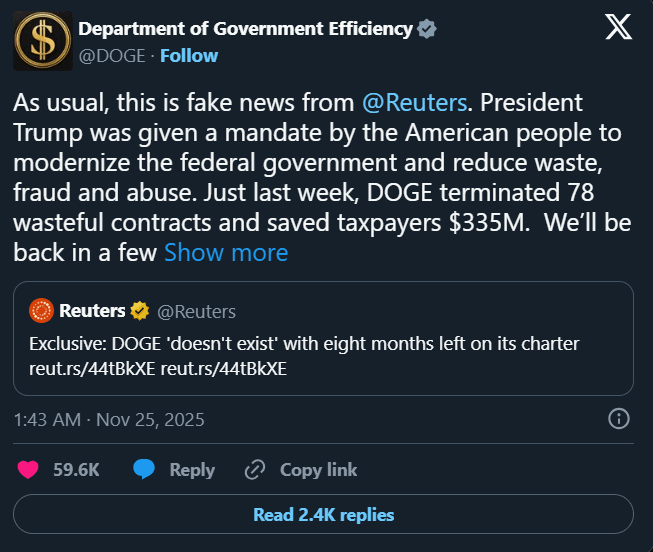
The statement claims the agency is aggressively cutting costs and, in the past week alone, "terminated 78 wasteful contracts, saving taxpayers $335 million."
Consequences
DOGE is a new initiative within the USDS, which was created in 2014 by then-President Barack Obama to provide technological support to the government and improve its efficiency. Certified paralegal Dmitry Levkin-Odrovaj told ForkLog that the presidential decree establishing DOGE merely adapted the original initiative to the government's current needs.
"Elon Musk's actions sparked heated debate, but this hasn't changed the impact of USDS/DOGE's activities. Furthermore, the team's employees remain within government agencies. Even if the department's methods of obtaining evidence are deemed illegal, the information collected could still be admissible in court, especially in civil cases. If DOGE's findings of fraud and double spending are proven true, reforms within the government agencies that committed violations are inevitable, and their employees will not be reinstated," he noted.
The lawyer believes the department has had a real impact on the effectiveness of the US government.
"This initiative, which appeared to be a PR stunt, accomplished its primary objective in record time—uncovering evidence of double spending—in just six months from the agency. The evidence presented and whether the courts will accept it depend on the quality of the DOGE staff's work in collecting this evidence, which remains to be seen," the expert concluded.
DOGE proved to be an important but controversial experiment. The transfer of startup logic to critical government functions led to administrative chaos, and the meme culture generated excitement but failed to add stability to the structure.
The department pointed to the potential of technology to speed up bureaucratic processes. However, incomplete verification of credentials, a weak legal framework, and a high reliance on PR stunts have created institutional stress.
In the future, similar technological experiments at the state level are possible only with a transparent legal framework, rigorous auditing, and phased testing—otherwise, the risks will outweigh the potential benefits.
