

The price of gold is rising against the backdrop of the session, which was facilitated by the weakening of the US dollar during the trading session on November 26. According to spot prices, the price of gold is $4167.47 per ounce, which is 0.85% higher than the closing level of yesterday's trading. The price of the precious metal reached a session maximum at $4169, the highest level in almost two weeks. The increase in prices is driven by expectations of a rate cut by the Federal Reserve System in December — the likelihood of such a cut has risen from 50% to over 80%. This was influenced by weak economic data from the US. The situation in the gold market resembles consolidation more, with the lower boundary around $3900 per ounce and the upper boundary around $4400 per ounce. This consolidation is supported from below by the level of $4000 and the 50-day exponential moving average, which provides reliable technical support.
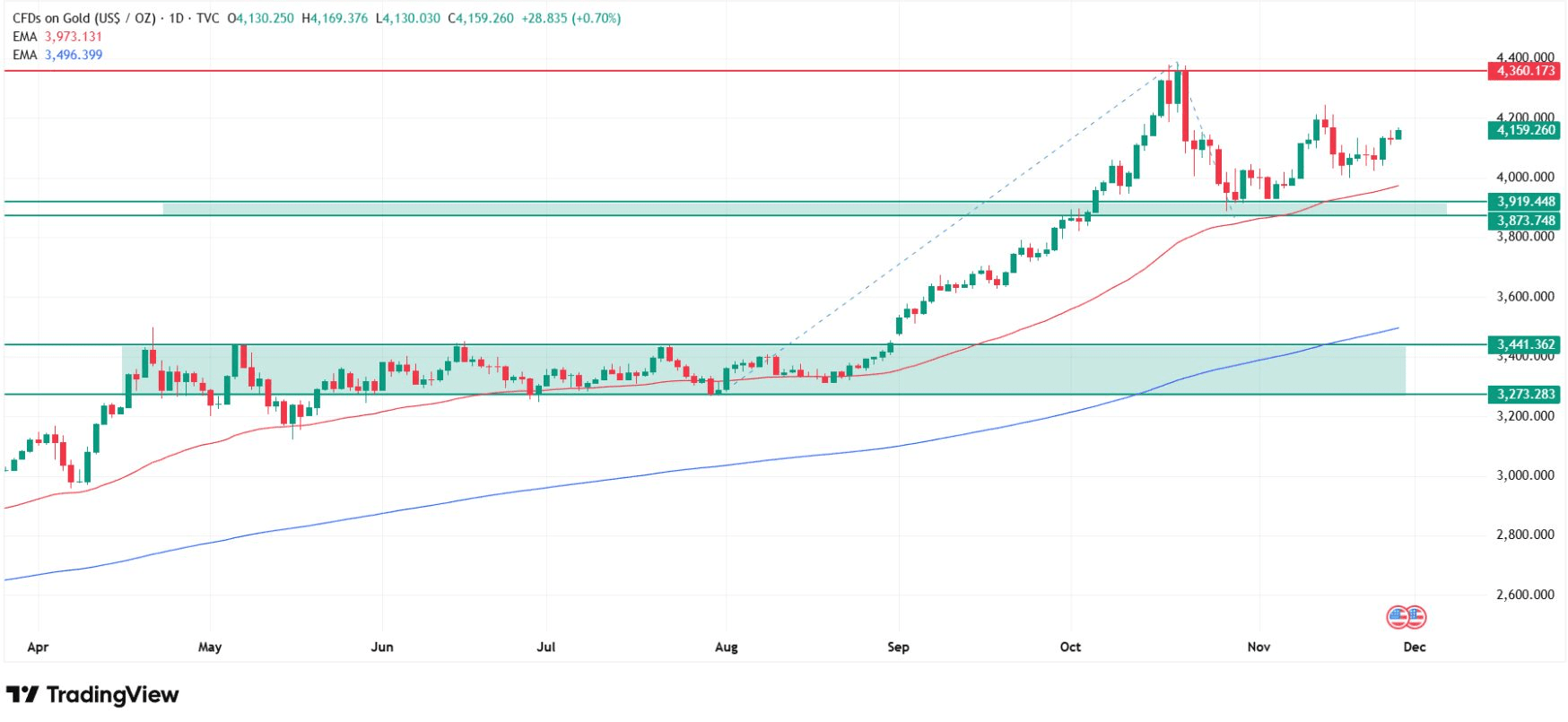
The range from $3300 to $3450 has formed a fairly wide support zone. Here, the 200-day exponential moving average (200 EMA) is also declining, indicating the possibility of a correction both downward and upward. To create a bullish forecast, it is advisable to use Fibonacci extensions, measuring the ascending trend from the July lows to the historically high maximums, as well as the descending correction at the end of October. Such measurement gives a 100% Fibonacci extension at the level of $5000 and a 161.8% extension above $5500.
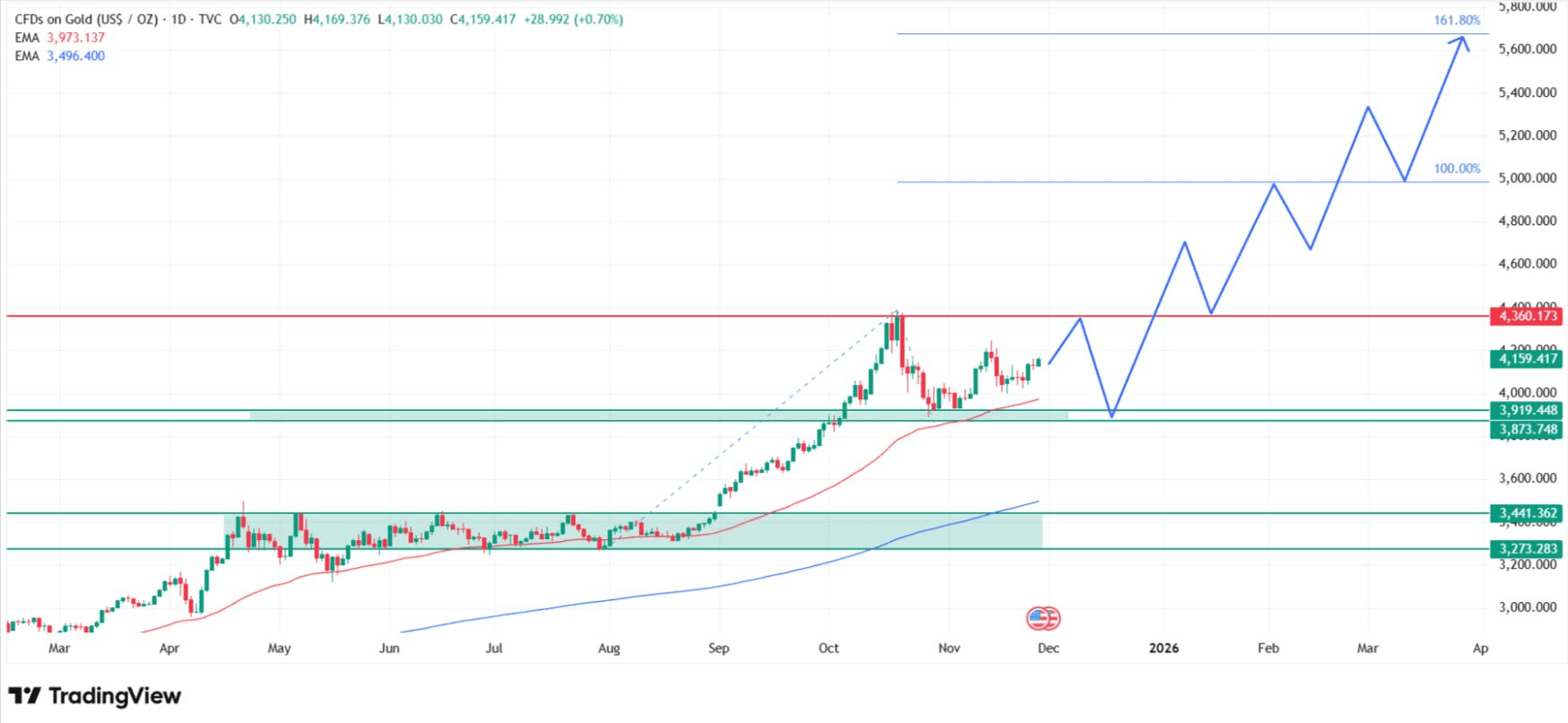
Despite the outstanding indicators of gold, which has increased by 60% since the beginning of the year, the sentiment of institutional investors is surprisingly restrained. In the report on macroeconomics, data from the Bank of America survey is presented, indicating that "only 5% of managers of global funds believe that by the end of 2026 the price of gold will exceed $5000."