
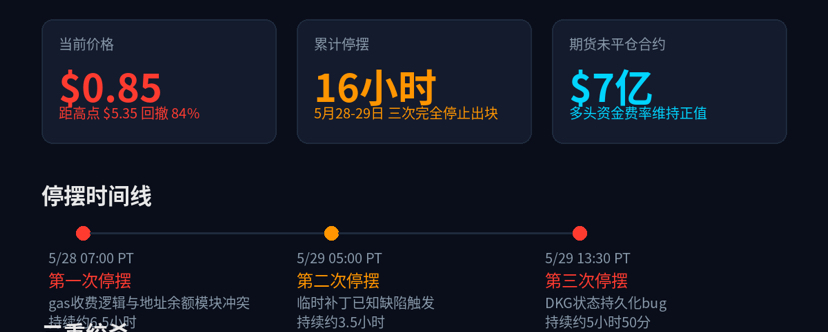
From May 28 to 29, 2026, the Sui mainnet experienced three consecutive complete block halts after the v1.72 upgrade, totaling about 16 hours of downtime. This wasn't just a one-off technical glitch; it was a systemic engineering failure triggered by a clash between gas fee logic and address balance modules. Currently, the SUI price has plummeted to around 0.85, reflecting a retracement of over 84% from its historical high of 5.35. Despite the futures open interest still sitting at about $700 million and the funding rates remaining positive, the on-chain daily active addresses are stagnating, DeFi ecosystem capital inflows are slowing down, and there's a linear unlocking pressure of approximately 43 million tokens each month throughout 2026, creating a triple whammy. This article, based on the official incident report from the Sui Foundation and on-chain market data, delves deep into the essence of this crisis: is it really the "cost of growth", or is it a turning point where the narrative of "high-performance L1" is thoroughly disproven by engineering realities?
1. 16 Hours of Darkness: Technical Anatomy of Three Shutdowns
At 7 AM Pacific Time on May 28, the Sui mainnet fell silent for the first time. Validator nodes running version 1.72 experienced a crash, halting block production. This wasn't just a few seconds of lag, but a complete shutdown lasting about 6.5 hours. The team urgently deployed a temporary fix, and the network was restored at 1:30 PM. However, the Sui Foundation later admitted in an official report that this temporary patch carried a 'known defect with a low probability of triggering'—they accepted this risk to restore the network as quickly as possible.
As a result, risks were realized in less than 24 hours. At 5 AM on May 29, a variant of the same root cause triggered the second shutdown, lasting about 3.5 hours. The team hastily produced a 'more robust fix', and the network went back online at 9:40 AM. However, the real nightmare struck at 1:30 PM that day: during the scheduled epoch switch node, an unrelated dormant bug was activated—when the validator nodes restarted to apply the morning's fix, the failure state of the distributed key generation (DKG) protocol was not correctly persisted to disk, causing the epoch to fail to close, leading to a third shutdown of about 5 hours and 50 minutes.
Looking at the three incidents in conjunction, an unsettling picture emerges: the first was the 'reckless launch of new features without adequate testing on the mainnet'; the second was 'gambling by choosing to deploy despite knowing the patch carried risks'; and the third was a chain reaction revealing deep-seated state management flaws in the system due to restart operations. The Sui Foundation rarely admitted in post-incident summaries that the complexity of gas fee logic has become 'difficult to eliminate boundary cases solely through manual review' and candidly stated that this module 'deserves the same level of deep investment as Move VM or Mysticeti consensus'.
In other words, this is not a one-off coding error, but a systematic warning about the engineering maturity of a core L1.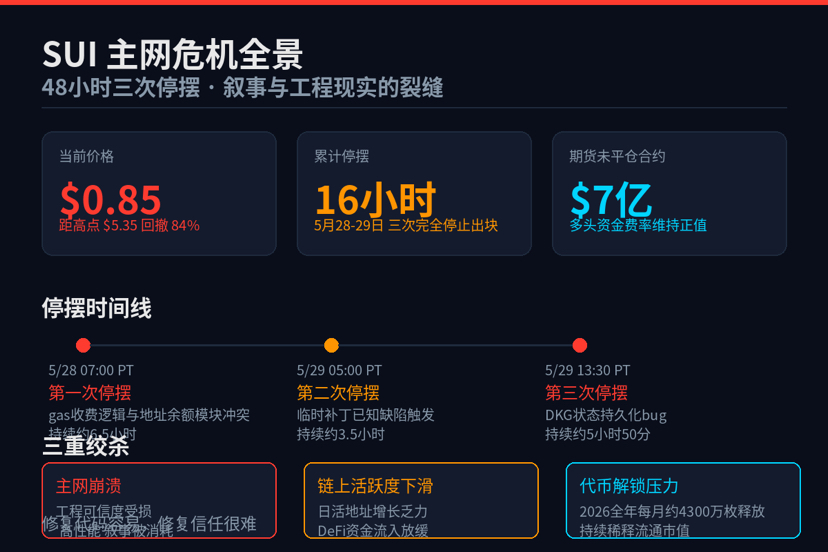
2. Price Judgment: Is $0.82 the bottom line or just a relay station?
When the incident occurred, the SUI price dropped sharply from about $0.99 to around $0.89, a decline of about 8%. By early June, the price had further slid to the range of $0.85 to $0.88, with a 7-day decline of about 13% to 16%, retracing over 83% from the historical peak of $5.35 in January 2025.
From a technical analysis perspective, $0.82 is a key accumulation zone for buyers historically tested multiple times. If this level holds, the price has a chance to retest resistance at $1.05-$1.07—this is an important support-turned-resistance level before the May crash. However, the current capital flow indicators are still below the zero axis, indicating that the net outflow of capital has not yet reversed, and active buying has not entered on a large scale.
Of greater concern is the 'split personality' in the derivatives market. SUI's futures open interest (OI) is currently about $700 million, up over 55% from 30 days ago, indicating that significant funds are still betting on directional movements. The funding rate remains in a positive range of 0.001% to 0.0052% every 8 hours, annualized at about 1% to 5.7%, indicating that longs are still continuously paying interest on their positions. However, this 'firm belief that it will rise' sentiment stands in stark contrast to the coldness of the spot market: in the past 24 hours, 97.9% of the $5.02 million in liquidations were longs—leveraged longs are paying real money for their faith.
This divergence between spot and futures is essentially a gamble on whether 'SUI can reclaim the narrative'. The $700 million contract long positions bet on the story of 'stronger after recovery', but the spot market's foot voting seems more honest.
3. The Truth on Chain: Dual Deceleration of DeFi Growth and User Activity
If prices can be artificially supported by futures leverage, on-chain data cannot be faked.
Sui's DeFi ecosystem showed remarkable growth momentum at the beginning of 2026. A weekly report from early May indicated that Sui’s TVL reached about $667 million, with a week-on-week growth of 19.32% and about 334,000 daily active addresses, marking a week-on-week growth of 25.64%. However, this growth was largely tied to institutional interest sparked by CME Group launching SUI futures contracts in April 2026, rather than an explosion in endogenous user demand.
The deeper issue lies in user stickiness and capital retention. Although Sui’s daily active addresses saw a rebound in early May, throughout 2026, its on-chain activity exhibited a distinct cyclical fluctuation characteristic—whenever ecological incentive activities (such as gaming, social, and trading mining) were initiated, the number of addresses surged; however, the retention rate after activities ended was not ideal. This stands in stark contrast to Solana’s robust performance with a year-on-year growth of over 50% in daily active addresses in 2026.
In the DeFi space, Sui's TVL is around $634 million to $667 million. While it ranks high among emerging L1s, it's a far cry from Solana's $5.78 billion and Ethereum's $44.8 billion. More critically, the inflow speed of DeFi funds into Sui is slowing down. Leading protocols like Cetus, Bluefin, and NAVI attracted early liquidity but lack 'killer' applications like Jupiter on Solana or Uniswap on Ethereum to continuously create real trading demand. The stablecoin market cap is about $500 million, with USDC dominating, but this figure is minuscule compared to the overall crypto market's $322.9 billion stablecoin market cap.
The direct consequence of the mainnet crash is that all DeFi protocols were frozen for 16 hours—positions couldn't be adjusted, trades couldn't be executed, and liquidations couldn't be triggered. For DeFi users who rely on high capital turnover, this 'downtime' experience is more destructive than price volatility. Once it can be forgiven, twice it can be tolerated, but combined with the consensus divergence shutdown on January 14, 2026, which lasted about 6 hours, and the validator node crash loop in November 2024, Sui has experienced four major availability incidents in less than 18 months.
'Faster than Solana, more stable than Aptos' narrative is being stripped away layer by layer by repeated technical incidents.
4. The Unlocked Door: The Sword of Damocles of Token Unlocking
If technical incidents are Sui's 'acute illness', then token unlocking is its 'chronic condition', and it's entering a high-incidence phase in 2026.
The total supply of SUI is fixed at 10 billion tokens. As of early June 2026, the circulating supply is about 4.01 billion tokens (40.1%), with about 60% still locked up. According to the established release schedule, Sui unlocks about 43 million to 44 million tokens each month, accounting for approximately 1.1% to 1.3% of the current circulating supply. These unlocks mainly flow to community reserves, early contributors, and investors.
Taking the unlock on January 1, 2026, as an example, approximately 43.69 million SUI were released that day, worth about $63.4 million. This 'once a month, without fail' supply pressure means the spot market needs to continuously absorb about 35 million to 50 million in new sell orders (at current prices) to maintain price stability. In a bull market, this pressure can be easily digested by incremental funds; however, in the current market environment, where sentiment leans cautious (the fear and greed index is around 30) and on-chain activity growth is weak, each month's unlock feels like a precision 'price dilution machine'.
The situation is more severe as the vesting schedule for early investors shows that Series A investors released 69.4% after a 1-year cliff, then entered a 1-year linear unlock; Series B investors released 33.3% before entering a 2-year linear unlock; early contributors released 17.8% before entering a 6-month linear unlock; Mysten Labs Treasury will enter a 6.5-month linear unlock after a 6-month cliff. This means that 2026 not only faces regular monthly unlocks but is also a key year for multiple large allocations entering the linear release phase.
As 'mainnet crashes' erode confidence on the demand side, 'token unlocking' continues to exert pressure on the supply side—this scissors effect represents the deepest contradiction facing SUI's current valuation.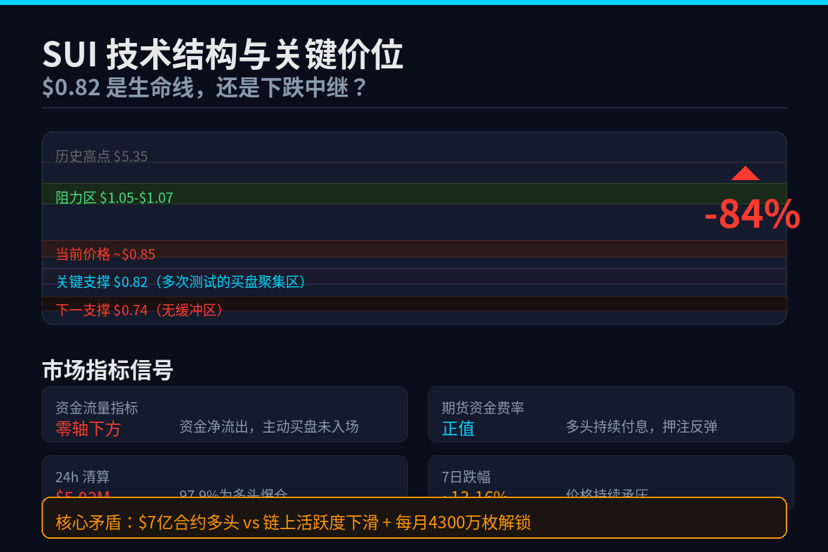
5. The Cost of Growth or the End of the Narrative?
Now back to the core question: is this the 'cost of growth, will be stronger after recovery', or is the 'high-performance L1 narrative being slapped by engineering reality'?
Supporters of the 'cost of growth' argument have valid points. Ethereum's The DAO hard fork in 2016 and Solana's multiple outages in 2021-2022 are precedents. Sui's Mysticeti consensus does provide sub-second confirmation times and extremely high TPS under normal conditions, and its object-centric data model has architectural advantages in parallel execution. The improvement directions proposed by the Sui Foundation after the incidents—such as better fault isolation mechanisms, stronger epoch switch resilience, and AI-assisted validator node diagnostics—demonstrate the technical self-reflection of the team.
But the key issue lies in frequency and context. Ethereum's The DAO was a one-time event and occurred very early in the ecosystem; although Solana's outages were frequent, its ecosystem's 'anti-fragility' stemmed from its established large developer community and user habits, which could withstand trust losses. Sui is different—it is still in the uphill phase of ecological construction and hasn't formed a sufficient network effect moat. Each mainnet shutdown consumes the already thin 'brand credit deposit'.
The deeper issue lies in the nature of the incidents. These four major incidents (November 2024, an unspecified potential event in 2025, January 2026, May 2026) share a common pattern: they were triggered by new bugs introduced by software upgrades. This indicates systemic blind spots in Sui's testnet and audit processes—especially in core modules like gas logic, which 'interacts subtly with consensus, execution engines, and schedulers', failing to discover boundary cases before the mainnet release of version 1.72. The Sui Foundation itself acknowledged that the gas fee logic 'deserves the same level of deep investment as Move VM or Mysticeti consensus'—this indirectly admits that prior attention to this module was insufficient.
For an L1 that positions itself on 'high performance', 'fast but unreliable' is far more damaging than 'slow but stable'. Institutional capital and large DeFi protocols often weigh availability (Uptime) higher than peak TPS when choosing a base layer. When CME futures brought institutional attention to SUI, the mainnet experienced three shutdowns within 48 hours—this contrast damages institutional confidence far more profoundly than it does for retail investors.
6. Conclusion: At the Crossroads of $0.82
SUI now stands at a critical crossroads.
In the short term, $0.82 is the lifeline for the bulls and bears. If it holds, there’s hope for a rebound to $1.05-$1.10 after liquidations are cleared; if it fails, the next meaningful support is around $0.74-$0.75, with almost no buffer in between. The $700 million in open contracts in the futures market and the bullish funding rate mean any directional breakout could be magnified by leverage.
In the medium term, Sui needs to prove 'stronger after recovery' on three dimensions: first, establish stricter testing and rollback mechanisms before the next major upgrade to prevent 'illness from going live'; second, drive endogenous growth of daily active users and TVL through truly killer applications (not just relying on incentive activities); third, demonstrate sufficient spot buying absorption capacity under the pressure of unlocking approximately 43 million tokens each month.
In the long run, Sui's fate depends on whether it can evolve from 'a faster alternative to Solana' to 'an irreplaceable infrastructure layer'. The security of the Move language and the parallel execution capabilities of its object model do provide differentiated advantages for scenarios such as gaming, payments, and AI agents. However, if the 'high-performance' label always carries the footnote of 'intermittent unavailability', these technical advantages will be unrealisable.
Three shutdowns in three days, 16 hours of darkness, an 84% retracement—these numbers don’t lie. They tell a story not of 'growing pains', but of a cautionary tale about the huge gap between 'narrative and engineering reality'. The Sui team has managed to restore network operations through technical fixes, but while fixing code is easy, restoring trust is hard. In 2026, a year filled with unlocking pressure and intensified competition, what SUI needs isn't more long faith on futures leverage, but a return of genuine on-chain activity, and a real record of stable operation without accidents.
The market ultimately rewards projects that 'walk the talk' rather than those that 'talk better than they do'. Whether the narrative of $SUI can be reborn depends on the quality of each block it produces next, rather than the TPS numbers on its whitepaper.
#sui #SUI🔥 #SUI.每日智能策略 #sui链 #SUIPricePrediction $BTC


