
On June 3, 2026, the cryptocurrency market experienced a rare and severe downturn, with BTC falling below $67,000 and ETH dipping under $1,900, leading to a 24-hour decline across the board of 2%-6%. Amid the cries of despair, HYPE and ZEC defied the trend, while the RWA sector shone brightly. This article will analyze the current situation to determine if this is a "golden pit" buying opportunity, using the latest on-chain data, macro sentiment, and technical signals, while uncovering those structural opportunities that stand firm in the storm.
1. Crash Overview: A premeditated "stress test"
The crash on June 3rd wasn't a coincidence. When BTC slid from over $90,000 down to below $67,000, and ETH breached the critical psychological level of $1,900, the AI sector took a massive hit of 6.06%, pushing the market fear index dangerously close to the extreme fear zone. This was driven by multiple bearish factors: the ongoing tightening of global macro liquidity, the lagging effects of the Fed's high-interest rate environment, and a collective correction of the previously overly optimistic market expectations.
It is noteworthy that this crash exhibits typical 'de-leveraging' characteristics. Unlike the crash in February 2025 triggered by Trump's tariff war, which saw 720,000 liquidations, this drop is more rooted in internal leverage liquidations and profit-taking within the crypto market. Data shows that perpetual contract funding rates had been high before the crash, indicating severe long leverage accumulation, with the market itself in a fragile balance.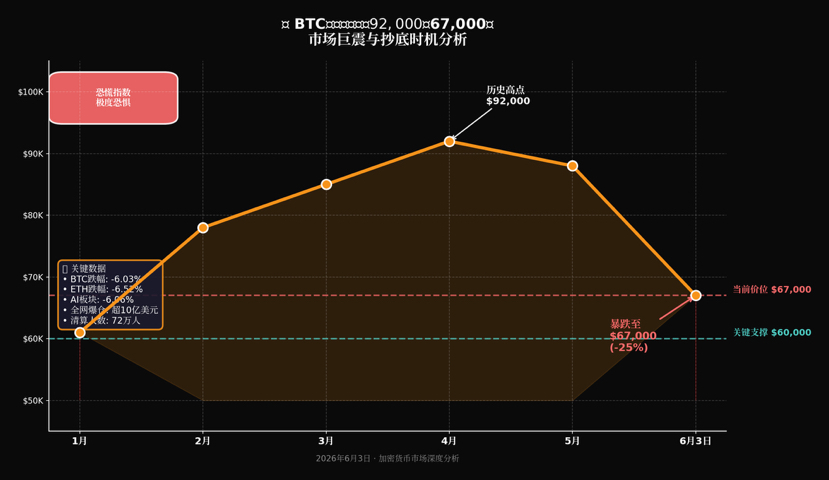
2. BTC Trend Analysis: Is $67,000 the Bottom or the Waist?
From a technical standpoint, BTC is currently at a critical crossroads. Looking back at the price action from late 2025 to early 2026, BTC surged from a low of $61,000 all the way up to over $90,000, forming a complete macro bull cycle. However, this time, the drop from $90,000 to $67,000 represents a decline of over 25%, technically touching the lower end of the mid-term uptrend line.
Support points for bottom-fishing logic:
Firstly, on-chain data shows that long-term holders (LTH) did not exhibit large-scale selling during this drop but rather showed signs of accumulation. This indicates that 'smart money' is accumulating chips amid panic. Secondly, from a cyclical perspective, 2026 is in the second year after Bitcoin's halving, a period historically associated with a new round of main upward waves after severe washouts. Moreover, the spot Bitcoin ETF recorded a net inflow of $6.63 billion over five weeks in 2025; the long-term allocation logic of institutional funds has not changed due to short-term volatility.
Risk Warning:
However, the market is not without concerns. Renowned on-chain analyst Ali Martinez warned at the beginning of 2026 that BTC has seen a 'death cross' between the 10-week and 50-week moving averages, historically similar signals have led to retracements of 53%-67%, with target prices possibly dipping to the $38,000-$50,000 range. While this prediction is quite extreme, it serves as a reminder: until a clear turning point in macro liquidity appears, prematurely loading up on bottom fishing still carries the risk of 'catching a falling knife'.
Conclusion: For BTC, the area around $67,000 could be considered a 'left side zone' for medium to long-term positioning, but it is by no means a 'blind bottom fishing' safety zone. A more prudent strategy is to build positions in batches, setting staggered buy points in the $60,000-$65,000 range while strictly managing your positions.
3. Counter-Trend Heroes: Why HYPE and ZEC Can Stand Out?
In the midst of market turmoil, the counter-trend strength of Hyperliquid (HYPE) and Zcash (ZEC) is no coincidence; they represent two distinctly different resilience logics.
HYPE: A 'cash cow' driven by product strength.
Hyperliquid, as the absolute leader in decentralized perpetual contract exchanges, holds about 72% of on-chain perpetual futures trading. Its core competitiveness lies in its unique 'repurchase and burn' mechanism: 99% of the platform's trading fees are used to repurchase and permanently destroy HYPE tokens. From January to October 2026, $645 million has been invested in repurchases, with over 45 million HYPE tokens destroyed, equivalent to 4.5% of the maximum supply.
This model, which deeply ties token value to actual business cash flow, makes HYPE more like a high-growth 'crypto blue-chip' rather than a purely speculative asset. When market panic sets in, investors instinctively seek assets backed by real earnings, making HYPE a safe haven. However, caution is warranted as its valuation heavily relies on the activity in perpetual contracts; if trading volume shrinks, repurchase intensity will decline accordingly.
ZEC: The Renaissance of Privacy Narrative.
Zcash's counter-trend rise is benefiting from a structural recovery in the privacy sector. Entering 2026, ZEC's privacy holdings have skyrocketed to 4.9 million coins (30% of total supply), a significant increase from 11% at the beginning of 2025; daily trading volume has surpassed $600 million, with a tenfold increase in trading volume. More crucially, ZEC has found a delicate balance between 'extreme privacy' and 'compliance auditing'—users can selectively disclose transaction records, showcasing stronger survival resilience than competitors like Monero in an increasingly stringent global regulatory environment.
Additionally, Robinhood officially launched ZEC trading in April 2026, opening up the channel for traditional retail investors to enter the privacy sector; meanwhile, the project team is actively promoting the transition from PoW to PoS, which is expected to reduce energy consumption and miner selling pressure. These factors collectively constitute ZEC's defensive moat.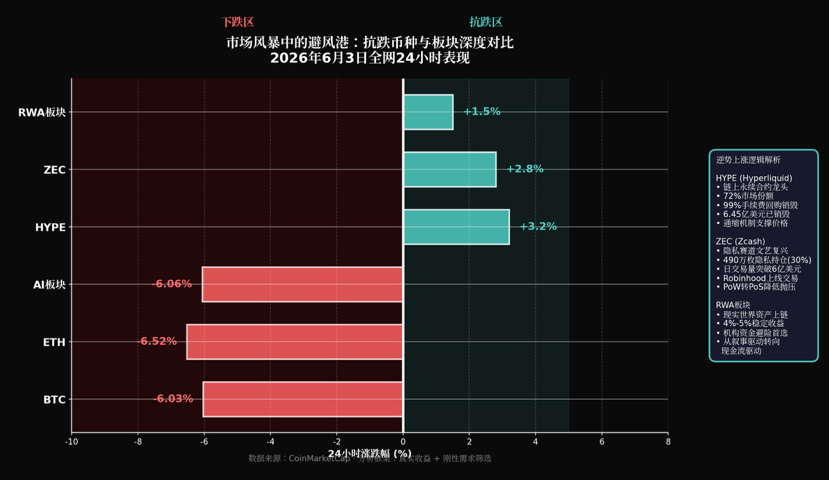
4. RWA Sector: The 'Stabilizing Force' in the Eye of the Storm.
If HYPE and ZEC are examples of individual strength, the collective strength of the RWA (Real World Assets) sector reveals a deeper trend: the crypto market is evolving from 'pure speculation' to 'value anchoring'.
The RWA sector brings traditional assets like government bonds, real estate, and commodities on-chain, providing stable income potential to the crypto world. In a high-interest environment, tokenized U.S. Treasury products can offer 4%-5% risk-free returns, which are highly attractive to cash flow-seeking institutional funds. As AI-related coins plummet by 6% due to valuation bubbles bursting, RWA tokens backed by real assets see inflows thanks to their 'safe-haven' attributes. This suggests that market sentiment is shifting from 'narrative-driven' to 'cash flow-driven'.
5. What other resilient coins are worth watching?
Based on the filtering logic of 'real earnings + rigid demand', the following sectors and tokens are worth focusing on during turbulent market periods:
1. Decentralized Infrastructure Layer.
Aside from HYPE, DEX tokens like GMX and dYdX, which have clear fee capture mechanisms, often display stronger resilience during market pullbacks. Their common characteristic is that protocol revenue can be directly returned to token holders, forming a value closed loop.
2. The Balance Point of Privacy and Compliance.
ZEC's strength may drive the entire 'compliant privacy' sector. Keep an eye on projects utilizing zero-knowledge proof (ZKP) technology that also support selective disclosure, as they are likely to find common ground between regulation and privacy.
3. High-Dividend RWA Tokens.
Look for RWA projects with transparent underlying assets, sound compliance frameworks, and the ability to efficiently transmit traditional asset returns onto the blockchain. In an era where 'cash is king', crypto assets that can provide stable dividends will become the first choice for institutional allocations.
4. The 'Defensive Position' of BTC and ETH.
Despite short-term pressure, BTC's status as 'digital gold' remains unshaken. Referring to the allocation strategy previously suggested by users—using gold as a risk control anchor to allocate 30%-40% of positions while deploying the remaining funds into Bitcoin—viewing BTC as the 'ballast' in a crypto portfolio is still a rational choice in the current environment. Although ETH has dipped below $1,900, its Layer 2 ecosystem's TVL (Total Value Locked) continues to grow; once market sentiment improves, its rebound potential may surpass that of BTC.
6. Bottom-Fishing Strategy: Maintain Discipline in Fear.
In the current market, whether to 'catch the bottom' depends on your investment horizon and risk tolerance:
For long-term investors (1-3 years): BTC at $67,000 and ETH below $1,900 have entered the 'value investment zone'. You can adopt a dollar-cost averaging or batch bottom-fishing strategy to gradually build your target position over the next 2-3 months, avoiding the timing risks associated with a single bet.
For short to medium-term traders: Currently, there are no clear bottom signals in the market. It is advisable to wait for two confirmation signals: first, for BTC to form a double bottom or head-and-shoulders bottom structure near $60,000; second, for macro-level expectations of Federal Reserve rate cuts or liquidity turning points to emerge. Until then, maintaining light positions and observing is the safer approach.
For risk-tolerant investors: You can allocate 10%-15% of your position to resilient leaders like HYPE and ZEC, as well as quality targets in the RWA sector, as a 'defensive offensive' position in the portfolio. However, strict stop-loss measures must be set to avoid heavy losses when counter-trend assets experience further declines.
In conclusion: Every crash is a reshuffling of market structure.
The crash on June 3 may seem like a price collapse on the surface, but it is essentially an evolution of market logic. As the bubble of AI-related coins bursts and tokens without fundamental support are brought back to reality, projects with real products, cash flow, and compliance frameworks have emerged as winners. This may be an inevitable path towards the maturation of the crypto market.
The best time to catch the bottom is never a precise price point, but rather the intersection of your understanding and discipline. In the face of BTC at $67,000, fear and greed coexist, but history has repeatedly proven that those who can maintain value investing during the darkest moments of the market will reap the most substantial rewards when dawn arrives.
Disclaimer: This article is for market analysis only and does not constitute investment advice. The cryptocurrency market is highly volatile; please make independent judgments based on your own circumstances and proceed with caution.


