
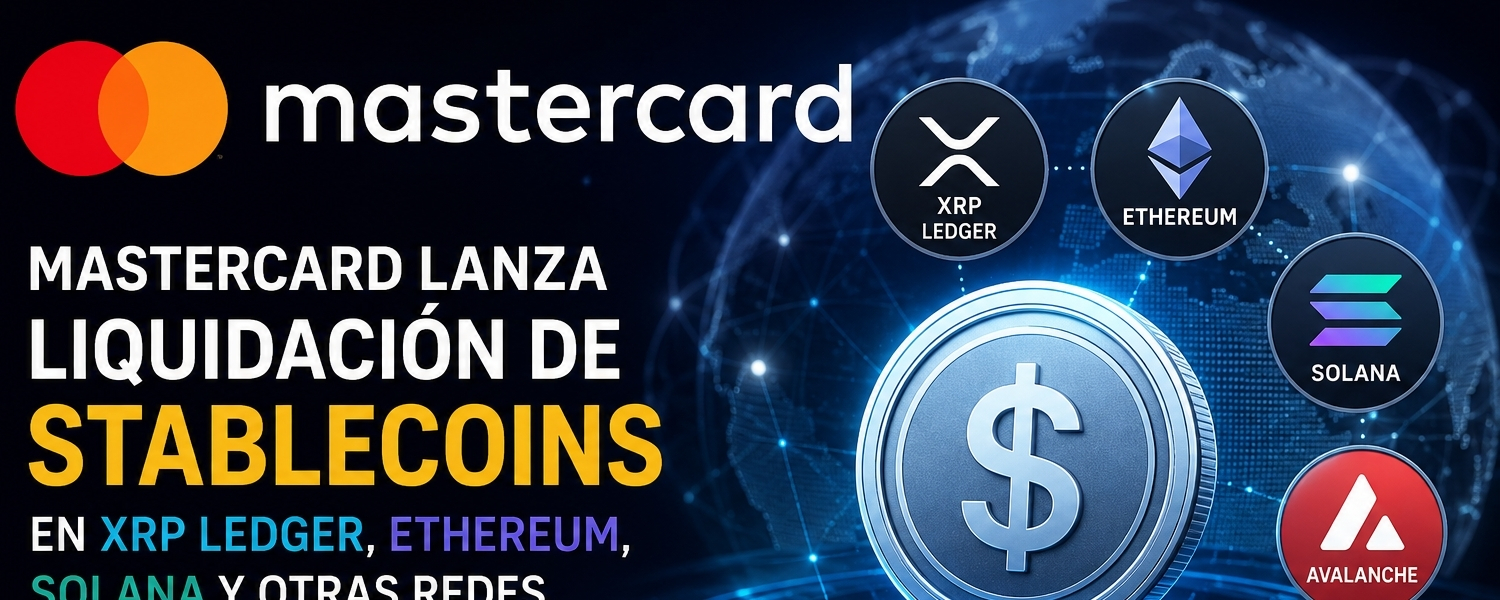
The financial giant enables settlements with stablecoins on eight networks #blockchain and accelerates the mass adoption of digital assets.
#Mastercard just took one of the most significant steps in the history of institutional cryptocurrency adoption. The company announced that it will start processing settlements using regulated stablecoins across eight blockchain networks, directly integrating crypto infrastructure with one of the largest payment systems on the planet.
The selected networks are:
✅ XRP Ledger (XRPL)
✅ Ethereum
✅ Solana
✅ Polygon
✅ Base
✅ Arbitrum
✅ Canton Network
✅ Tempo
The news has generated a strong reaction in the market, especially due to the inclusion of #XRP Ledger, #Ethereum and #Solana three of the most recognized and utilized blockchains in the ecosystem.
According to Mastercard, the new infrastructure will allow for virtually instantaneous settlements, available 24/7, eliminating many of the limitations of the traditional financial system.
Additionally, the company confirmed support for several regulated stablecoins, including:
💵 USDC
💵 PYUSD
💵 RLUSD
💵 USDG
💵 USDP
💵 SoFiUSD
This decision is a clear signal that major financial corporations are no longer watching crypto from a distance: they're starting to integrate it into their actual operations.
XRP, Ethereum, and Solana are in the spotlight
The presence of XRP Ledger has sparked special interest as the network was designed specifically for fast and low-cost international payments. Meanwhile, Ethereum continues to solidify its position as the leading decentralized financial infrastructure, and Solana maintains its status as one of the fastest and most used chains in the market.
On the other hand, the incorporation of Base and Arbitrum shows that Mastercard is also betting on next-gen scalability solutions that are driving the evolution of the Ethereum ecosystem.
A historic step for the industry
With over 3 billion cards in circulation and presence in more than 210 countries and territories, Mastercard could become one of the biggest bridges between traditional finance and blockchain technology.
What seemed impossible just a few years ago is now a reality: major cryptocurrency networks are starting to become part of the infrastructure used by one of the world's most important financial companies.
🔥 The question is no longer if cryptocurrencies will be adopted by the financial system.
🔥 The question is how fast it will happen.
At least that's how I see it
Regards, Darkripto


