

HYPE took half a month to rise from $38 to $75
But in just 2 days, it plummeted from $75 to $56
The shock from this wave was indeed significant, but is it a collapse of faith or just a short-term correction?
Let's analyze the factors that led to this drop one by one to assess their ongoing impact and gauge the momentum of HYPE:
1. Factors that caused the recent drop in HYPE:
(1) Arthur Hayes' massive sell-off triggered some serious FUD
BitMEX co-founder Hayes recently liquidated his entire HYPE position (around $18 million), after previously being extremely bullish on HYPE to $150. This liquidation caused the price to quickly drop from the $75 high to the $56-67 range, triggering a wave of panic selling, leverage liquidations, and a trust crisis. Short-term sentiment took a major hit.
(2) Pressure from token unlocks.
The impending massive token unlock is creating some selling pressure, which could further lead to price declines.
(3) Competitiveness from rivals.
CEX and emerging perpetual DEX competition is intensifying, eating into Hyperliquid's market share.
(4) Factors from the macro market.
Geopolitical factors, combined with BTC's pullback.
(5) Regulatory pressure.
TradFi giants like CME/ICE are pushing for regulatory investigations into Hyperliquid.
(6) Concentrated holdings leading to profit settlements.
HYPE has shown a doubling trend over the past half month. Even if outlook remains optimistic, there exists short-term profit-taking sell pressure.
(7) Periodic weaknesses in the buyback mechanism.
Hyperliquid's buyback mechanism is tied to trading volume; when the platform's trading volume decreases, the buyback weakens, making it unable to sustain continuous price declines.
2. Views on the aforementioned bearish factors.
(1) Large-scale selling by Arthur Hayes triggered FUD.
Firstly, Arthur Hayes's sell orders have been fully executed, and the market has managed to absorb them completely. Only a bit of 'post-selling sentiment' is still lingering, which will gradually fade with time and return to HYPE's value. BTC is currently in a similar situation; after extreme panic, value will slowly return.
(2) Pressure from token unlocks.
HYPE's unlocking mechanism is: releases occur on the 6th of every month, linearly releasing until the end of 2027 when everything will be fully released.
Linear release means that the team's share of 238 million HYPE will be unlocked over 24 periods, so theoretically about 9.917 million tokens are released each month.
This means that the last unlock time was May 6, when HYPE was priced at $42. If we consider 9.917 million tokens, and if all were sold, the total value would be approximately $4.16514 billion. Observing the market, from May 6's $42, it dropped to $38 by May 13, a decline of 11%. Then, starting from May 14, HYPE surged to $75, almost a 100% increase.
Looking back: On April 6, HYPE was priced at $35, and by the next unlock on May 6, HYPE's price was $42. Not only did it not drop, but it also increased by 24%.
This proves that no one cared about HYPE's unlocks before; it just happened to drop this time coinciding with the market downturn, which is why everyone is mentioning the unlocks now.
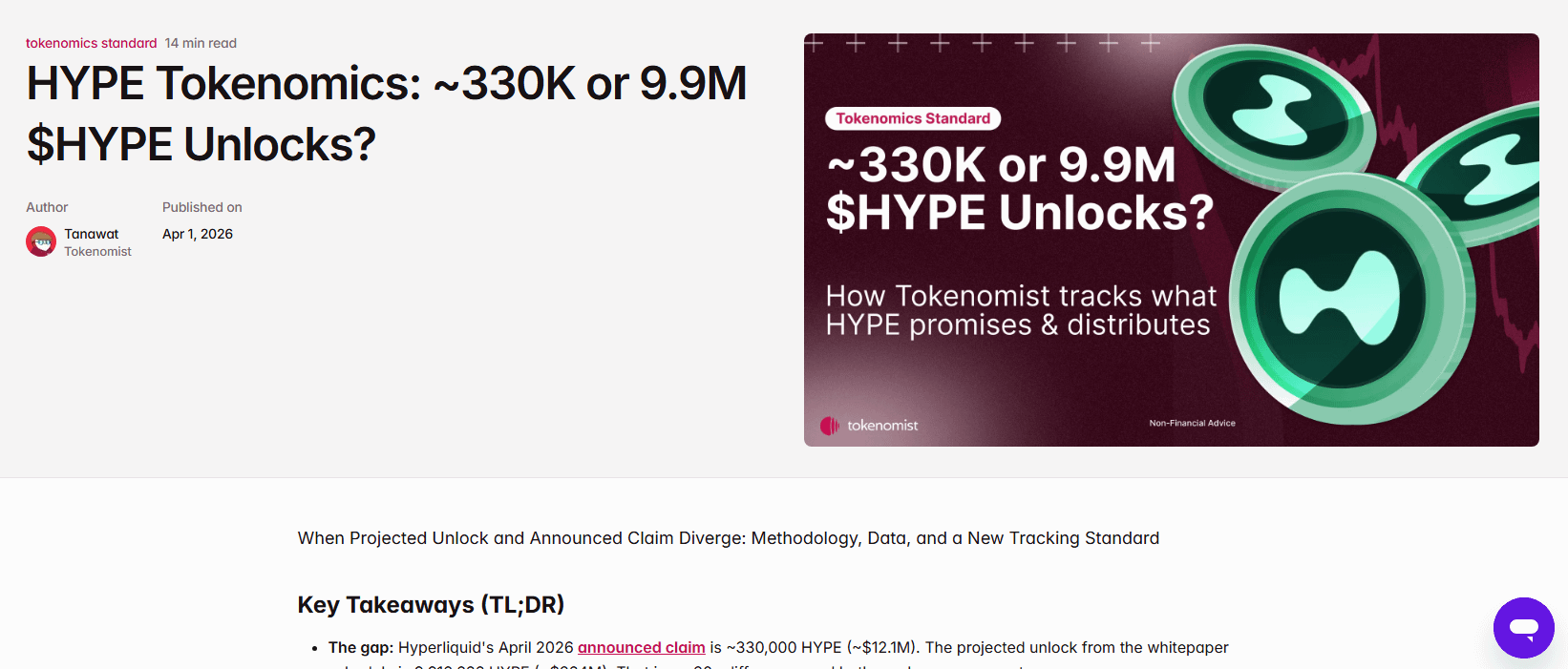
Secondly, and more importantly: The HYPE white paper states that about 9.92 million HYPE should be unlocked each month (worth about $364 million). However, the team has actually announced that only about 330,000 tokens will be unlocked each month (worth about $12 million). Both sides are correct; the 30-fold discrepancy mainly comes from two aspects.
On one hand, from the contract level: permissions have indeed been unlocked (for example, 400 million tokens have been unlocked).
On the other hand, the team has only claimed a small portion (currently only about 3.19 million tokens have been claimed, with a claim rate of 0.79%).
Key data (as of March 2026):
· Contracts unlocked: 405 million tokens.
· Actual claims: 3.19 million tokens (claim rate of 0.79%).
· Tokens to be claimed in April: 330,000 (doubled from March's 173,000, but only accounted for 3.3% of the theoretical maximum).
· Burn rate: 10.27%.
· Buyback rate: 10.29%.
· Trend: Although April's claim volume doubled month-on-month, it remains very low compared to the theoretical maximum. The team continues to 'exercise restraint in claiming'.
It's like looking at HYPE unlock data before, which felt like checking a 'credit limit' (9.92 million), but now you're simultaneously seeing the 'actual bill' (330,000). A high limit doesn't mean a lot is spent; the market previously confused this and scared itself.
Data sourced from: https://tokenomist.ai/research/hype-tokenomics-330k-or-9-9m-hype-unlocks?utm_source=chatgpt.com
(3) Competitiveness from rivals.
Directly looking at the data, the exchange data for June 6:
· Binance's 24-hour trading volume: $111.836 billion.
· OKX's 24-hour trading volume: $50.203 billion.
· Bybit's 24-hour trading volume: $32.151 billion.
· Gate's 24-hour trading volume: $23.7291 billion.
· MEXC's 24-hour trading volume: $21.597 billion.
· Bitget's 24-hour trading volume: $20.610 billion.
· Coinbase's 24-hour trading volume: $13.3741 billion.
· Hyperliquid's 24-hour trading volume: $15.426 billion.
· Aster's 24-hour trading volume: $4.501 billion.
Data sourced from: https://www.coinglass.com/zh/exchanges
(Screenshots are not real-time, with slight discrepancies, but do not affect analysis.)
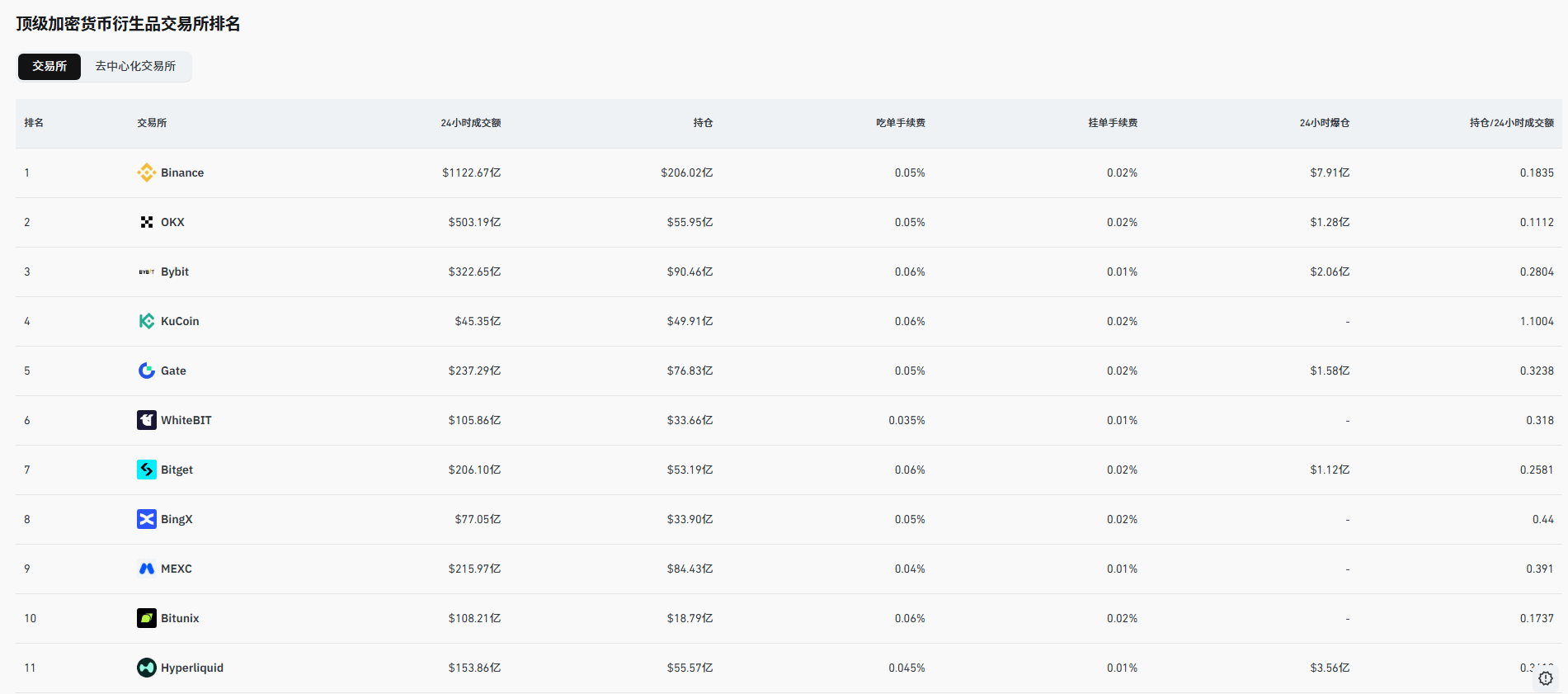
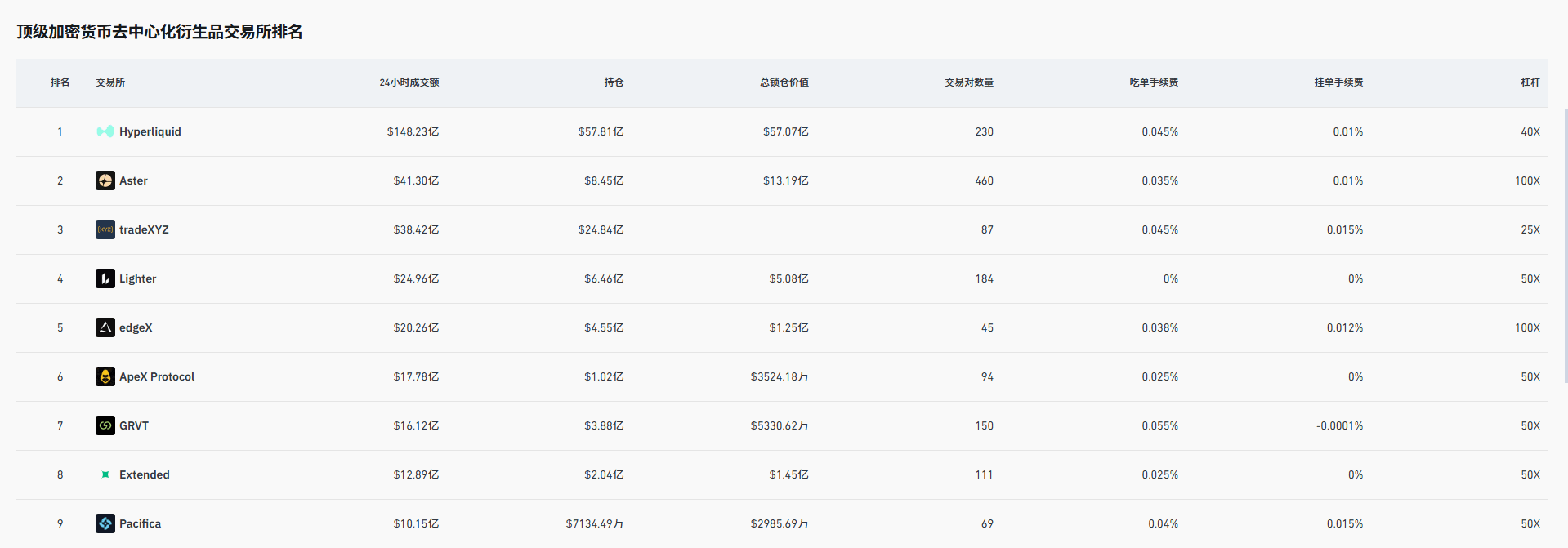
Hyperliquid ranks 7th in trading volume among all CEXs and DEXs. Although it's not high, there are several noteworthy points:
· $15.426 billion leads in DEX by a landslide, surpassing the second place ASTER by nearly $10 billion.
· Hyperliquid was established in 2023, Binance in 2017, OKX in 2013, and Bybit in 2018.
· Hyperliquid does not have its own app.
· Commonality of CEXs, no KYC required.
It can only be said that Hyperliquid faces pressure to catch up, but this doesn't mean Hyperliquid is being besieged. CEXs and DEXs serve different paths and customer bases.
(4) Factors from the macro market.
This point is quite subjective; recently, we've also seen:
· The crypto market is experiencing a pullback across the board under the influence of BTC.
· U.S. stocks have also dropped across the board after reaching a peak.
· There are no signs of easing in the U.S.-Iran conflict.
Since it's influenced by macro sentiment, one might ask, what can be done to avoid it?
(5) Regulatory pressure.
First off: TradFi giants like CME/ICE are pushing for regulatory investigations into Hyperliquid. The essence of this matter is 'pushing', meaning there’s no actual regulatory filing in place.
At the same time, on May 29, the CFTC released a statement saying: The CFTC today published a policy statement outlining the committee's views on the listing of perpetual contracts. This policy statement was released concurrently with an order allowing designated commodity exchanges (DCMs) to list perpetual contracts based on the spot price of Bitcoin as futures contracts.
The policy statement clearly states that due to the unique characteristics of perpetual contracts (which often differ based on their underlying assets), the committee believes that the case review procedures detailed in Regulation 40.3 apply to perpetual contracts that reference asset classes not considered in this order.
Original link: https://www.cftc.gov/PressRoom/PressReleases/pr-9242-26
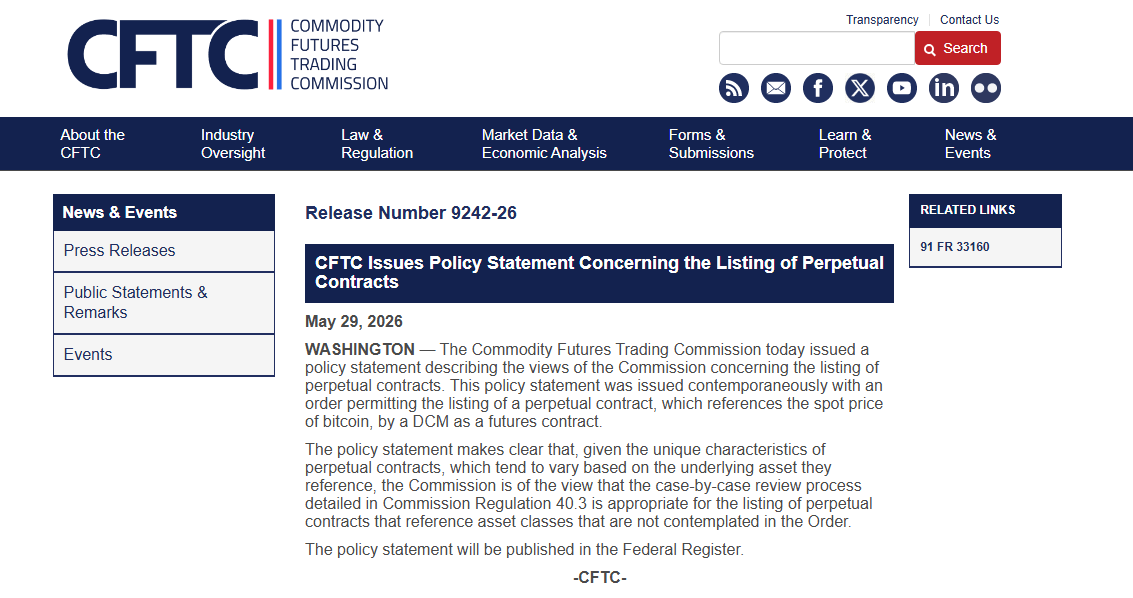
This represents that the U.S. has finally begun to open the door for the perpetual contract market. Although it doesn't mean that HYPE's regulatory issues have disappeared, the pressure has lessened, which is no longer considered a bearish signal. Previously, when the CFTC hadn't made these statements, HYPE was still facing potential regulatory scrutiny and rose against the trend. Why now, with the CFTC relaxing regulations, does it turn into a huge bearish signal?
(6) Concentrated holdings leading to profit settlements.
There are indeed risks, but one can only say: If it's purely about taking profits, it might only lead to a pullback, but it doesn't hinder the subsequent rise; it's not a barrier to upward movement.
(7) The buyback mechanism has periodic vulnerabilities.
The buyback mechanism of Hyperliquid was not designed to drive prices up; it’s an automatic enforcement mechanism written into the smart contract from the start.
Thus, at any time, there is net buying support, especially at low points where the cost-effectiveness is high. Such buybacks are likely to serve as a floor during downturns rather than be a burden!
3. Current bullish factors for HYPE.
When we only focus on negative sentiments, we can only analyze whether HYPE will face a sustained decline. However, we cannot assess if it has hit a bottom or if it will continue to rise, so we need to look at the positive factors impacting HYPE as well.
(1) a16z continues to buy in large amounts.
a16z-related entities have hoarded 90,091 HYPE in the past 10 hours, valued at $5.238 million. The total stake by 2026 has reached 6.996 million HYPE, valued at $32.7 million with an average price of $46.85.
a16z is now one of the largest external holders, and most of its holdings have been staked.
(2) Acceleration of ETF and institutional adoption.
· Bitwise, 21Shares, and Grayscale have all launched HYPE ETFs, and all of them have staking.
· Goldman Sachs didn't directly buy HYPE; instead, they bought PURR (which is like Hyperliquid's stock).
· Galaxy Digital has withdrawn nearly 400,000 HYPE (valued at $28.9 million) in just two days.
This is the additional purchasing power outside of HYPE's own buyback.
(3) Huge potential for product expansion and ecosystem upgrades.
Hyperliquid is aggressively upgrading its products through proposals like HIP-3 and HIP-4, aiming to evolve from a 'pure crypto perpetual exchange' to a comprehensive financial trading platform. Once this is implemented, trading volume will surge → transaction fees and HYPE buybacks will also increase, marking it as the most anticipated long-term positive factor.
In conclusion:
On a side note, recently looking at U.S. stocks while researching the holdings of 'Trump, Jensen Huang, and Buffett' (three very prominent figures), you'll find that only Buffett's holdings are incredibly refined and have a long holding period. We usually call this investment technique 'value investing'.
When you invest in a particular asset, you're buying into its underlying value potential. Once that value is captured, it's just a matter of time before it rises.
Back to crypto, when we trade the most valueless MEMEs, how can we catch their rises? In my view, it boils down to two points:
(1) Ample funds ensure every asset gets on board, capturing profits and losses easily.
(2) Seeing useful value in useless value, which we call heavy narrative positions, until we achieve significant results.
U.S. stocks hold value because each stock corresponds to a real company; memes are void because everyone creates a token for a gimmick.
What category would you prefer to classify Hyperliquid?