
#genius $GENIUS
Studying the materials @GeniusOfficial , I caught myself thinking unexpectedly. Most talks about crypto revolve around investment decisions:
Which token to buy..
Where to enter..
When to take profits..
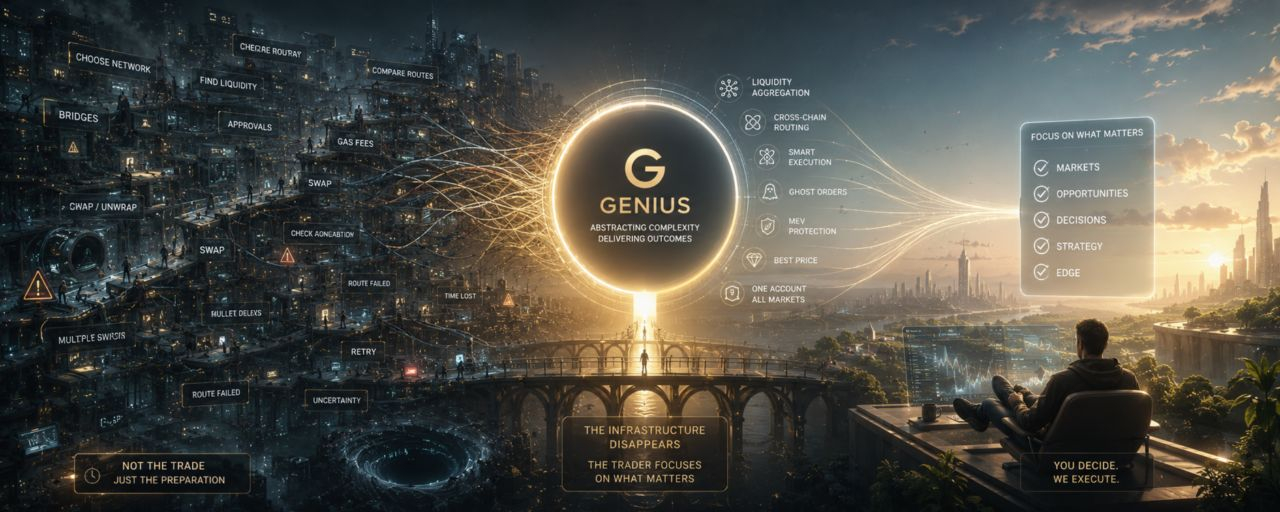
But the deeper you dive into the market, the clearer another picture emerges. A huge amount of time is spent not on making investment decisions, but on the infrastructure - You need to choose the network;
Understand where the liquidity is;
Compare exchange routes;
Transfer assets between ecosystems;
Check the bridge's functionality;
Ensure that the desired asset is actually available in the right place.
And interestingly, none of these actions are the actual trade. They're just preparation for it.
I'm interested in something else.
If you look at the evolution of technology as a whole, the most successful systems rarely won because they were more complex.
Usually, it was the opposite: they won because they removed complexity from the user's view.
Today, no one thinks about the servers through which internet traffic passes.
No one manually builds the route for an email.
No one chooses the cables through which data is transmitted.
The infrastructure exists.
But it stopped requiring constant attention.
It seems like the crypto industry is gradually moving in the same direction.
As the number of networks, DEXs, and liquidity sources grows, value starts shifting from the blockchains themselves to the systems that can connect them.
That's why, while studying @GeniusOfficial and the $GENIUS ecosystem, I often find myself thinking not about which blockchain will win.
A much more interesting question.
What will happen to the market when most users no longer have to think about blockchains at all?