
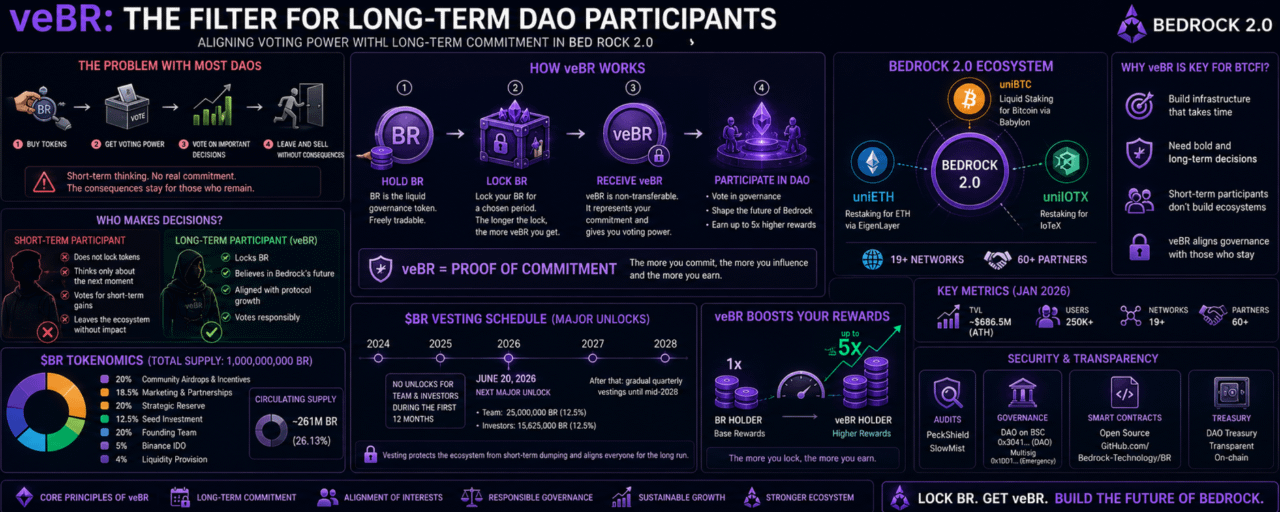
As I dive into the materials @Bedrock , I'm increasingly realizing that one of the most intriguing aspects of Bedrock 2.0 isn't just the evolution of BTCFi or the new opportunities for leveraging Bitcoin in DeFi. What's even more fascinating is the project's approach to managing the ecosystem through the veBR mechanism.
In many DAOs, voting rights are directly tied to the number of tokens in your wallet. This model seems logical, but it creates an interesting contradiction. A user can buy tokens, participate in voting on an important issue, and the very next day completely exit their position. Meanwhile, the consequences of their decision will impact the project for months or even years.
In the ecosystem #bedrock , a different approach is used. To obtain veBR, it's not enough to simply hold token $BR. Users must lock their tokens for a specific period. Only after that do they gain additional governance rights and access to enhanced features within the protocol.
At first glance, this may seem like standard staking mechanics. But looking deeper, it becomes clear that veBR serves a much more critical function. Essentially, Bedrock creates an economic filter for governance participants. The system doesn't ask whether the user believes in the project's future. It requires them to confirm that belief with their own capital and willingness to temporarily forgo liquidity.
This approach is particularly interesting in the context of Bedrock 2.0 and the development of the BTCFi direction. Building infrastructure around Bitcoin requires long-term solutions, integrations, and ongoing development of products like uniBTC. The results of such initiatives rarely materialize instantly. Therefore, it's crucial for the ecosystem that a significant portion of decisions are made by participants who are interested not only in short-term price movements but also in the future of the protocol itself.
Another feature is that veBR links governance and economic incentives. Owners of locked tokens gain not only the ability to influence the development of the ecosystem but also additional benefits within the protocol. Thus, Bedrock aims to align the interests of users with those of the network into a unified motivation system.
In my opinion, this is where one of the most underrated ideas of Bedrock 2.0 lies. Most discussions focus on TVL, yield, or the prospects of token $BR. However, the veBR mechanism shows that the team is trying to tackle a much more complex challenge: to ensure that governance of the protocol gradually shifts to those participants who are willing to tie their future to the development of the ecosystem.
That’s why veBR appears not just as an additional feature for holders of $BR, but as one of the fundamental elements of the entire governance architecture @Bedrock .