
#bedrock $BR
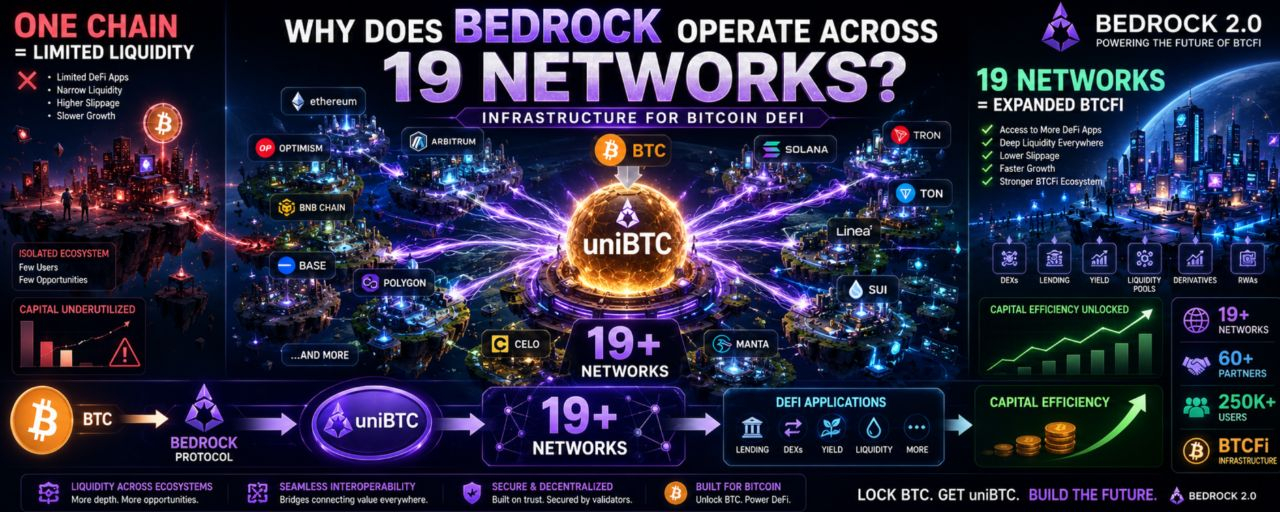
Many are mentioning that it supports operations across 19 blockchain networks and has over 60 partner integrations. However, for BTCFi, this isn't just a scale indicator of the ecosystem.
The main goal of Bedrock 2.0 is to boost Bitcoin's efficiency within DeFi. To achieve this, the protocol issues liquid assets, including uniBTC, which should be usable across various ecosystems simultaneously.
If liquidity is concentrated solely in one network, the asset's use cases are limited to that network's infrastructure. With a multi-chain approach, users gain access to a broader range of DEXs, lending protocols, liquidity pools, and DeFi applications.
According to published data, Bedrock is already operating in 19 networks and developing integrations with over 60 partners. This infrastructure allows liquidity to be distributed across multiple ecosystems instead of being concentrated in a single blockchain.
This is especially important for uniBTC. Bitcoin has one of the largest market capitalizations, but a significant amount of BTC is still sitting on the sidelines and not participating in DeFi. To expand BTCFi, it's not enough to just create a liquid token. We need to ensure its practical application across various networks and protocols.
That's why the expansion of Bedrock 2.0 across 19 networks seems more like an infrastructure strategy than a marketing stunt. The more ecosystems that support uniBTC, the higher the potential utility of the asset and the broader the opportunities for utilizing capital without selling Bitcoin.
In the context of BTCFi development, the scale of available infrastructure could prove to be one of the key factors for the further growth of the ecosystem #Bedrock and demand for $BR.