
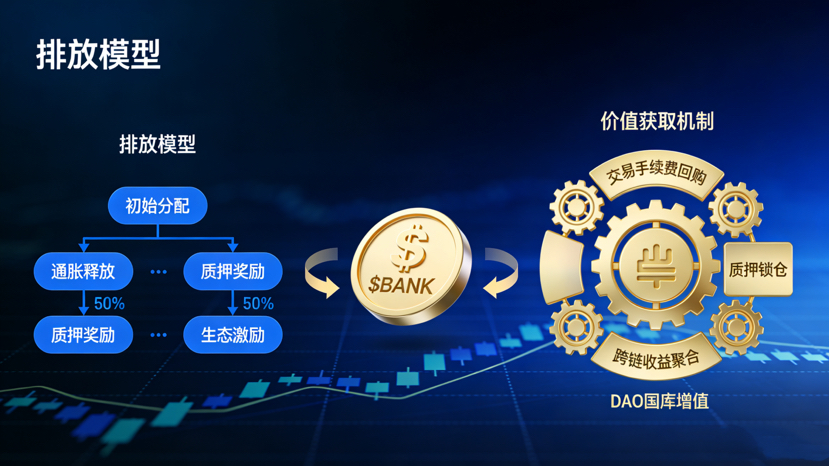
In the world of on-chain asset management, the value of tokens is never just a fluctuation of market prices. The Lorenzo Protocol recognized early on that tokens should be the core driving force of ecological operation, rather than merely trading subjects. The $BANK token embodies this concept: through a meticulously designed emission model and value capture mechanism, it tightly binds user behavior, lock-up commitments, and ecological contributions, allowing every participation to directly impact governance and returns.
When many people first see the $BANK token emission model, they may subconsciously think of it as just a 'reward mechanism', but a closer analysis reveals that it actually conceals three levels of logical innovation behind it.
1. Emission Model: The Art of Dynamic Balance
In the Lorenzo Protocol, the emission of $BANK is not simply released linearly over time, but is highly dependent on ecological behavior and long-term commitment. In simple terms, the more you contribute, participate deeply, and lock up for a longer time, the more valuable the tokens you receive will be.
This design has several highlights:
1. Incentivizing Long-term Participation: Short-term traders cannot quickly obtain a large amount of tokens, thereby reducing speculation's interference with governance and strategy stability.
2. Encouraging Behavior Orientation: Participating in OTF products, providing liquidity, executing strategy operations... each can affect the token release amount, linking contribution to rewards.
3. Dynamic Adjustment Mechanism: When the ecosystem expands or strategy modules increase, the pace and weight of emissions will also be adjusted accordingly to ensure that the scarcity of $BANK matches its actual value.
In other words, the emission model of $BANK is not a 'uniform distribution', but is closely tied to the ecological operation of the Lorenzo Protocol, with the tokens themselves becoming carriers of behavioral incentives.
2. Value Capture Mechanism: Synergy between Lock-up and veBANK
Emission is just the first step; value capture is the key to truly closing the loop for $BANK. In the Lorenzo Protocol, the veBANK mechanism binds token lock-up with revenue distribution, achieving synergy between governance rights and economic rights.
Users lock $BANK to become veBANK, which not only allows participation in on-chain strategies and OTF product voting but also enables earning fee-sharing, strategy revenue dividends, and other incentives. In other words:
• The longer the lock-up period, the greater the governance rights
• The greater the governance rights, the higher the influence in strategic decision-making
• Participating in ecological decision-making will also increase future yield weight
This design creates a virtuous cycle: locked-up users continue to contribute, strategies become more robust, the ecosystem becomes more active, and the economic value of the tokens continues to increase with the growth of the ecosystem.
3. The Dual Value of Scarcity and Behavior Orientation
In addition to the lock-up and governance mechanisms, $BANK 's value capture has a core logic: the combination of scarcity and behavior orientation.
In many on-chain projects, the value of tokens often relies on market speculation, while the Lorenzo Protocol derives its value from ecological contributions themselves.
• Scarcity is reflected in the limited total amount of emissions and the lock-up time window.
• Behavior orientation is reflected in that users must participate in strategies, provide liquidity, or govern to fully unleash the potential of $BANK.
This means that $BANK is not just a speculative tool, but a certificate of ecological participation: the more actively you contribute, the more valuable the tokens in your hands become.
4. My Observations and Perspectives
I believe that the design of $BANK is very clever: it tightly couples token emission, lock-up governance, and value capture, making the tokens of the Lorenzo Protocol not only economic rewards but also lubricants for ecological operation.
Its uniqueness lies in:
1. Ecological Behavior Orientation—Token value is linked to contributions, rather than mere speculation.
2. Long-termism—The longer the lock-up, the deeper the participation, the more returns and governance rights, encouraging users to focus on the long-term development of the ecosystem.
3. Mechanism Closed Loop—The emission model, veBANK, and revenue distribution together form a token value cycle, reducing governance risks brought by short-term volatility.
Overall, $BANK is not just a token, but the core hub of the Lorenzo Protocol ecosystem: it organically binds user behavior, ecological value, and economic returns, making the entire on-chain asset management system both robust and growth-oriented.
Conclusion
In summary, $BANK in the Lorenzo Protocol ecosystem is not just a reward tool, but a key hub that maintains the operation of the entire system. Through a combination of emission models, veBANK lock-up, and revenue distribution, it achieves a balance between governance rights and economic incentives, allowing users to participate with both a voice and actual value.
As the ecosystem gradually expands, the design logic of $BANK will continue to strengthen the long-term sustainability of the Lorenzo Protocol, making each participation a part of the closed loop of on-chain asset management.
@Lorenzo Protocol #LorenzoProtocol

