
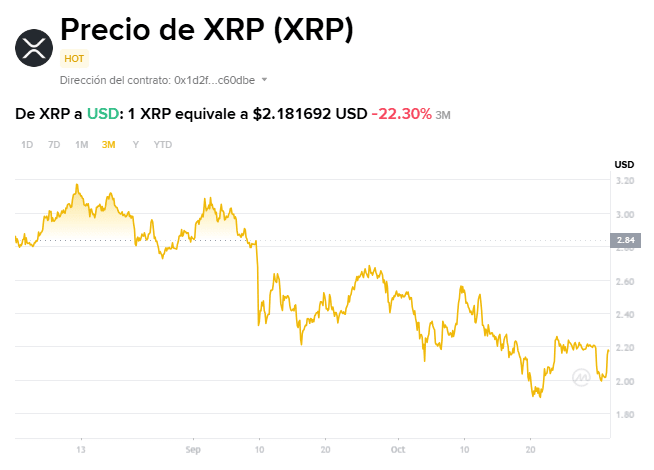
XRP is at a turning point. With the token trading near 2 dollars, the market is closely watching to see if it will break the 2.30–2.50 dollar zone, a range that has historically been decisive for enabling more aggressive moves. If it manages to surpass that level with volume and consistency, the path to 4 or even 5 dollars gains strength both technically and fundamentally.
The current scenario combines factors that have not aligned for years: the expectation of spot ETFs, a real increase in institutional demand through new Ripple solutions, a strategic expansion based on key acquisitions, and a much more predictable regulatory environment.
These vectors could represent the momentum that pulls XRP out of its long consolidation phase and projects it towards a new upward trend.
In this article, we tell you how these factors are taking shape and why they could lead XRP to reach 5 dollars in the next cycle.
XRP ETFs: the institutional catalyst that could change the game.
One of the most followed topics is the possible approval of a spot ETF for XRP. This type of instrument was crucial in changing institutional behavior towards Bitcoin and, more recently, Ethereum.
A spot ETF is not just a new investment avenue: it legitimizes the asset in the traditional market, opens doors to regulated funds, facilitates exposure, and creates a safe channel for large investors to enter the ecosystem. In other words: assets with ETFs are seen as more mature, attractive, and with future potential.
In the case of XRP, the recent approval of two ETFs represents a paradigm shift. The token, which for years was shrouded in regulatory uncertainty, now has its first fully compliant institutional channel with U.S. regulations. The impact on liquidity, volume, and risk perception can be enormous — and it could be exactly what is needed to initiate a growth cycle similar to what BTC experienced after its ETFs.
Ripple Prime: the platform that can boost corporate demand for XRP.
Another key factor is Ripple Prime, the new institutional platform designed to connect companies, banks, payment providers, and professional investors with a robust liquidity infrastructure.
Unlike a simple exchange, Ripple Prime offers a complete set of services: smart order routing, regulated custody, institutional execution tools, regulatory compliance, and direct connection to global financial networks.
This is relevant because the more Ripple positions itself as a bridge between the traditional financial system and the crypto ecosystem, the more concrete use cases appear for XRP.
The deep liquidity provided by institutional players tends to reduce volatility, stabilize price, and increase predictability of capital flow — essential factors for sustaining significant upward movements.
Strategic acquisitions that reinforce the Ripple ecosystem.
In recent years, Ripple has accelerated its global expansion through acquisitions focused on payments, financial infrastructure, regulatory compliance, and solutions for businesses.
These acquisitions create a solid technological foundation, capable of integrating XRP into increasingly broader processes of the financial system — from cross-border payment settlement to infrastructure for banks and remittance services, especially important in countries like Mexico, Colombia, and Argentina.
The more companies integrate into the Ripple ecosystem, the greater the possibility that XRP will be adopted as a real operational tool, beyond its use as a speculative asset.
This type of corporate growth strengthens the fundamentals of the token and creates a scenario where its valuation does not depend solely on the crypto market, but also on the institutional and technological development of Ripple.
The regulatory cycle finally turns in favor of XRP.
For years, XRP carried one of the heaviest burdens possible for a digital asset: regulatory uncertainty in the United States. The legal process with the SEC generated fear, pushed away investors, and limited its projection.
Now, that scenario has changed. Recent court rulings have provided clarity on the token's status in different contexts. This has motivated exchanges to reactivate their support, institutions to regain interest, and developers to return to the ecosystem.
Clear regulation reduces systemic risks. And in the case of XRP, this shift is so significant that it removes many of the obstacles that hindered its progress since 2020. With that weight off the path, the token competes on equal footing with other significant cryptocurrencies — something that can radically change its price potential.
Can XRP really reach 5 dollars?
From a technical standpoint, the first step would be to strongly surpass the 3-dollar zone. From there, the combination of greater institutional liquidity, expansion of the Ripple ecosystem, increased trading volume, and greater regulatory clarity can create the ideal environment for new impulses.
From a fundamental standpoint, the catalysts are more aligned than at any other time in the last decade. XRP does not rely solely on narrative; it depends on concrete products, real liquidity, and infrastructure — and all these elements are advancing simultaneously.
Nothing guarantees that the token will reach 5 dollars directly, but current signs point to one of the most promising scenarios for XRP since its all-time high.
XRP may be entering its most promising stage since 2017.
With ETFs already approved and others on the radar, growing institutional demand, the Ripple ecosystem strengthening, and a stabilized regulatory environment, XRP could be facing one of the most relevant junctures in its recent history.
If these factors continue to align, a convincing breakout from the 3-dollar zone could mark a structural change — and the 5-dollar target would stop being a theory to become a concrete possibility in the next bullish cycle.
And you, do you think these factors will lead XRP to surpass its historical record?
---
Image generated in Sora AI


