
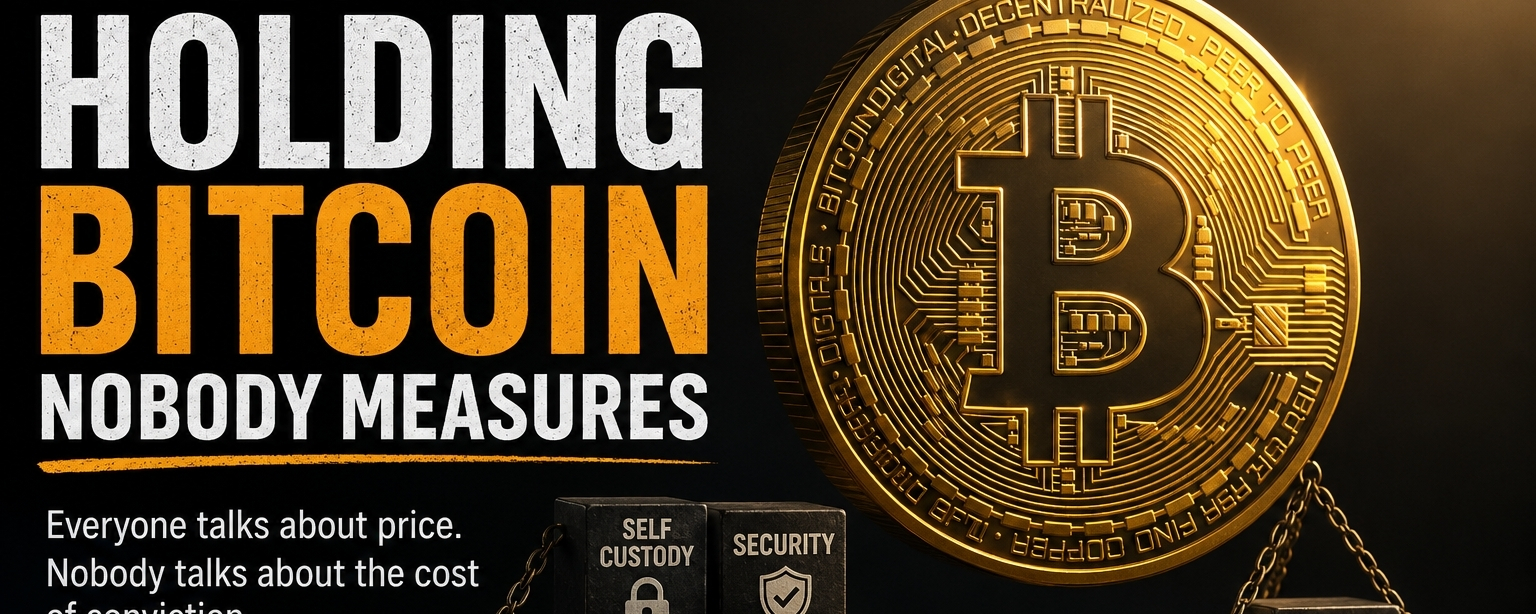
A pattern I keep noticing in Bitcoin cycles is that people spend endless hours debating price targets while almost nobody studies the operational burden created by long term conviction itself. I stopped reading prediction threads for a while and started looking at the infrastructure that quietly absorbs the weight of every historical transaction. Different question. Bigger consequences.
Bitcoin is usually framed through scarcity. Twenty one million coins. Fixed issuance. Halving mechanics. Everyone knows the story. What gets less attention is the fact that scarcity is only one side of the system. The other side is persistence. Full nodes maintain and verify a growing historical record. Miners secure ordering. The UTXO model tracks spendable outputs. Blocks continue arriving. Data accumulates. Time compounds. That changes incentives in ways most market participants never think about.
The popular narrative says Bitcoin becomes stronger as adoption increases. That is directionally true. But strength is not free. Every durable monetary system pushes costs somewhere. In Bitcoin the interesting question is not whether value grows. It is who carries the burden required to preserve trustlessness as that value grows. Retail traders rarely ask this because they experience Bitcoin through an exchange interface. Institutions rarely discuss it because infrastructure costs are a small percentage of their exposure. Node operators see it differently.
This is where behavior becomes more interesting than technology. A holder who self custodies Bitcoin is not merely making a financial choice. They are accepting responsibility. Key management. Backup procedures. Transaction verification. Security hygiene. The longer Bitcoin survives, the more these responsibilities become part of the ownership experience. Most people love sovereignty in theory. Fewer enjoy the maintenance requirements that come with it. Human nature matters.
I think this creates a hidden separation inside the Bitcoin economy. One group wants exposure. Another group wants participation. Exposure is easy. Participation is expensive. Not necessarily in dollars. In attention. In discipline. In consistency. Those costs rarely appear on a chart.
That distinction becomes more important over long time horizons. If Bitcoin continues attracting capital, custody increasingly concentrates into professional environments because operational complexity scales differently than enthusiasm. People celebrate institutional adoption as a signal of legitimacy. Fair enough. But concentration introduces its own tension. The system was designed to reduce reliance on trusted intermediaries while economic gravity constantly pulls users toward convenience. The protocol and human behavior are not always moving in the same direction.
Most market analysis ignores this friction because it cannot be expressed through a simple metric. You can measure hash rate. You can measure active addresses. You can measure exchange reserves. Measuring psychological willingness to maintain sovereignty is harder. Yet that variable may be one of the most important drivers of Bitcoin's future structure.
Another overlooked point is that scarcity changes behavior long before supply becomes truly constrained. People begin treating assets differently when they believe replacement will become more difficult in the future. Spending slows. Hoarding increases. Liquidity becomes selective. This is not automatically bullish for every participant. A system optimized for preserving value can create unexpected tradeoffs around circulation and economic activity. Different incentive layers emerge.
That is why I increasingly view Bitcoin less as a technology story and more as a behavioral filter. The protocol itself is remarkably simple compared with the narratives built around it. The real experiment is observing who remains willing to carry the responsibilities attached to decentralization when easier alternatives exist. Markets eventually reveal preferences. They always do.
The irony is that Bitcoin's greatest achievement may not be digital scarcity at all. Scarcity can be copied conceptually. Thousands have tried. What is harder to replicate is the social willingness to keep validating the same rules across decades without a central authority coordinating belief. That is where the deepest friction lives. Not in price volatility. Not in headlines. Not in the next cycle.
