
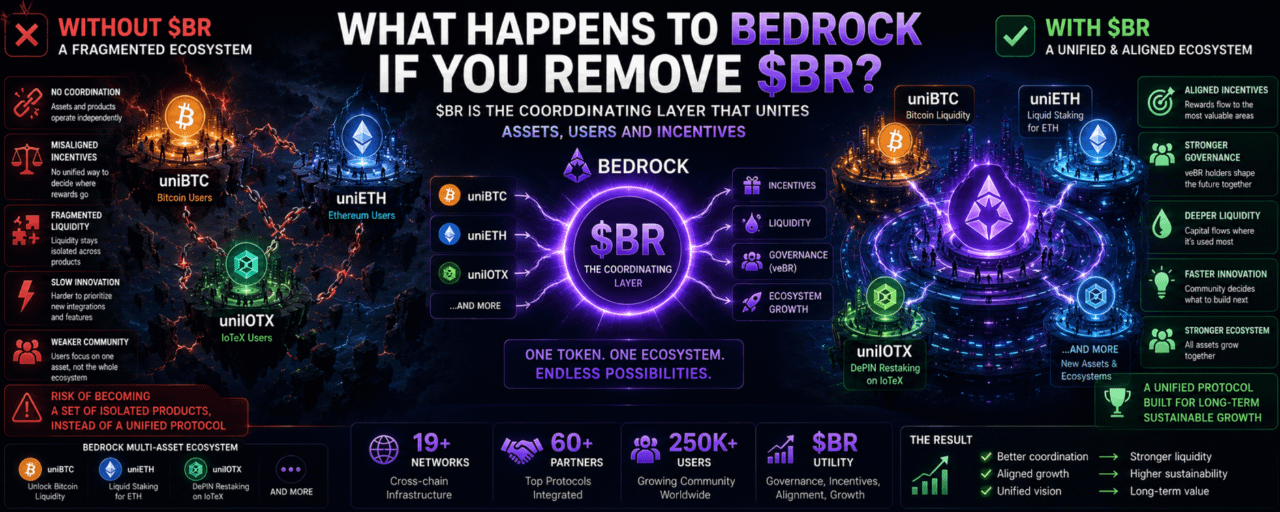
This question seems odd because most discussions around @Bedrock focus on the token's price, yield, or the prospects of BTCFi.
However, from an architectural standpoint, it's far more important to understand why BR even exists within the protocol.
Bedrock operates simultaneously with several types of assets. The ecosystem includes uniBTC, uniETH, and uniIOTX. Each of these assets has its own liquidity, users, yield strategies, and risks.
Without a single coordinating mechanism, such a system begins to break apart into independent products.
Bitcoin users are interested in the development of uniBTC.
Ethereum users are interested in the development of uniETH.
Liquidity providers might prefer some directions over others.
As a result, a problem arises regarding the distribution of incentives.
How do we determine which products should receive more rewards?
Which integrations should be funded first?
What new features should be introduced in the protocol?
This is exactly the problem that $BR addresses.
Through the veBR mechanism, token holders participate in governing the distribution of incentives within the ecosystem. In fact, BR becomes the glue between multiple assets and various development directions of Bedrock.
This is especially crucial for Bedrock 2.0, which bets on not just one asset, but several markets: Bitcoin, Ethereum, IoTeX, and the BTCFi infrastructure.
If you take BR out of the system, Bedrock will retain uniBTC, uniETH, and other products. However, the unified mechanism that allows for the coordination of the entire ecosystem's development will disappear.
In this case, the protocol risks turning into a collection of separate services without a central decision-making body.
Therefore, the value of BR is defined not just by the ability to earn rewards or participate in votes.
From the perspective of protocol architecture, BR plays a much more critical role. It unites various products #Bedrock into a single economic system, where users of different assets can participate in the distribution of incentives and the development of the entire ecosystem.
That's why, when analyzing Bedrock 2.0, I think it's important to look not just at TVL, the number of users, or the yield of uniBTC.
It's equally vital to understand what problem the token $BR solves within the ecosystem.
Because in the long run, the ability to coordinate capital, incentives, and governance might be one of the key reasons for Bedrock's existence as a unified protocol, rather than just a collection of separate products.
#Bedrock $BR