According to Dhaiwat's sharing - Ethereum Developer
When you send money in the normal world, there is a company like Stripe in between handling everything.
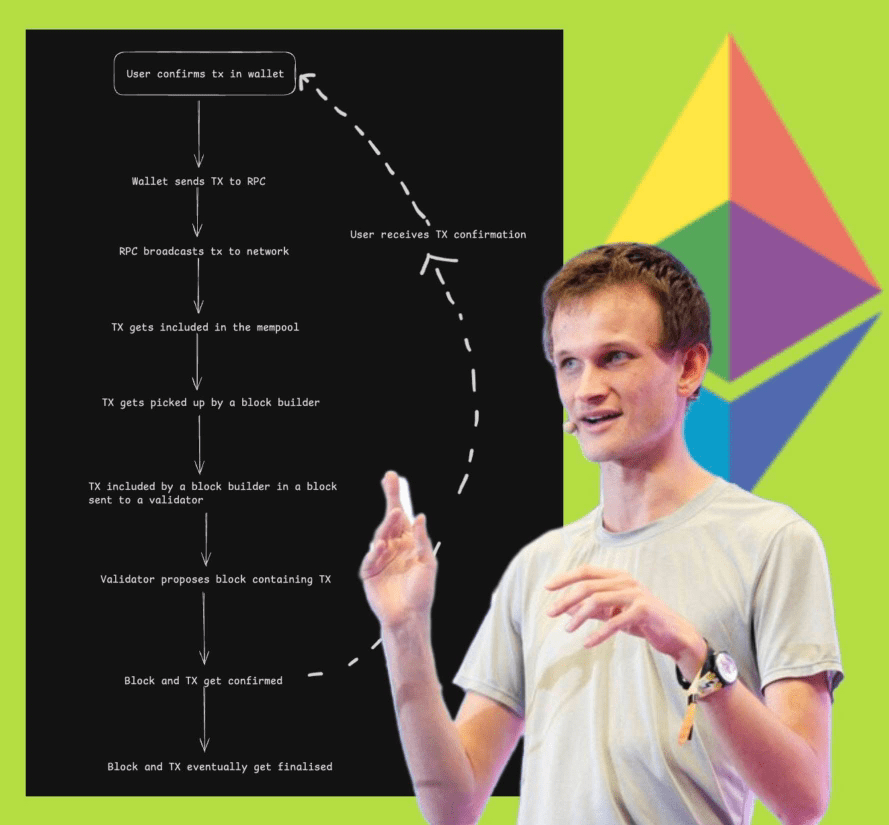
On $ETH there is no one in between - each transaction must find its own way to be processed by the network. Below is the journey of a transaction from the moment you click 'Submit' until it is recorded on the blockchain:
1. APPLICATION CREATES TRANSACTION
For example, you swap USDC → ETH on Uniswap.
When you click "Swap", Uniswap will prepare a "transaction draft" that includes:
- Sent to which contract
- What action do you want to take (how much to swap)
- How much gas are you willing to pay at maximum
- Nonce (your transaction's order number)
⚠️ If the old transaction is stuck, the new transaction will also be stuck because the nonce must run in order.
2. YOUR WALLET SIGNS THE TRANSACTION
WALLET WILL SHOW YOU WHAT THE TRANSACTION WILL DO.
You click "Submit" → wallet signs the transaction with your private key.
This proves you are the one allowing the transaction.
3. TRANSACTION SENT TO THE ETHEREUM NETWORK
Wallet sends the transaction to an RPC (like Alchemy or Infura).
RPC will place the transaction into the mempool — where pending transactions are collected.
Think of the mempool like:
👉 "Common queue" of the network.
But:
- There is no single mempool
- No "first come, first served" rule
- Transactions with higher fees are always prioritized
4. BLOCK BUILDERS WILL SELECT YOUR TRANSACTION
Previously validators built blocks themselves, but now they almost entirely delegate that to block builders.
Block builder:
- Retrieve transaction from mempool
- Rearranged for maximum benefit (optimizing MEV)
- Closed into a block
- Take that block to "auction"
- Validator selects the block with the highest payout
In short:
👉 Block builder is the one who actually selects your transaction to include in the block.
5. TRANSACTION CONFIRMED
After the block is created:
First confirmation: ~12 seconds
→ Safe enough for swaps, sending regular tokens.
Finalisation: ~13 minutes
→ Almost impossible to reverse.
→ Used for large transactions, exchange listings, or bridges.
6. WHEN DOES A TRANSACTION FAIL?
1. Transaction is stuck
Reason:
- Fee is too low
- Transaction with a smaller nonce has not been processed
How to handle:
- "Speed Up" (increase fee)
- Or "Cancel" by sending a new transaction with the same nonce but a higher fee
2. Transaction failed
Even if it fails, you still lose gas, because Ethereum had to "test run" the transaction.
Common reasons:
- Slippage exceeds limits
- Insufficient allowance
- Transaction conditions are no longer valid at the time of processing
3. Transaction removed from mempool
If the fee is too low for a long time → node ignores → must resend.
IN SUMMARY
- Application generates transactions
- Wallet signs the transaction
- RPC broadcasts to mempool
- Block builder selects transactions to include in the block
- Validator confirms the block
- Done, your transaction is recorded on $ETH