
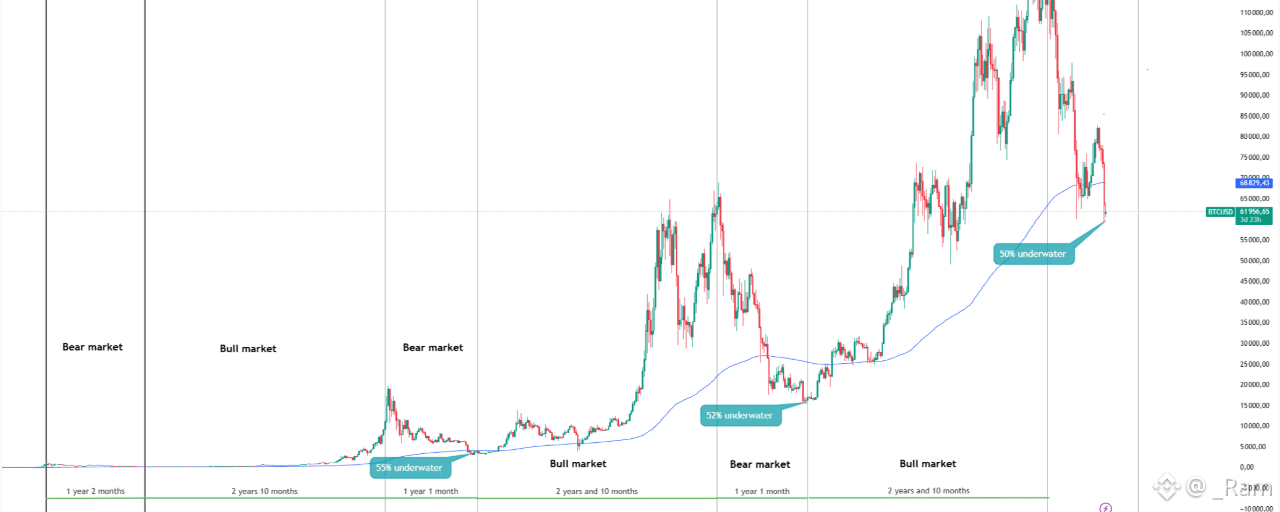

For the first time in this cycle, more bitcoins are held at a loss than at a profit. Historically, this type of situation is not insignificant.
The community is currently split into two camps.
On one side, the bulls. On the other, the bears.
The bulls
The bulls believe that this situation could directly impact the dynamics of the available supply in the market. Their reasoning is simple: when a majority of holders are at a loss, many of the weaker sellers have often already exited the market. Those who panic easily have already sold. Those who remain have shown a greater capacity to withstand volatility.
In this scenario, the available supply for sale gradually decreases. Even a slight uptick in demand could then have a more pronounced impact on the price.
The pessimists
The pessimists, on the other hand, believe that this metric absolutely does not guarantee that the market has reached its bottom. According to them, Bitcoin could still experience significant bearish movements before building a true market bottom. Some investors currently at a loss could still capitulate if the price continues to drop.
Analysis
The reality is that it’s difficult to say for certain that one camp is right and the other is wrong. This data remains primarily indicators to interpret.
However, some elements deserve consideration.
1.
Following the reasoning of the optimistic camp, it’s worth noting that Bitcoin has already tested the $60,000 zone in recent months. The investors most sensitive to fear have already had several opportunities to sell.
If some holders weathered those initial corrections without selling, and then continued to hold their positions despite further dips, it suggests some psychological resistance.
After all, an investor who buys solely under the influence of FOMO or who systematically sells under panic tends to exit the market at the first waves of significant volatility.
Conversely, those who have held onto their positions through several returns to $60,000, and then through new phases of market weakness, show behavior more akin to seasoned investors.
2.
There’s also another possibility: some players may have strengthened their positions during successive dips. In this case, they demonstrate a more advanced understanding of market cycles, viewing periods of weakness as accumulation opportunities rather than reasons to sell.
What to take away?
This doesn’t mean that the cycle bottom has already been reached.
Conversely, this could indicate that the market is operating in a zone historically associated with advanced phases of capitulation.
Previous major bear markets have shown that a majority of $BTC holders at a loss typically appear close to major lows. In 2018, over 55% of BTC were held at a loss. The price eventually hit around $3,200. That was practically the bottom of the bear market. During the FTX crisis in 2022, this figure exceeded 52%.
Each time, sellers have gradually run out of steam before a new bullish cycle could set in.
History never repeats itself perfectly, but it often provides useful benchmarks.
In my view, this metric should not be seen as an exact signal of market bottom. However, it likely serves as an important signal indicating that Bitcoin is moving into a zone where the chances of approaching a bottom are becoming progressively more interesting.
In other words, even if the price were to record new lows, each additional dip could now be interpreted as moving within a historically close range to market bottoms rather than the start of a new structural collapse.
This is precisely what makes this phase of the cycle particularly interesting to observe.
