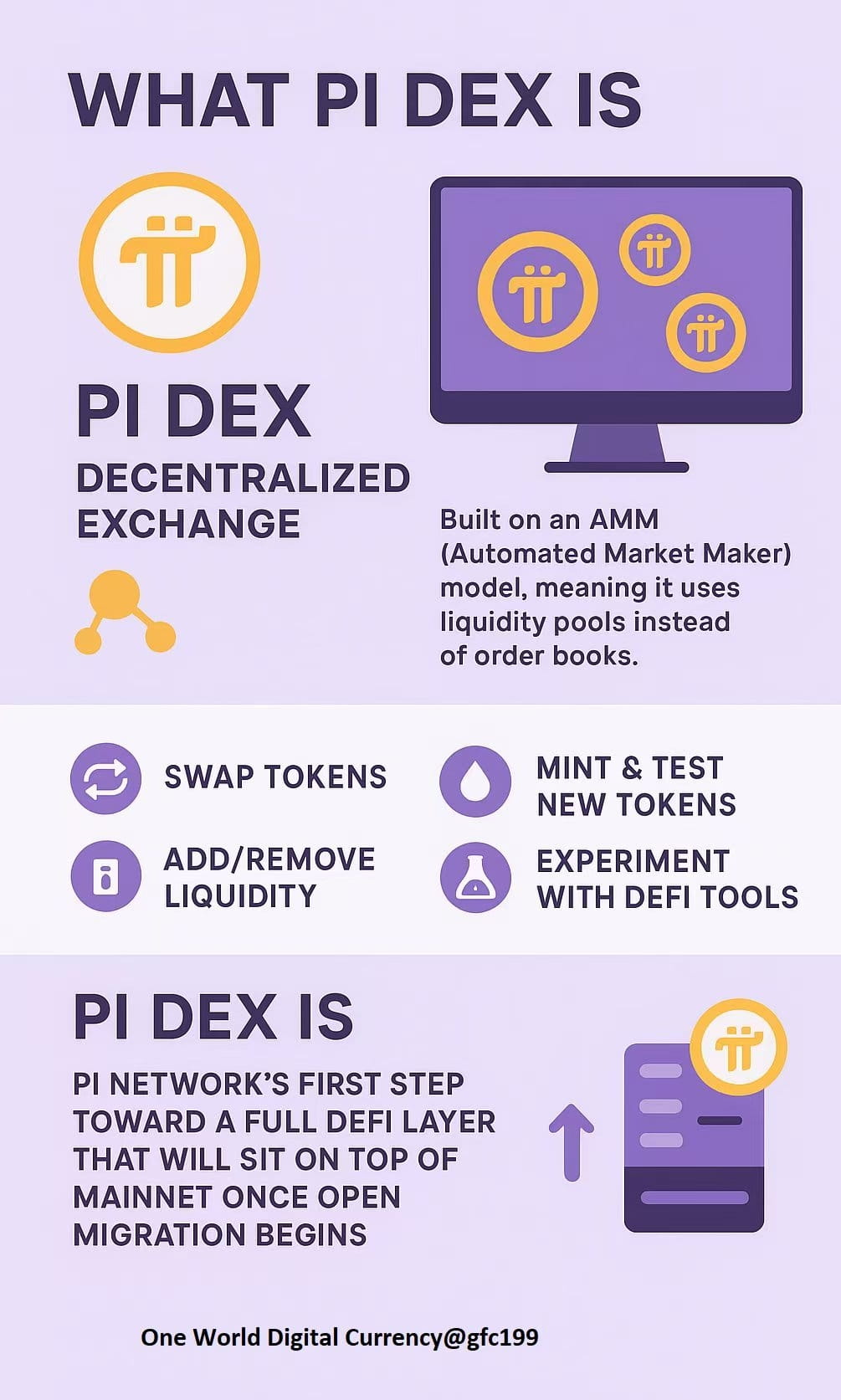
Pi DEX is the native decentralized exchange of the Pi Network, currently operating on the Pi testnet within the Pi wallet.
Based on the Automated Market Maker (AMM) model, it relies on liquidity pools rather than order books, allowing for a smoother and fully decentralized trading experience.
In fact, Pi DEX allows users:
Instantly swap tokens
to add or remove liquidity
to mint and test new tokens
Experiment with DeFi tools in a secure, Testnet-only environment
Pi DEX represents the foundation of the full-scale DeFi layer that Pi is about to launch—once migration begins, this crucial step will run on the Mainnet.
Difference between Pi DEX and CEX
1. Self-custody (DEX) vs Central custody (CEX)
DEX: Your Pi stays in your own wallet.
CEX: You deposit Pi into the controlled wallet of the exchange.
Pi DEX = fully owned, no intermediaries.
2. Liquidity pools (DEX) vs order books (CEX)
DEX: Exchanges are executed automatically through AMM pools.
CEX: Trading relies on matching buyers and sellers.
3. Transparent smart contracts (DEX) vs centralized ledgers (CEX)
DEX: All logic is on-chain and verifiable.
CEX: Internal systems are opaque and cannot be audited.
Pi DEX = trustless and transparent.
4. Community-driven liquidity (DEX) vs exchange-controlled liquidity (CEX)
DEX: Users provide liquidity and earn fees.
CEX: Liquidity belongs only to the exchange.
Pi DEX = shared rewards and community ownership.
5. Permissionless token creation (DEX)
Pi DEX includes token mining tools that allow developers to launch:
Public tokens
Game tokens
Governance tokens
Market tokens
Event tokens
Application-specific tokens
This is not allowed in CEX without strict approvals and listing fees.
Pi DEX = open, unrestricted innovation.
Why is Pi DEX currently on Testnet?
1. Prevent early market instability
Pi mainnet is not yet open. Enabling DeFi too early may trigger:
Fake market
Arbitrary fiat pricing
External manipulation
Testnet prevents speculative distortions.
2. Educate and nurture millions of pioneers
Before interacting with real-value Pi, users must understand:
Wallet security
Liquidity pool mechanism
Impermanent loss
Token minting
DeFi risk management
This learning phase is crucial for the long-term security of the ecosystem.
3. Allow developers to build before the mainnet
Pi DEX as a sandbox, developers can:
Prototype
Test tokens
Integrate AMMs
Build dApps
Prepare for the launch day on Mainnet
It accelerates the ecosystem's readiness for open migration.
Will Pi DEX support Pi ↔ fiat exchange in the future?
Direct answer: No.
Pi DEX will not provide direct fiat conversion.
Why?
DEX can only operate using on-chain assets. Fiat requirements:
Banking integration
KYC/AML compliance
Regulated on/off ramp partners
Licensed financial institutions
These cannot be resolved solely through decentralized smart contracts.
However, Pi ↔ fiat conversion will be achieved through the following:
1. Pi wallet open/close boundaries
Possible partners include:
Bansa
Onramper
Transact
PiBridge (an external service used by some pioneering companies)
These channels will convert Pi into fiat currency (and vice versa) through regulated means.
2. Future π-based stablecoins
Developers may ask the following questions:
Pi-USD
Pi-MYR
Pi-SGD
These can be traded on Pi DEX, but they are not fiat currency themselves.
3. Licensed CEX partners
After opening the mainnet, centralized exchanges can:
List Pi
Allow deposits/withdrawals
Trade Pi against USDT, USD, EUR, Malaysian Ringgit, etc.
All of this happens off-chain, outside of Pi DEX.
Summary
Pi DEX is not a fiat exchange.
Pi DEX is the DeFi platform of Pi Network based on on-chain AMM.
It will enable:
Pi ↔ Pi-native token swap
Pi
Pi ↔ Pi-based stablecoin
Liquidity pool
Token minting
DeFi utilities
But Pi ↔ fiat will always circulate through regulated gateways, not decentralized exchanges.