
I have been trading cryptocurrencies for ten years and made 7000W. Because I want to change my destiny, I must try the crypto space. If you can't make money in this circle, ordinary people will have no chance in their lives.
I believe that excellent traders must be able to be patient to endure the prosperity! 'Five poor and six absolute' is the same every year. According to cycle theory, which months can you trade cryptocurrency in a year? 'Five poor and six absolute, seven may not necessarily turn around.' Every year in May, June, July, and August, I am always in cash.
So when is the right time to enter the cryptocurrency market?
First, enter the market at the end of September and clear the position at the end of November.
Second, enter the market before the Spring Festival and clear positions in April.
Third, execute the above two iron rules, of course excluding cases where small-cap coins are manipulated.
Fourth, the next step is to learn how to find hundred-fold coins; combining it with a bull market can lead to wealth.

After more than 10 years of market experience, currently one of my accounts has accumulated 30 bitcoins! The investment return rate for this account has also reached
Before discussing capital management techniques, I strictly adhere to the following 8 ironclad rules:
1. When entering the market, do not only look at the cryptocurrency candlestick chart, especially for short-term trades, you also need to look at the 30-minute candlestick chart, and the overall market must stabilize and resonate at that moment before entering.
For example, sometimes when I see a candlestick with a long upper shadow, I feel there are no opportunities, but the next day it pulls out a big bullish candle or even hits the limit up. Actually, looking at the 30-minute candlestick shows the brilliance of it.
2. If the trend and order are not right, looking once more is a mistake. One must go with the trend, and the order of the rise must not be disrupted.
3. Short positions should not be taken in hot or potentially hot markets.
4. Give up all impulsive entries. Trade your plan, plan your trades.
5. Any person's view or opinion is merely a reference; one must have their own thoughtful and careful analysis.
6. First lock the direction, then select the coins. If the direction is correct, it will yield twice the result with half the effort; if the direction is wrong, it will yield half the result with double the effort.
7. Intervene in coins that are currently rising. Trying to guess the bottom is a big taboo, as it often feels like a rebound is imminent, only to face a final shakeout. Stock prices always move towards areas of small resistance, so intervening in coins that are currently rising means choosing a direction with less resistance.
8. After significant gains and losses, empty the position and reevaluate the market and yourself. Clarify the reasons for the significant gains or losses before taking action again.
After many years in cryptocurrency trading, I found that after significant gains and losses, emptying the position has a probability of being correct over 90%.
Without further ado, let's get straight to the point:
Capital management techniques refer to how traders decide the position size for each trade. There are many methods of capital management that traders can choose from.
The most important point here is that traders must choose a clear method and not frequently change it. Consistency in position management can make the account curve smoother and avoid drastic fluctuations caused by improper position management.
Summarizing the most commonly used capital management techniques by traders, the most frequently mentioned include the following:
#1 Fixed percentage method
The standard position management method is called 'fixed percentage method'. In this method, traders set the risk percentage they are willing to take for each trade based on their total account balance.
Typically, this risk ratio ranges from 1% to 3%. The larger the account size, the lower the risk percentage tends to be.
For example, if your account is $10,000 and your risk level is 1%, then the risk for each trade is $100. This means that once the stop-loss is triggered, you will lose $100.
The advantage of the fixed percentage method is that it assigns the same weight to each trade. Therefore, the account curve is generally smoother with less volatility.
Disclaimer: Of course, stop-losses may not always be strictly triggered, and there may be additional risks in actual trading.
#2 Average scaling method (scaling up)
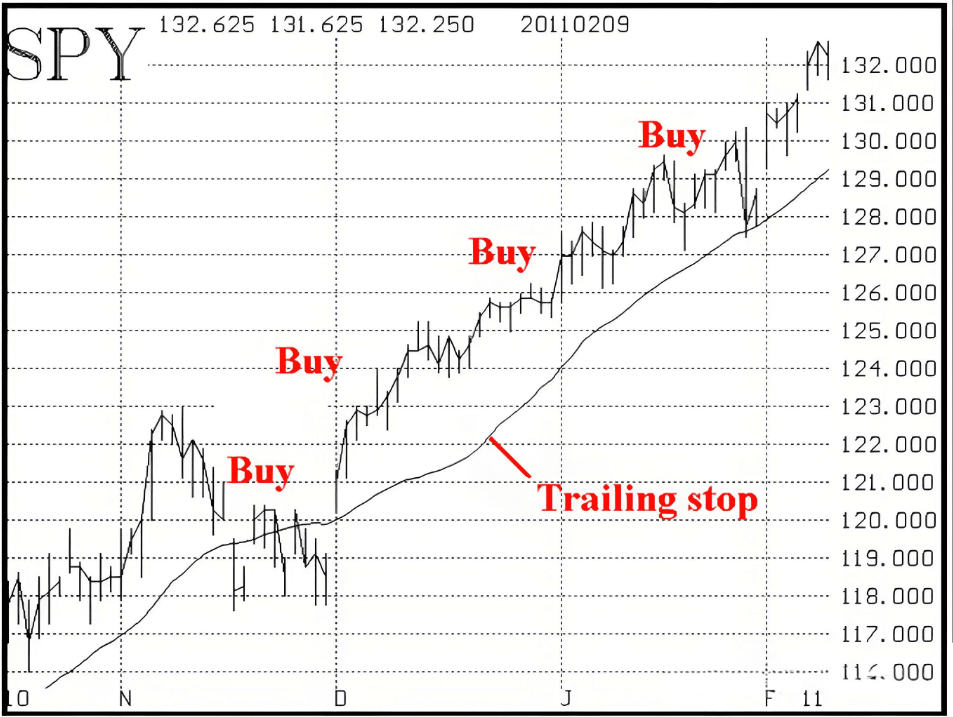
The average scaling method, also known as 'continuing to scale on profitable positions' or 'pyramiding', means that when a trade enters a profit zone, as the price continues to move in a favorable direction, the trader will continue to add contract quantities based on the original position.
✔ Advantages
When using the average scaling method, the initial position size is relatively small, so the relative loss from potential losing trades is also smaller. This method may be more beneficial, especially for trend-following strategies, as it allows traders to gradually increase their positions as the trend reinforces itself.
✖ Disadvantages
Finding a reasonable and optimal price level for scaling can be challenging. Moreover, once the price reverses, losses can quickly offset profits. To mitigate this effect, traders may use larger positions in early orders and reduce the size when starting to average in, which somewhat undermines the aforementioned advantages.
#3 Cost averaging method (scaling down)
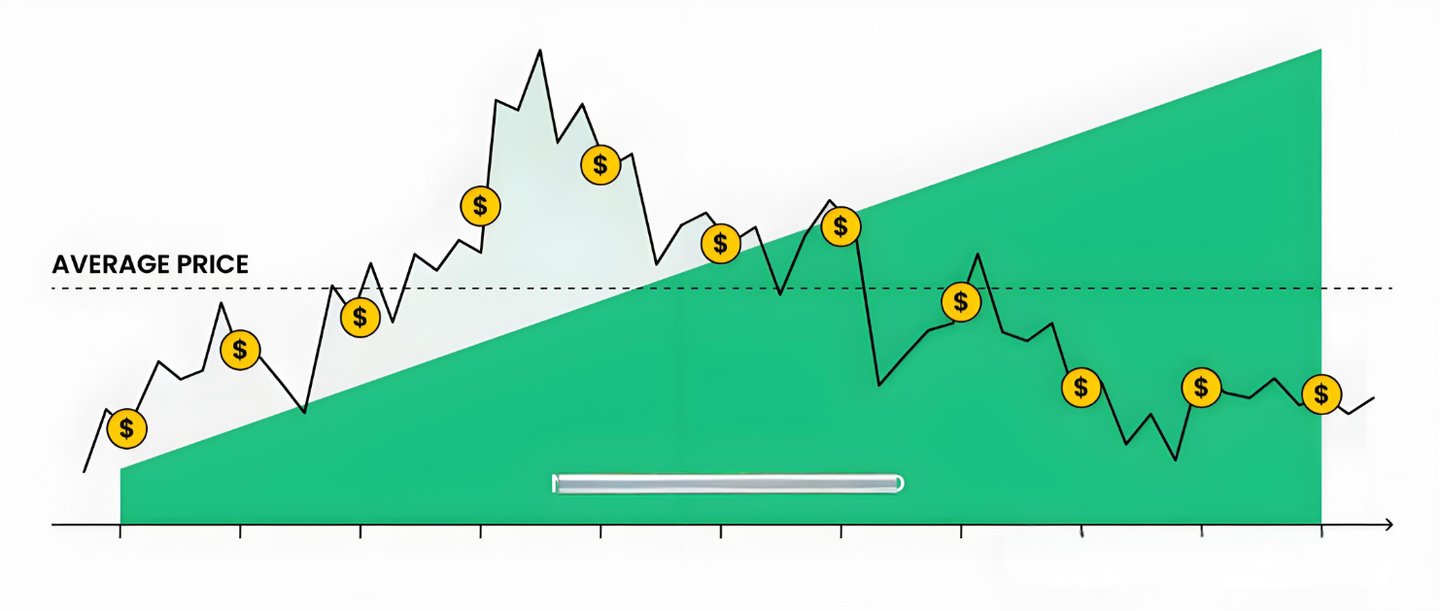
This method is often referred to as 'continuing to scale on losing positions' or 'averaging down against the trend', and it has always been a topic of significant debate among traders. It is completely opposite to 'average scaling method': when your trade is adverse, you continue to scale up to increase the position size.
✔ Advantages
The idea behind this strategy is that once an unfavorable trade reverses, potential losses may decrease, and it can return to the break-even point faster.
✖ Disadvantages
This method is often misused, especially by inexperienced amateur traders. When they are in losing positions and develop emotional dependencies, they often blindly add positions during a downturn without a reasonable trading plan or principles, holding onto the hope that 'prices will eventually reverse'. Improper use of the cost averaging method is a common cause of significant losses for amateur traders.
We do not recommend the 'cost averaging method' for novice traders or those who lack discipline and are prone to emotional trading.
#4 Martingale
The Martingale position management method is highly controversial, just like the previously mentioned 'cost averaging method'.
The core practice is that after a losing trade, the trader will double the position for the next trade, hoping to make up for all previous losses in one go when they finally profit.
✔ Advantages
Just one profitable trade can potentially recover all previous losses.
✖ Disadvantages
As the position doubles continuously, it will eventually reach a point where one must 'go all in'; once this happens, the risk is almost equivalent to betting the entire account. In the long run, all traders will encounter consecutive losses. A slightly prolonged losing streak is enough to destroy the entire trading account. If a trader is prone to revenge trading or impulsively placing orders after losses, the Martingale strategy can bring significant risks and may lead to account zeroing out faster.
For example, even if a trader only risks 1% per trade, after 8 consecutive losses, they will lose their entire account:
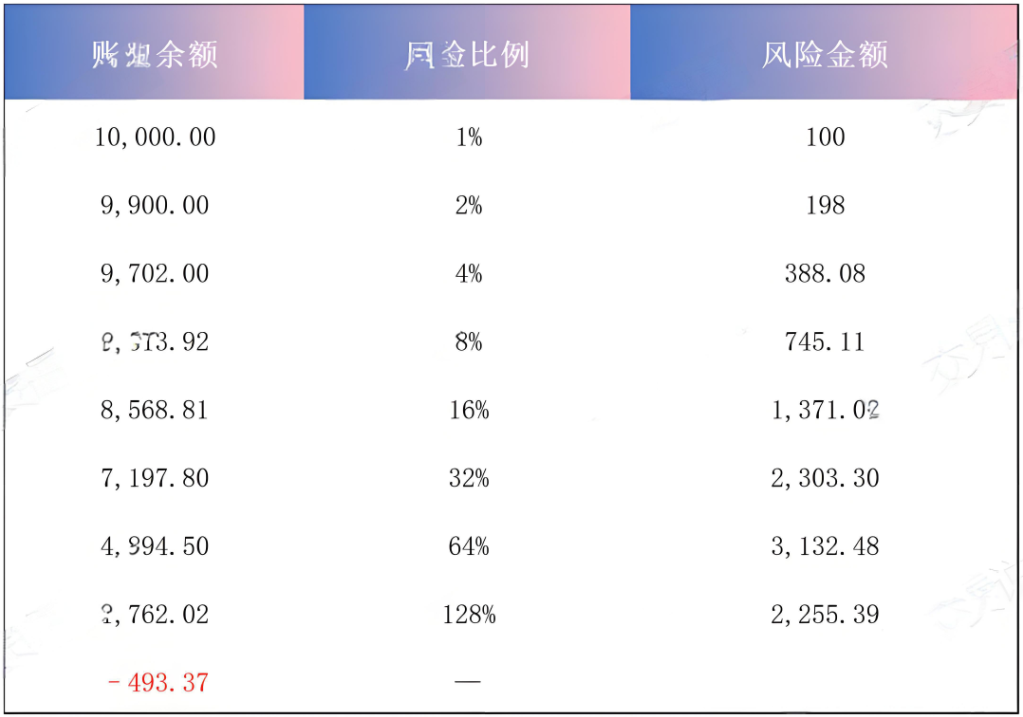
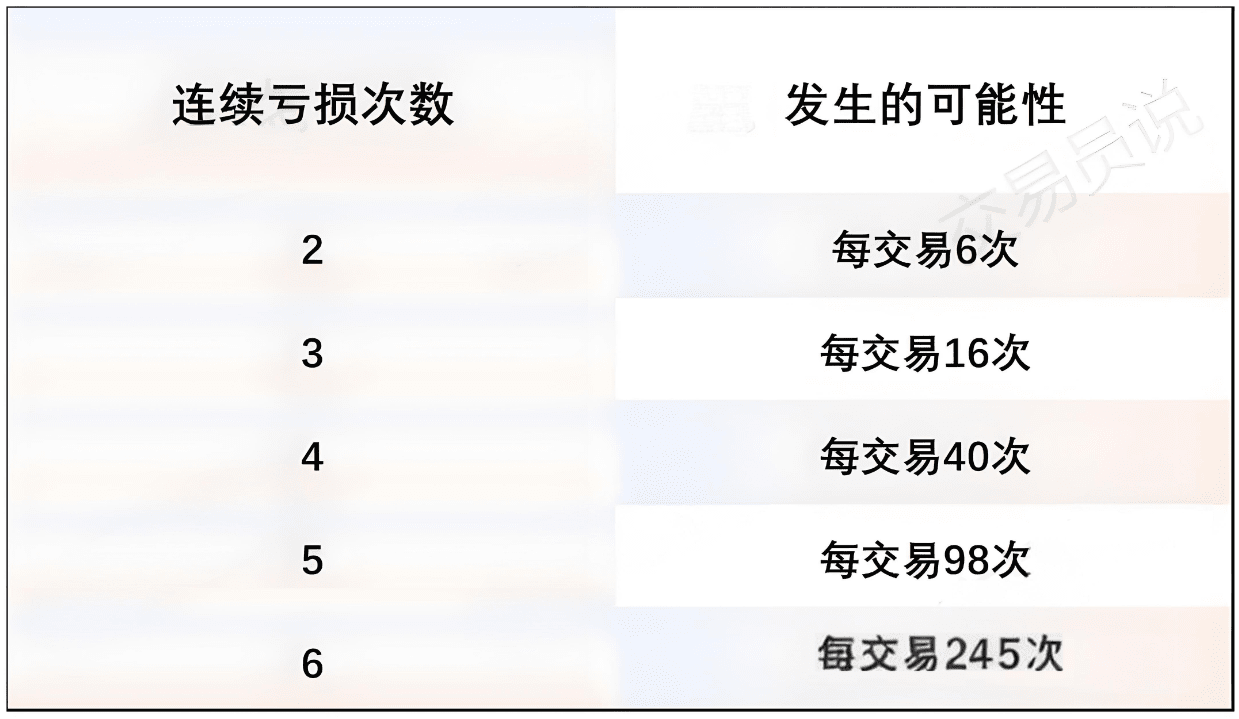
Statistics have confirmed that no matter how excellent a trader is, consecutive losses will occur. Therefore, using the Martingale strategy to blow up an account is just a matter of time.
#5 Anti-Martingale
The goal of anti-Martingale is to eliminate the risks of the pure Martingale method.
In this method, traders do not double their positions after a loss but continue to use their normal risk level. Therefore, consecutive losses will not destroy the account as quickly as Martingale.

On the other hand, when traders experience a winning streak, they will double their positions, taking twice the risk on the next trade. The idea is that after a profit, the trader is using 'money from the market' to continue taking risks.
For example, a trader with a $10,000 account takes a 1% risk to earn $200 profit, bringing the account to $10,200. In the next trade, he can risk $200, which is 1.96% of the account. If that trade wins again, with a profit-loss ratio of 2, he will gain $400, bringing the account to $10,600. Next time, he can risk $600, which is 5.7% of $10,600.
✔ Advantages
During winning streaks, traders may earn more and find it less likely to fall below the original account balance.
✖ Disadvantages
Just one loss can wipe out all prior gains. Therefore, traders should not simply double their positions, but rather choose a multiplier less than 2, so that they can at least retain some profits after a loss.
The anti-Martingale method can lead to significant account volatility because experiencing a loss after a winning streak can be very large. If traders cannot bear this volatility, anti-Martingale will bring additional risks.
A more prudent approach is to set a threshold: once the position grows to a certain level, do not continue to double, but return to the original risk level to lock in profits.
#6 Fixed ratio method
The fixed ratio method is based on the trader's profit factor. Traders need to set a profit amount (referred to as 'Delta'), and once that amount is reached, they can increase their position size.
For example, a trader starts with 1 contract and sets Delta at $2000. Each time the cumulative profit reaches $2000, they can increase the position by 1 contract.
✔ Advantages
Only when traders are genuinely profitable will they expand their position size.
By selecting the Delta value, traders can control the growth rate of their account equity. A higher Delta means traders increase their position size more slowly; a lower Delta means they will grow their position size more quickly after a profit.
✖ Disadvantages
The setting of Delta is subjective, based more on personal preference rather than precise science.
High Delta will slow the expansion of the position after account growth; low Delta will allow the position to grow quickly after reaching the profit zone, and the differences between the two can be quite significant.
7 Kelly Formula
The Kelly formula aims to maximize compound growth rates by reinvesting profits to enhance account growth. The Kelly formula uses the win rate and the profit-loss ratio to calculate the optimal position size.
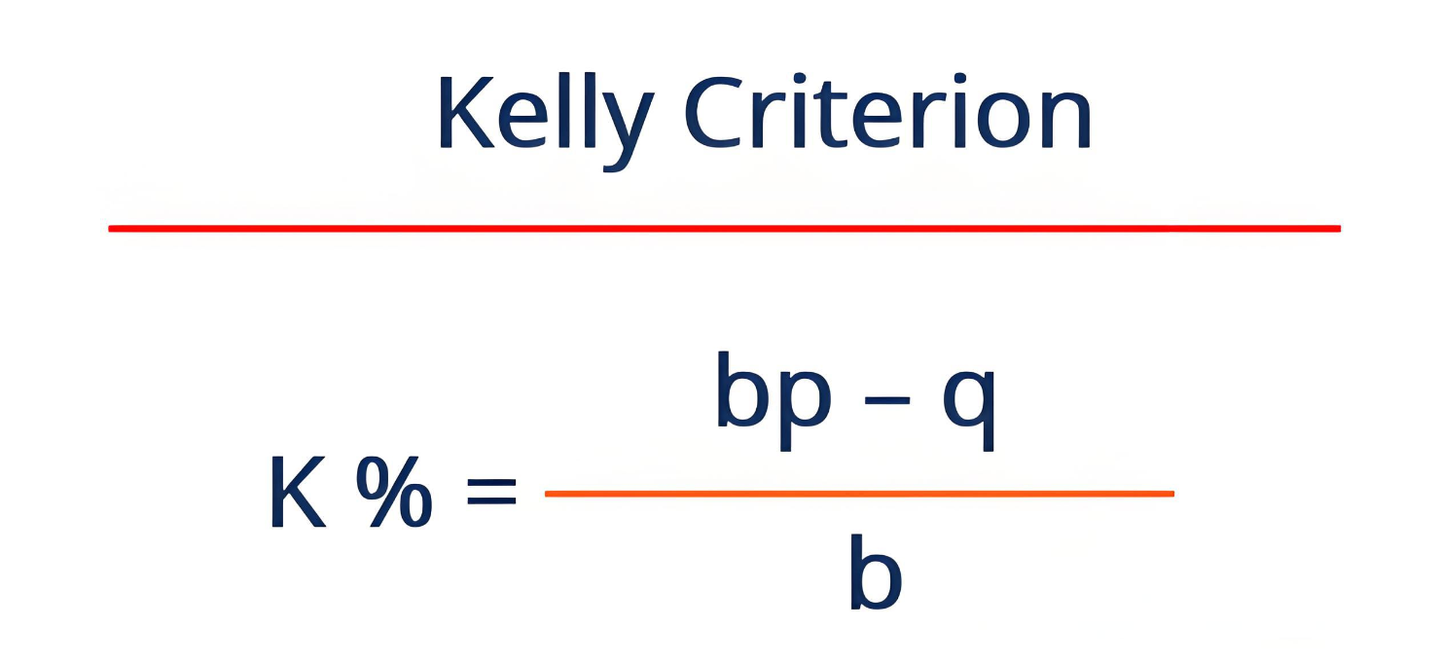
The formula is as follows:
Position size = Win rate – [(1 – Win rate) / RRR]
However, the position given by the Kelly formula often underestimates the impact of losses and consecutive losses. The following two examples illustrate this point:
Example 1:
Position size = 55% – (1 – 55%) / 1.5 = 25%
Example 2:
Position size = 60% – (1 – 60%) / 1 = 20%
It can be seen that the position suggested by the Kelly formula is very large, far exceeding the level that reasonable risk management should consider. To offset this impact, the usual practice is to only use a portion of the Kelly formula. For example, using one-tenth of the Kelly method, the position sizes in the above example would be 2.5% and 2%.
✔ Advantages
Maximize the speed of account growth. Provide a structured, mathematical framework for position management.
✖ Disadvantages
Using the full Kelly can quickly lead to significant drawdowns, which carries very high risk. In practice, partial Kelly should be used.

