
If we talk about the most outstanding projects this year, Hyperliquid must have a place.
It stands out in the fiercely competitive contract arena not because of flashy narratives, but from an extremely simple decision:
Hype tokens only circulate on-chain and are resolutely not listed on centralized exchanges.
This strategy has saved the project a significant amount of unnecessary costs, and also made its price movements clearer and more natural, with almost no traces of artificial intervention.
Does the institution want to buy in? Then it should honestly acquire from the open market—no discounts, no gray channels, and no behind-the-scenes allocations.
The reason Hype can move so steadily is precisely because it has never "handed over the chips to others."
This point has become its most core moat.
Many projects are eager to go public, but who are the real beneficiaries?
The outside world often sees "listing on exchanges" as a sign of project success, but the question is:
Does this "achievement" bring value to users, or primarily create value for exchanges?
Going public on CEX is definitely not as simple as a single announcement:
Liquidity market making, chip coordination, various fees, and resource consumption...
Who will ultimately bear these costs?
If a project cannot fill the gaps, the community has no real benefits, the price lacks transparency, and the chips are not in one's own hands.
Throughout the entire process, the project side often loses initiative.
This also explains why more and more emerging projects choose to stay away from exchanges.
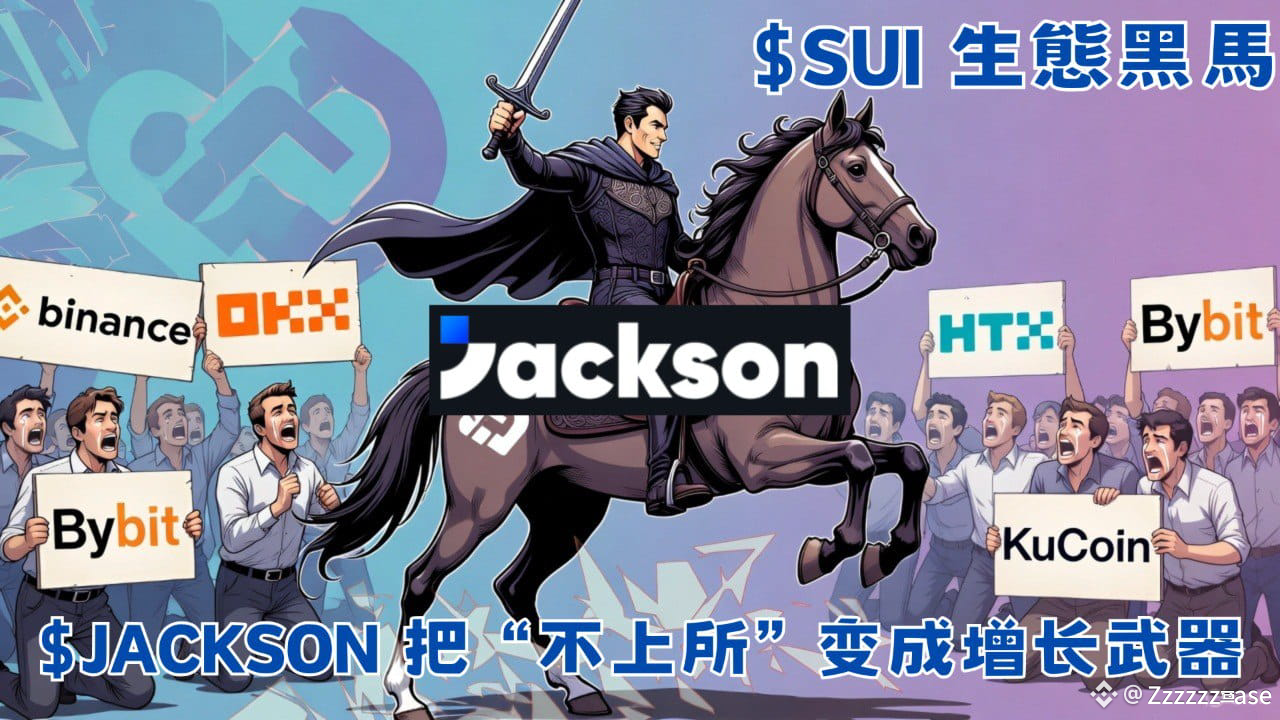
Looking at Jackson.io: $JACKSON's decision to "not go public" is a well-considered strategic choice.
This decision is not an impulse, nor a pretense, but based on the following realistic considerations:
1. Never hand over control of tokens to others.
On-chain, every transaction and every liquidity is clearly visible;
Once entering CEX, who provides the depth and who controls the market often becomes a mystery.
2. Resources must be used in places that truly benefit users.
Rather than spending hundreds of thousands or even millions of dollars on listing fees,
it is better to directly incentivize the community, promote product iteration, and optimize user experience.
3. Jackson.io pursues a "real market," not a false prosperity.
How much of the trading volume on CEX comes from real demand?
Looking at it from another angle, this question itself is thought-provoking.
Hyperliquid has already proven that one can achieve brilliance without going public.
Looking back at the development trajectory of Hype makes it clear:
Not going public is not a resistance, but an accelerator for growth.
In a market where all chips are publicly transparent:
Who is willing to buy, who is willing to sell, and how prices fluctuate are entirely decided by real supply and demand.
No one can hold a large amount of chips to crash the market in advance, nor can anyone secretly accumulate chips to control the market.
Users are the true masters of the market.
This mechanism itself is the best interpretation of "fairness."
$JACKSON essentially brings Hyperliquid's successful experience into the Sui ecosystem.
$SUI The high performance is sufficient to support a more transparent and fully on-chain token model.
It's just that most people are still accustomed to the old paths and have not yet realized that the new model has already been proven feasible.
Jackson.io today chooses a purer path:
• Liquidity is always settled on-chain.
• Chips are completely determined by the market.
• Resources are concentrated on products and business.
• The community continues to receive real incentives.
There are no intermediaries, no gray areas, and no "invisible hands."
The conclusion is clear and firm:
Others rely on going public to create momentum,
$JACKSON, on the other hand, protects value by not going public.
These two paths may be hard to distinguish in the short term,
but in the long run, they will lead to entirely different outcomes.
