
Introduction: A fundamental choice is whether to buy when the market is fearful or to follow the trend after it becomes clear?
In a volatile market, we all face a fundamental choice: whether to buy when the market is fearful or to follow the trend after it becomes clear? This choice distinguishes two fundamentally different trading philosophies - left-side trading and right-side trading.
The decision moments of two types of traders
Let's make a thought experiment: a highly watched stock continues to drop 30% from its peak, and market sentiment is pessimistic.
Left-side traders begin to study the fundamentals of the company in depth, assessing whether its intrinsic value is underestimated. He believes in 'being greedy when others are fearful' and starts to buy in batches, even though the stock price may continue to fall.
The right-side trader watches the changes and waits for clear rebound signals. Only when the stock price stabilizes and breaks through key technical positions does he start to enter the market, pursuing 'going with the trend.'
Recently, a target dropped from a peak of 300 by about 75%. Left-side traders may have started buying at 150 and bought in batches down to 70; whereas right-side traders may still not have bought in, waiting for stabilization and a breakthrough of higher resistance levels before entering.
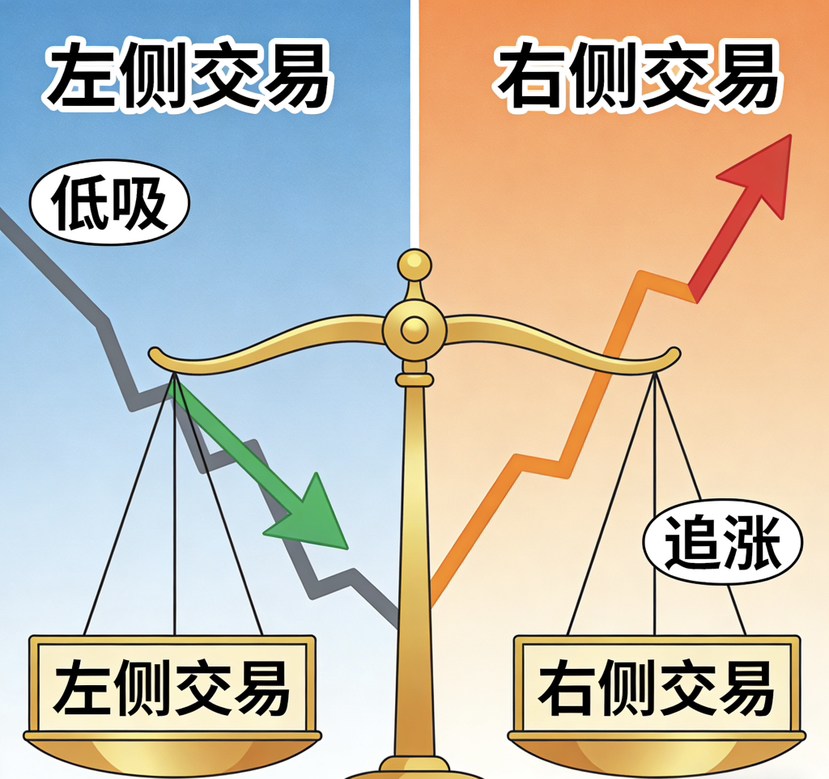
Contrarian thinking vs going with the trend
The essence of left-side trading is value discovery and contrarian investing.
Buying in a downward trend and selling in an upward trend.
Based on the belief that 'price will eventually return to value.'
Need to endure the psychological pressure of unrealized losses and a longer waiting time.
The core of right-side trading is trend following:
Waiting for the trend to clarify, buying in an upward trend and selling in a downward trend.
Pursuing 'being friends with the trend,' giving up the fish head and tail, only eating the fish body.
Need for quick reaction ability and strict stop-loss discipline.
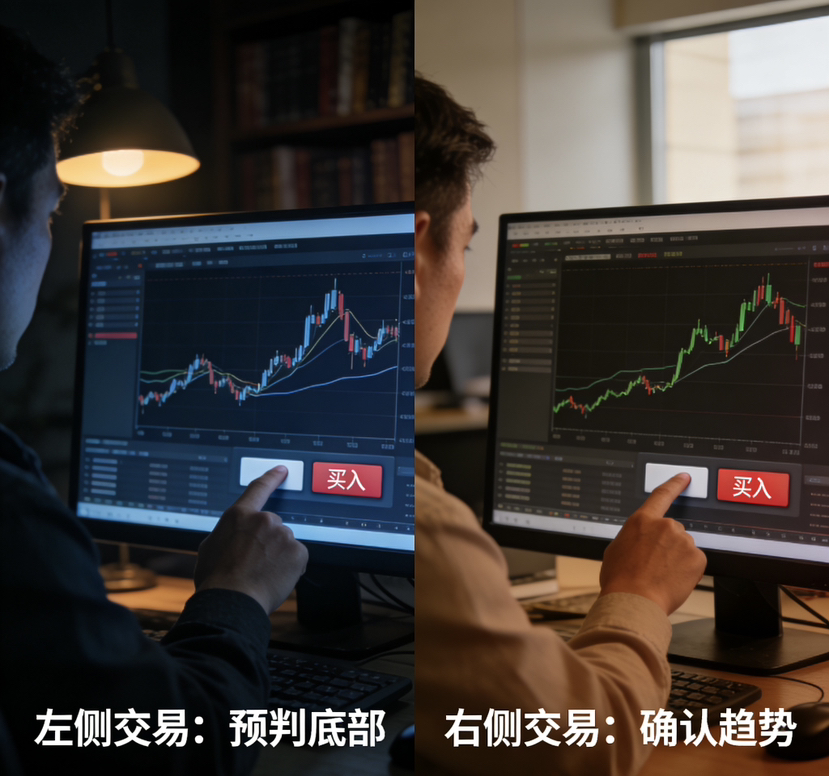
The division of thinking patterns
Left-side traders are like 'value archaeologists,' searching for buried treasures among assets abandoned by the market. They believe that as long as their judgment of a company's value is correct, time will become a friend.
Right-side traders are 'trend surfers,' not predicting when the wave starts but observing after the waves have formed before stepping onto the surfboard and going with the flow.
The risk of left-side trading is the possibility of 'catching a falling knife'—buying in only to see further significant declines, or the time for value recovery far exceeding expectations.
The risk of right-side trading is the possibility of 'buying high and selling low'—entering the market at the end of a trend, or frequently being deceived by false breakouts.
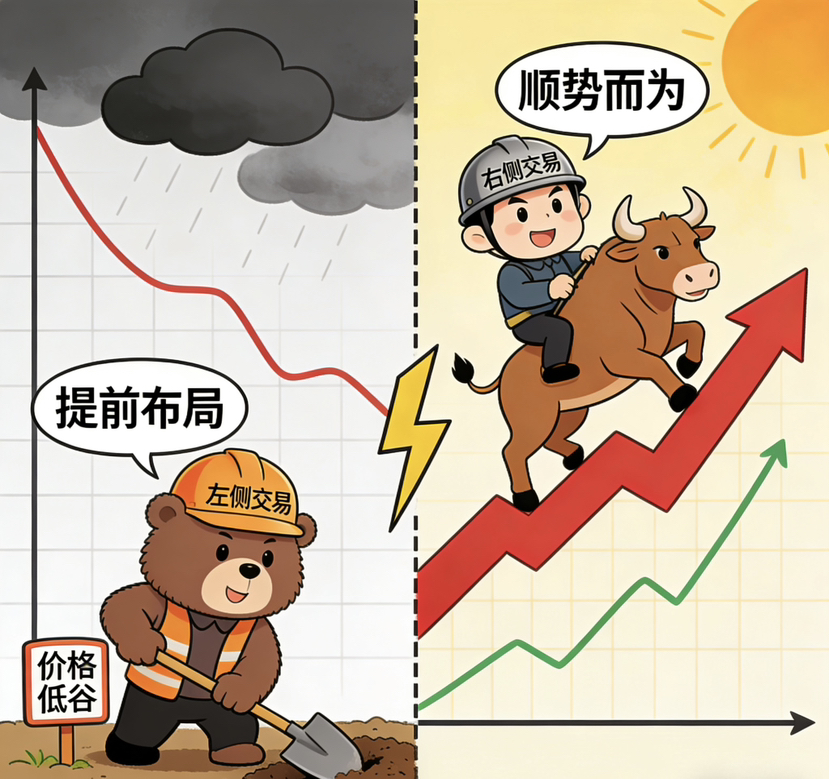
There is no standard answer to multiple-choice questions.
There are no absolute advantages or disadvantages, only suitability.
Left-side trading is more suitable for:
Long-term investors, value investors
Those with in-depth research capabilities in company fundamentals.
Those with strong psychological resilience who do not mind short-term unrealized losses.
Right-side trading is more suitable for:
Trend traders, technical analysts
Those who focus on capital efficiency and risk control.
Those who can strictly adhere to trading discipline.
Many successful investors actually mix both strategies: using left-side thinking to find opportunities and right-side thinking to seize timing.
When to use which method
Typical scenarios of left-side trading:
High-quality companies facing short-term negative impacts, such as the recent wave of lock-up sales for a certain target.
The entire market experiences irrational panic, such as the retail panic at the end of the four-year cycle in November.
In-depth research and conviction of undervaluation, such as the investment strategies of Buffett and Munger: looking for good companies that are undervalued.
Typical scenarios of right-side trading:
Growth stocks or popular sectors with clear trends.
Unfamiliar but technically sound targets
The market is in a clear bull or bear market phase.
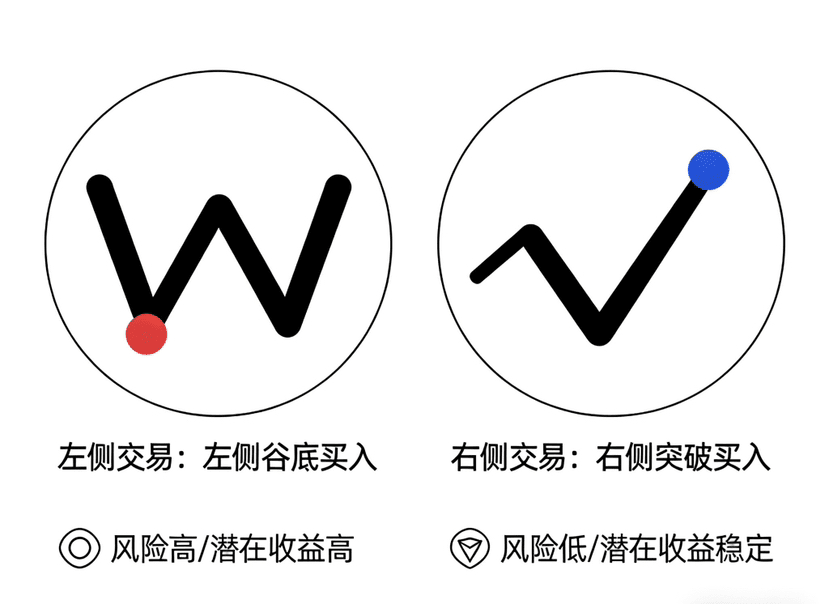
Beyond trading
The difference between left-side and right-side trading essentially reflects two cognitive ways of understanding the world:
Left-side thinking is independent thinking, going against the grain—not following the crowd, believing in one's own judgment.
Right-side thinking is about observation and confirmation, going with the trend—no subjective speculation, respecting market reality.
Both ways of thinking are valuable not only in investing but also in life.
Sometimes we need left-side thinking—calmly reflecting while others chase hot topics; sometimes we need right-side thinking—decisively following when the trend is already established.
Trading methods reflect oneself.
Choosing left-side or right-side trading ultimately reflects our confidence in our cognitive abilities, risk preferences, and our perspective on time.
There is no best strategy, only the strategy that best suits one's personality and capabilities.
True investment wisdom often lies not in finding answers to the multiple-choice question of 'should it be left-side or right-side,' but in understanding the essence of both and forming one's unique hybrid strategy.
Buffett-style value investing is left-side, Soros' reflexivity trading is right-side, while Ray Dalio's all-weather strategy attempts to transcend this dichotomy.
Ultimately, the choice of trading strategy is not just a technical issue, but a reflection of cognitive depth and self-awareness.
