
Gate Learn
Course
Article
Glossary
Research
Search
Gate Learn
Article
Lorenzo Protocol: A Platform that Unlocks Bitcoin Liquidity
Lorenzo Protocol: A Platform that Unlocks Bitcoin Liquidity
23/7/2024, 09.37.13
Intermediate
Bitcoin
DeFi
Discover how the Lorenzo Protocol transforms staked BTC into liquid restaking tokens, enhancing liquidity and enabling participation in DeFi. Learn how Lorenzo facilitates Bitcoin liquidity, making it more versatile and accessible to users across the DeFi ecosystem.
As the father of cryptocurrency, Bitcoin has proven its resilience and value over the years. However, Bitcoin faces limitations, particularly in terms of liquidity and accessibility. Traditional financial systems are not fully integrated with Bitcoin, hindering its growth potential.
Enter the Lorenzo Protocol - a revolutionary solution that connects Bitcoin and decentralized finance (DeFi). Lorenzo aims to unlock Bitcoin liquidity, making it more versatile and accessible to users across the DeFi ecosystem.
What is the Lorenzo Protocol?
Source: Lorenzo Protocol Website
The Lorenzo Protocol is a decentralized financial infrastructure designed to address the liquidity challenges faced by Bitcoin holders, allowing them to participate in a broader DeFi ecosystem.
Lorenzo, founded by Matt Yedan Fan Sang, acts as a bridge, enabling Bitcoin to flow smoothly into decentralized applications (dApps) and protocols. It leverages smart contracts to facilitate secure interactions between Bitcoin and other assets. By providing liquidity, Lorenzo enhances Bitcoin's utility beyond its role as a store of value.
The Lorenzo Protocol serves as a liquidity gateway for Bitcoin into the DeFi landscape. It allows stakers to participate in yield farming, lending, and other DeFi activities while maintaining exposure to Bitcoin.
Key Features of the Lorenzo Protocol
Immutability: Transactions on Lorenzo are irreversible, ensuring trustless operation.
Enhanced Liquidity: Lorenzo bridges the gap between Bitcoin and DeFi tokens, creating a dynamic ecosystem.
Integration Flexibility: It seamlessly integrates with existing DeFi platforms and protocols.
Lorenzo Architecture
Source: Lorenzo Protocol Whitepaper
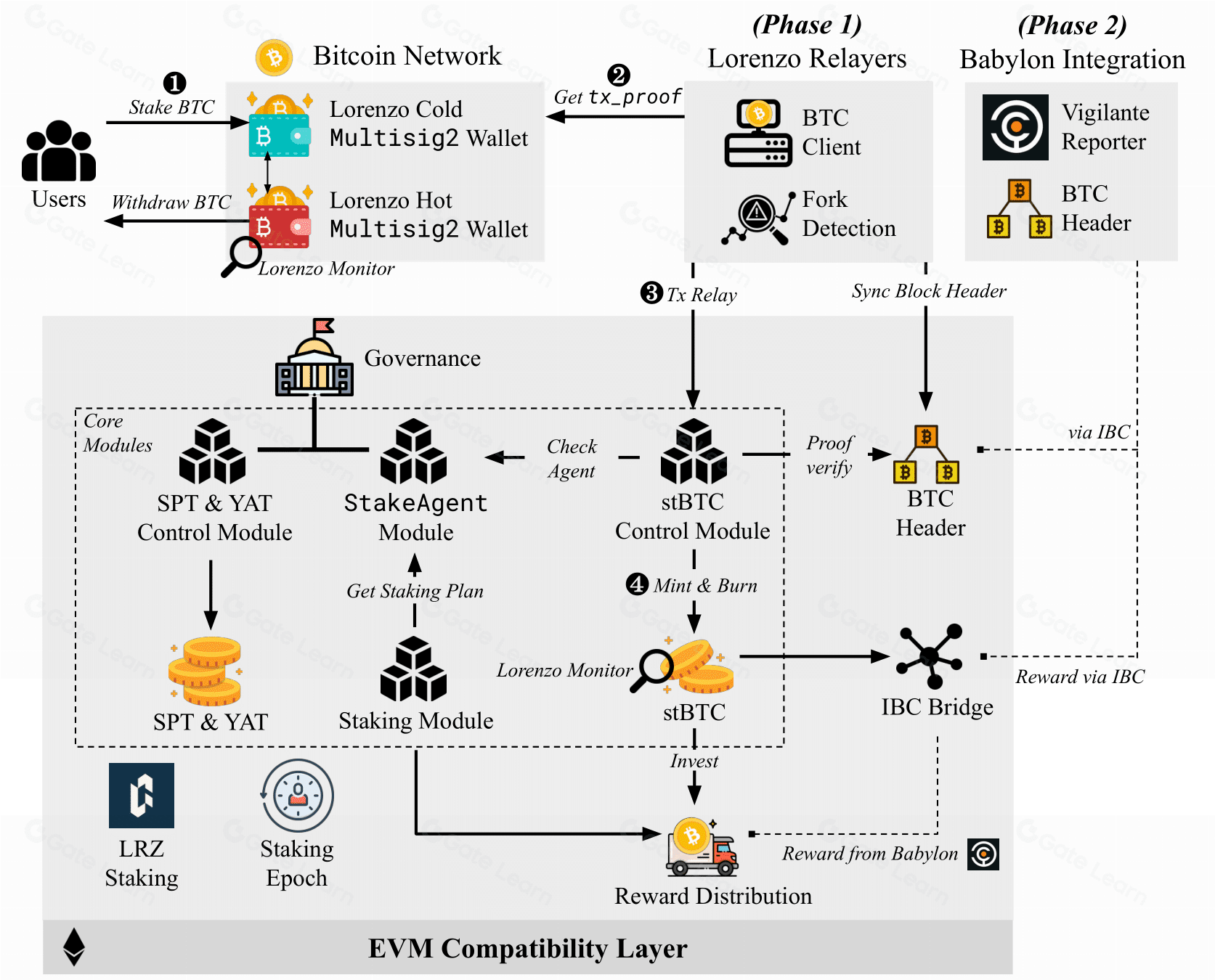
The Lorenzo Protocol has a modular architecture to enhance the scalability and functionality of Bitcoin within the DeFi (decentralized finance) landscape. Lorenzo's primary priority is to assist projects needing to restake Bitcoin to obtain Bitcoin. Conversely, through Lorenzo, Bitcoin holders can discover viable income opportunities by being paired with projects requiring Bitcoin liquidity. Below is the modular architecture underlying the Lorenzo Protocol and its components.
Phase 1: Bitcoin Network (Base Layer)
Users: At Lorenzo, users play a crucial role. Individuals can stake their Bitcoin (BTC) at Lorenzo, initiating the process.
Lorenzo Cold Multisig2 Wallet: This secure offline wallet protects staked BTC, ensuring maximum protection.
Vigilante: Acting as a guard, the Vigilante component monitors the Bitcoin network for potential forks or security threats. If there is any suspicious activity, such as a fork or security breach, it promptly issues alerts to protect users' investments.
Phase 2: Babel Integration (Expansion Layer)
Stake Agent: The Stake Agent is a critical intermediary between Bitcoin stakers and the Lorenzo network. Its primary role is to facilitate the conversion of staked BTC (Bitcoin) into liquid restaking tokens BTC (BLRT). By connecting stakers to the Lorenzo ecosystem, the Stake Agent ensures a smooth flow of liquidity.
Lorenzo Relayers: The Lorenzo Relayer acts as a bridge, ensuring efficient communication between Lorenzo's smart contracts and external DeFi platforms. Its responsibilities include token swaps, providing liquidity, and settlement.
Lorenzo Hot Multisig2 Wallet: This wallet is designed for more frequent transactions, complementing cold storage options.
Cove Module:
StakeAgent Module: This manages the staking process, handling user deposits and withdrawals.
Control Module: This regulates the overall protocol operations and interactions with other modules.
SPT & YAT Control Module: This oversees the issuance and management of Stake Pool Tokens (SPT) and Yield-Accrued Tokens (YAT). SPT represents staked BTC, while YAT captures accrued rewards.
Governance: This module enables decentralized decision-making through a voting system by empowering users.
EVM Compatibility Layer: By interacting with Ethereum Virtual Machine (EVM) based DeFi applications, Lorenzo extends its reach and functionality.
Reward Distribution: This ensures users receive rewards for staking BTC, encouraging participation.
Cosmos Appchain and Ethermint
The Lorenzo Protocol is built on the Cosmos appchain using Ethermint technology. The Cosmos appchain provides scalability, interoperability, and security while Ethermint ensures compatibility with Ethereum smart contracts, enabling seamless interaction with existing DeFi protocols.
Benefits of Lorenzo's Modular Architecture
Scalability: The functional partitioning of Lorenzo allows it to handle more transactions without compromising security.
Flexibility: The seamless integration of new modules ensures adaptability to evolving DeFi needs.
EVM Compatibility: Interoperability with the Ethereum DeFi ecosystem opens up new possibilities.
User Governance: Decentralized decision-making empowers the Lorenzo community.


