

In DeFi, everyone loves to promise everything at once: secure, decentralized, fast, scalable.
In reality, it doesn’t work like that.
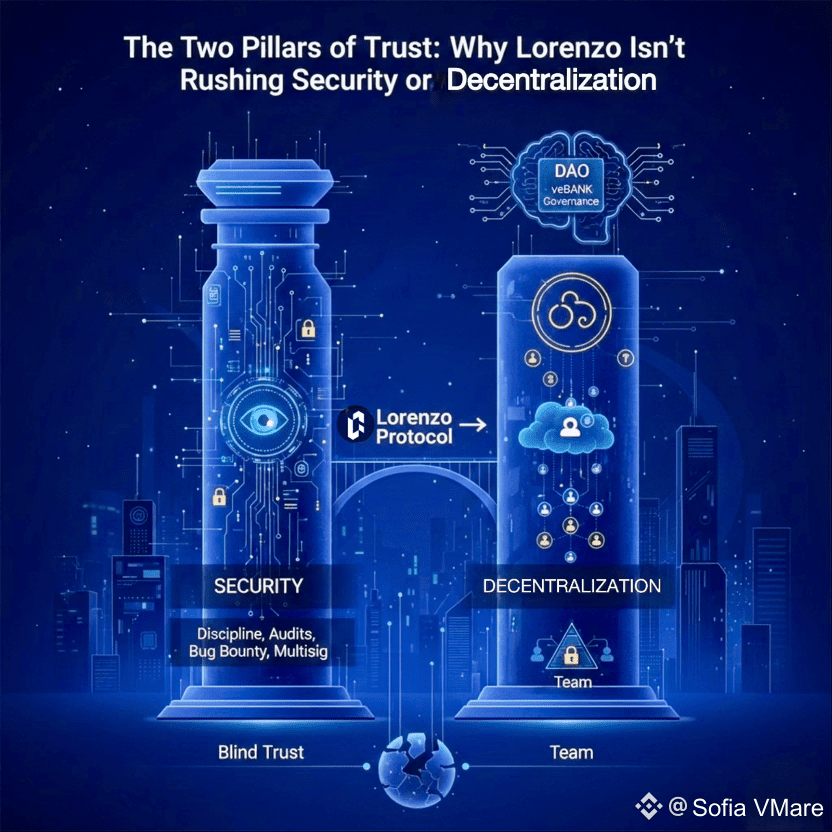
Real trust rests on just two things — code that doesn’t break and power that can’t be hijacked.
Lorenzo Protocol is moving toward these points not like an idealist, but like an architect.
1. Security is not a report — it’s discipline
Before talking about DAOs and governance, the team focuses on the least glamorous but most crucial part — the foundation.
Lorenzo has a healthy habit: it doesn’t trust even its own code.
The protocol’s core smart contracts undergo external audits that target not only obvious vulnerabilities but also the quiet, logical traps that tend to explode at the worst possible moment.
By publishing audit results, Lorenzo gains an unexpected advantage:
the audit becomes public proof that the system isn’t running on blind trust.
But there is no point in DeFi where you can declare: “Done, secure forever.”
Security isn’t a milestone — it’s a moving process.
The bug bounty opens the door to global security researchers.
Anomaly-monitoring tools work like a fire alarm running 24/7.
Critical actions are handled through multisig — no one gets to push the “red button” alone.
This isn’t perfect protection. This is protection that lives and responds.
2. Centralization → Delegation → Community
The second pillar of trust is distributing power. Lorenzo doesn’t pretend to be a fully decentralized protocol yet — and honestly, that’s better than claiming decentralization where it doesn’t exist.
The early stage does involve more centralized decision-making — you simply can’t iterate fast, patch issues, or launch new features otherwise.
But the route is clearly mapped out:
team → token holders → DAO.
The engine of this transition is the $BANK + veBANK governance system.
Once fully activated, holders will vote on essential parameters such as:
which assets to integrate,
how rewards are distributed,
what fee structure is optimal,
where the protocol’s economy should evolve.
Governance stops being an abstract promise and becomes an economic tool.
The final stage is a full DAO, where decisions are not just discussed but executed by smart contracts.
At this point, the protocol is no longer a company — it becomes digital infrastructure that stands because the community keeps it standing.
Conclusion
Lorenzo builds trust not through slogans but through process:
strengthening security while gradually opening the door to distributed governance.
It moves slower than impatient users would like — yet faster than many “decentralized” projects where decentralization exists only in the description.
And the question that naturally emerges:
Once the community takes full control, will Lorenzo be able to keep this balance — or will governance simply shift into the hands of the largest veBANK holders?
@Lorenzo Protocol #LorenzoProtocol $BANK

