
$BTC Let's be clear: in the cryptocurrency world, making big money is more reliable through trend trades and pattern trades rather than day trading and leveraged contracts. It's not that you can't make money short-term, but to compete with large funds, the 'stupid method' of holding long-term positions actually has a higher success rate. Today, let's discuss the underlying logic, risk differences, and what kind of traders can handle this type of trading.
So why are trend trades and pattern trades easier to make big money?
The core principle is simple: exchange time for space and follow the general direction.
In a bull market for mainstream coins, a trend can increase several times or even dozens of times. Pattern trades focus on the mindset of 'not making small money, but making big moves', seizing these large fluctuations.
Short-term trading is about earning the price difference; buying today and selling tomorrow seems frequent, but in reality, it is exhausting and easy to lose—
Firstly, high-frequency trading fees accumulate over time and can eat away a lot of profits; secondly, timing short-term trades is too difficult— even if you are right eight times out of ten, two mistakes can wipe out all previous profits.
Trend positions do not require daily monitoring for decision-making; as long as the overall direction is not wrong, you can enjoy the benefits of rising prices, which is akin to 'making money by riding the wave', much easier than struggling with short-term trading.
So where exactly is the difference in risk between trend positions and short-term/contract positions?
In fact, the risks of the two are not on the same path, but the risks of short-term trading and contracts are more 'deadly':
The risks of trend/pattern positions: mainly fear of 'misjudgment' and 'unexpected events.'
For example, thinking it is the start of a bull market, but it turns out to be a short-term rebound (trend misjudgment); or encountering heavy regulatory strikes or project explosions (black swan) during the holding period.
As long as you use spare money to buy, do not leverage, and set stop-loss in advance (for example, selling if it drops below a key price), the maximum loss is just your own principal, and you won't lose more.
The risks of short-term trading/contract positions: somewhat like 'stepping on a minefield.' Firstly, high-frequency decision-making is prone to errors, and a single misjudgment can lead to losses; secondly, contracts are leveraged, and even slight price fluctuations can lead to liquidation (total loss of principal); and the more one watches the market, the more emotional one becomes, chasing highs and cutting losses, resulting in high fees but actual losses.
What hard skills should traders with trend positions have?
Traders who can manage trend positions are definitely not relying on luck, but rather on 'technology + mindset + capital management' being all in place:
1. Capital management: absolutely no reckless heavy positions or leverage: they won't let you invest all your money in one go; generally, total positions should not exceed 5%-10% of your total assets, and no single cryptocurrency position should exceed 60% of your cryptocurrency portfolio. They will also teach you to buy in batches and sell in batches, for example, selling 20% if you gain 50%, or reducing position if it drops below key support and hasn't rebounded for three days, absolutely not putting all eggs in one basket.
2. Emotional control: able to withstand large drawdowns without being swayed by the market: trend positions may be held for several months or even a year, with price drops of over 30% being quite common. But they won't panic, won't casually change strategies, and won't be pressured by fans to 'sell quickly' or 'buy quickly', able to resist the temptation of market noise and short-term fluctuations, sticking to their own judgments.
3. Technology + judgment: must understand various aspects, not just follow the trend blindly: they won't only look at K-line charts, but will also pay attention to global regulatory policies (for example, a country's attitude towards cryptocurrencies), project fundamentals (for example, whether the team is working hard, whether on-chain data is good), and the flow of large funds (whether whales are buying or selling). They will also review monthly; if a previously favored project deteriorates (for example, the team runs away), they will decisively let you liquidate without clinging to it.
Such traders do not boast, are very stable, and are a rare breed.
Most are aged 30-45, having worked in the cryptocurrency or traditional finance sectors for over 5 years, not chasing obscure coins with no reputation, only focusing on mainstream coins and truly valuable projects; they have a particularly low frequency of trades, only 1-3 times a month, and won't force you to trade every day; each trade will clearly state 'how much to buy, where to sell if it drops, where to take profit if it rises, how long to hold,' avoiding vague language; they might even proactively mention possible black swan events (like regulatory changes); their emotions are particularly stable, even if there are significant drawdowns, they won't panic in the community, only objectively analyzing whether the trend has changed, encouraging everyone to remain rational.

Want to follow a successful trader + ID:ai12345
Personally, I think that contracts are a way for people with little capital to pry up the earth with a toothpick for big returns; of course, one must have a good mindset and if you can't bear it, don't pry!
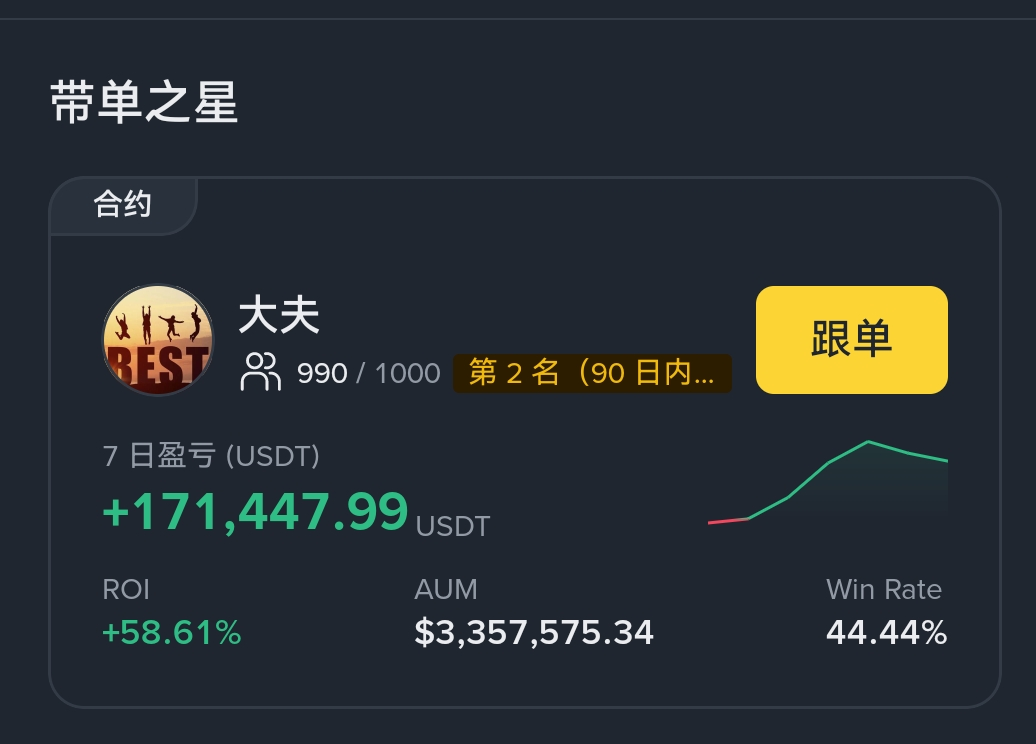
In summary: if you want to make big money, don't be greedy for small profits from short-term trading; follow reliable trend traders, use profits, manage positions, and withstand fluctuations; this is the more stable approach. And reliable traders are never 'accurate in calling orders', but are 'clear in logic, strict in risk control, and stable in mindset'—after all, in this market, surviving is the key to waiting for big money opportunities.
