
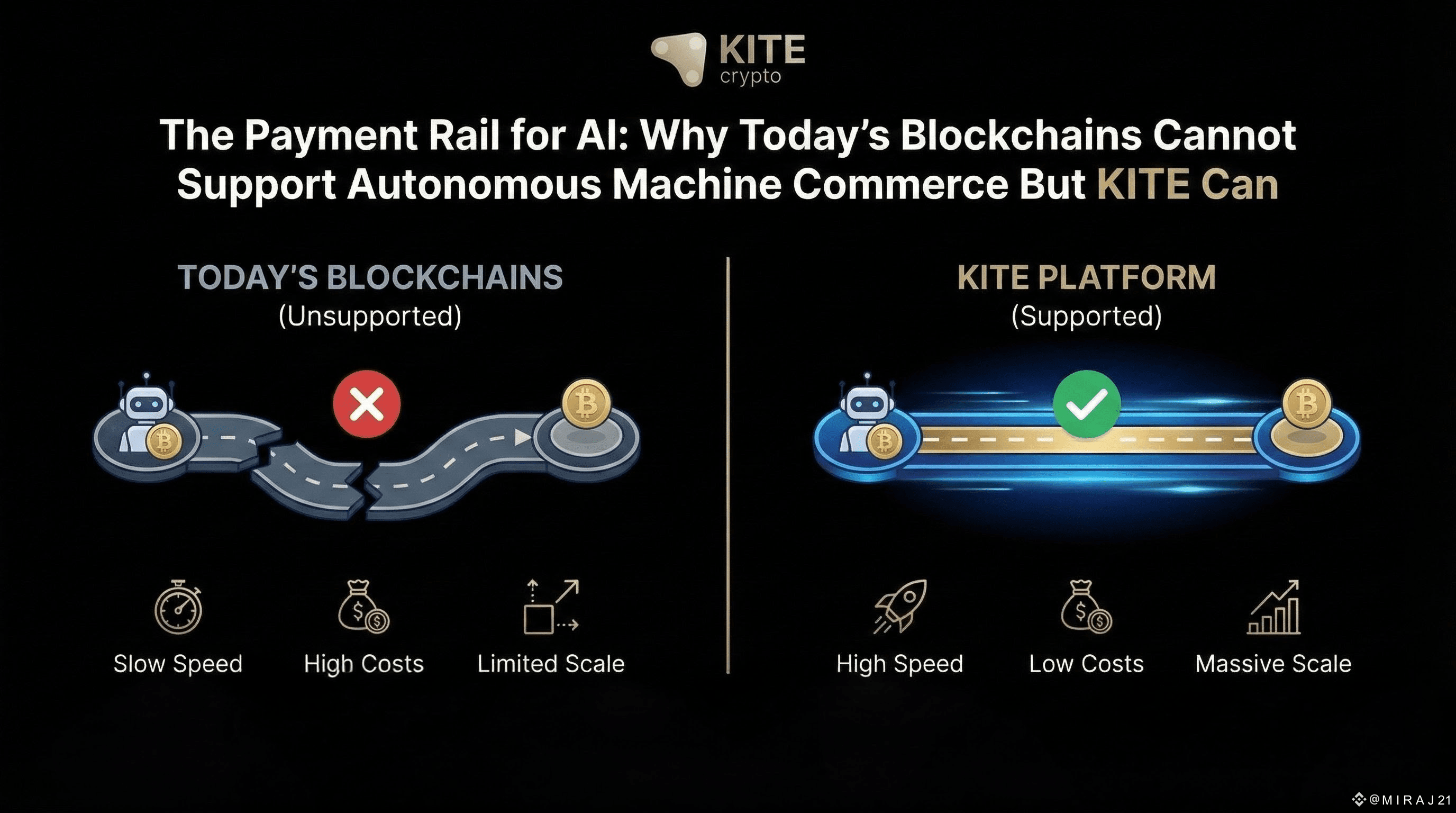
A fresh economic model is arising. One where devices conduct exchanges with devices. And the current blockchains are not designed for this.
AI systems are advancing from instruments to independent agents that can execute tasks manage resources and handle financial choices. However these agents are missing a skill: engaging in commercial activities. Conventional blockchains can hold value. They are incapable of supporting the flexible ongoing programmable payment mechanisms needed for autonomous transactions, between machines.
KITE is creating the payment rail. A monetary framework crafted exclusively for AI.
The majority of blockchains were created with transactions in mind rather than, for automated machine economies.
Human monetary actions are gradual, intentional and constrained by authorization. Blockchains mirror this:
blocks are completed every seconds or minutes
transactions need gas calculation and authorization of signature
payments take place intermittently not steadily
identity is connected to wallets of actions
expenditures cannot be limited through programming
Conversely AI functions, at machine velocity necessitating micro-transactions automated financial planning, conditional expenditures and intricate economic principles that conventional blockchains are unable to implement.
Self-governing agents require payment systems that comprehend intent, policy and risk. Beyond relying on signatures.
For a machine economy to operate participants need to be capable of:
execute payments without human triggers
follow spend policies encoded directly into their identity
obey budget limits and task-specific constraints
hire other agents on demand
purchase compute, data, or services programmatically
settle micro-transactions at high frequency
Conventional blockchains inherently lack these primitives.
KITE performs.
KITE’s payment framework starts with agent- wallets controlled by programmable rules.
Each AI agent is given an, on-chain wallet through which every financial transaction is routed managed by a policy engine that specifies the agents permissions and prohibitions. These limitations consist of:
maximum spend per task or per day
whitelisted counterparties
treasury rules for allocation and reserves
risk thresholds and emergency stops
compliance-aware restrictions
model-specific permissions for financial autonomy
This changes payments from human decisions, into organized rule-based financial activity.
Ongoing micro-transactions demand verification, within a fraction of a second. A capability that traditional chains lack.
Agents communicate continually:
A research representative purchases information.
A reasoning agent employs a summarization agent.
A trading agent compensates a sentiment model, for market indicators.
Such exchanges demand seamless and trustless transactions.
Traditional blockchains cause lags since they were designed to:
human-paced commerce
infrequent transactions
asynchronous settlement
manual signing workflows
KITE’s design focuses on customizable settlement specifically for machine-, to-machine trade.
Uncertainty in gas and fees prevents operations, on conventional blockchains.
Picture an AI agent conducting 10,000 micro-transactions every hour with each incurring gas fees. This violates:
budgeting
task predictability
execution determinism
revenue calculations
No independent system can depend on transaction fees.
KITE solves this issue by providing gasless or cost-predictable execution guaranteeing that agents operate loops, with consistency and accuracy.
When identity encodes regulations it transforms into a factor. KITE equips agents with this capability.
Conventional wallets are incapable of conveying:
spending permissions
risk models
task scopes
delegation logic
financial hierarchies
KITE considers identity as an economic entity with each agents actions governed by on-chain rules instead of, outside trust.
This guarantees secure autonomy. A condition, for machine economies.
Machine commerce demands that agents compensate agents. A feature that Web3 infrastructure has yet to accommodate.
A series designed for people presupposes:
each transaction is intentional
each signature is manual
each payment is discrete
But in machine commerce:
transactions cascade automatically
signatures follow policy guidelines
payments are processed nonstop
The design of KITE inherently enables commerce between agents.
This is the component required to transform AI models into economic agents rather than just API interfaces.
The Instruction Layer generates demand by allowing agents to market skills and purchase services.
Payments are relevant when there is an item or service to be paid.
KITE’s Instruction Layer transforms AI functionalities into services. The economic base of self-governing labor markets:
inference microservices
research outputs
data retrieval
workflow tasks
compute outsourcing
specialized reasoning modules
Agents generate income by completing jobs, for others and subsequently channel that income into additional resources. This illustrates the concept of a self-sustaining digital economy.
Reliable rule-based payments enable firms to operate agent teams.
Organizations need:
transaction transparency
risk guardrails
compliance enforcement
treasury observability
audit-friendly payment logic
KITE guarantees that each agent functions, within boundaries providing businesses assurance to implement autonomous systems that manage expenses prudently.
This is the stage that conventional blockchains never expected.
Economic independence shapes the future of AI.. Kite represents the inaugural blockchain created for this purpose.
Once AI agents can:
earn revenue
pay for resources
contract other agents
manage capital
adhere to encrypted regulations
participate in marketplaces
they transform into self-supporting entities.
This opens up a realm of efficiency. One in which intelligence supports its own functioning financially.
KITE is not simply a blockchain.
It is the payment infrastructure for autonomous intelligence.

