
The real trader Pickle Cat published an article about the 'high-frequency day trading scam,' gaining attention and readership over a sluggish weekend market.
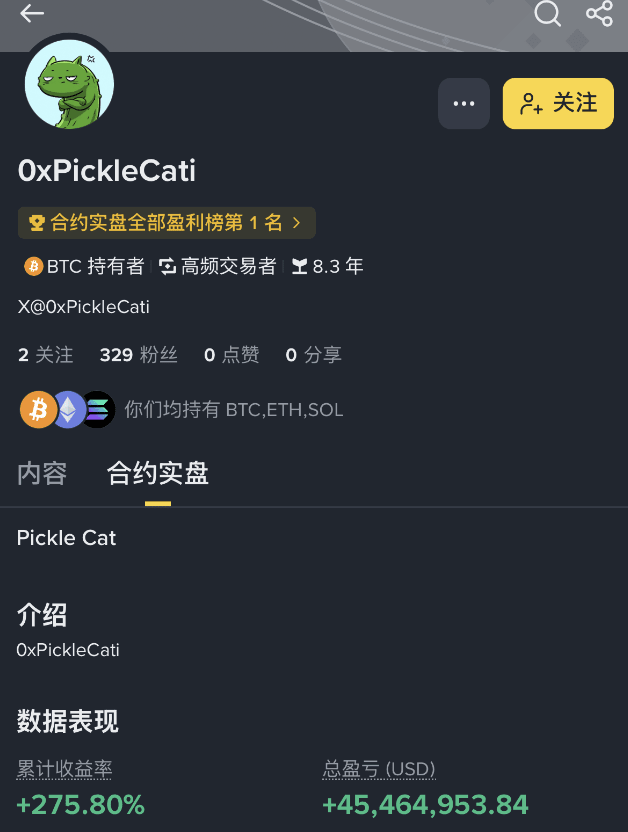
Pickle Cat is currently the top trader on the 'Binance Contract Real Trading Rankings,' with total profits and losses exceeding 45 million USD. His article explains in detail why retail investors should not engage in high-frequency day trading; retail day trading has too many flaws and shortcomings compared to institutional day trading. In reality, the trading strategy you believe in and execute may not consistently make you money and may not be suitable for you. Often, persisting in high-frequency day trading results in losing all your chips; this model may not yield better results than seizing the market to make a big move. Odaily Planet Daily has compiled it as follows:
If you want to stop losing money in cryptocurrency, the first thing you need to do is stop intraday trading, because retail intraday trading is structurally a scam.
The article is a bit long, but if you're willing to spend 2 minutes reading it, I swear you'll thank me years later.
I've been trading since my teens; I once felt like 'Batman' when I made profits from trading, and I also collapsed due to failures, and I’m still trying to recover. I've tried every trading strategy available to retail traders. I even did intraday trading for a year, thinking it would save me, but ultimately failed, to the point where every time I think about it, it feels like a knife in my heart. My win-loss ratio was terrible; how can I describe it? I helped my grandma set up automatic BTC purchases, and she earned more money than I did.
Later, I became a low-frequency swing trader, rarely changing positions casually; after making a profit, I would completely exit and pause trading for a while. At that time, my life started to get better, and everything began to fall into place.
I am not a saint; I wrote this article to save that young, foolish, naive, impulsive version of myself.
First of all, as a retail trader engaging in intraday high-frequency trading, you have no real informational advantage (no real order flow, no real liquidity map, no market maker positions, no execution advantage, nothing at all). You can manage a few intraday trades each quarter. But what about doing more than 10 trades a week? Even if you possess the world's strongest 'discipline' and 'risk management' skills, the mathematics will still lead you to ruin.
Retail traders fail not because they have never made a profit, but because they have never stopped trading, and the ultimate result of high-frequency trading is loss or even bankruptcy. This is exactly why I set up a punishment mechanism for myself to prevent exceeding quarterly trading limits.
Every significant loss I've experienced was due to continuing to trade after obtaining high returns instead of cutting losses in time.
Every time I've made a big gain (and actually held onto the funds for a long time) was because I captured a major market movement and calmly responded to it.
This pattern is obvious; winning does not mean you suddenly made a lot of money. It means keeping that money and not losing it again next year.
I saw a 14-year-old kid on TikTok calling himself an intraday trader, drawing lines on TradingView, thinking that by buying a course from a guru or joining Discord, he had acquired some executable trading system for each day. It disgusts me; I wish they knew this is gambling.
I don't care; at least they realized the essence of the game, but the scale of this intraday trading is larger than the dropshipping wave of 2016 and 2017, and we all know the outcome of madness.
People underestimate the difficulty of trading but greatly overestimate their abilities.
The problem is not just about mathematics. In fact, the more you trade, the fewer stop losses you set, and the harder it becomes to achieve consistent profitability.
But the real problem is that young retail traders genuinely believe that as long as they practice 'discipline' and 'risk management,' they are not completely gambling. They think intraday trading is a 'skill' that can be executed like daily life. This logic applies not only to cryptocurrency intraday trading but also to the U.S. stock market and basically all markets; intraday high-frequency trading only works for institutions. For example, in the U.S. stock market:
Do you know what institutional traders don't even look at? That's candlestick charts and TradingView; they have data on Bloomberg terminals that retail traders can never access.
Of course, you know that. But kids aged 14 to 18 don't know this; they think the indicators they use are the same as all traders are using. This is the real danger.
If you know you are gambling, at least deep down you will know when to walk away, but once you believe this is a 'system,' you will never stop. You keep trading until the market drains you.
It's really like a disguised casino. When you walk into Las Vegas or Macau, you clearly know what kind of place you are entering; you see lights, gambling tables, and dealers, and your brain knows this is gambling. But today's intraday high-frequency trading is actually a casino disguised as a coffee shop.
When novice traders come in, they think they are here to 'learn a skill,' but they don't realize they are just sitting at a specially designed gambling table meant to slowly drain their funds. So they won't stop.
This is where the real tragedy lies. It's not failure. It's that they believe they are not gambling; this mindset keeps them going until they lose everything.
And those retail traders you see who seem to be 'profiting a lot' (like me), to be honest, most of them just caught a big market movement. They got lucky at the right time, plus enough lessons from previous failures that taught them how to take profits. Even so, this small portion represents less than 1% of all retail traders.

Making money through trading is not difficult; holding onto profits is incredibly challenging.


