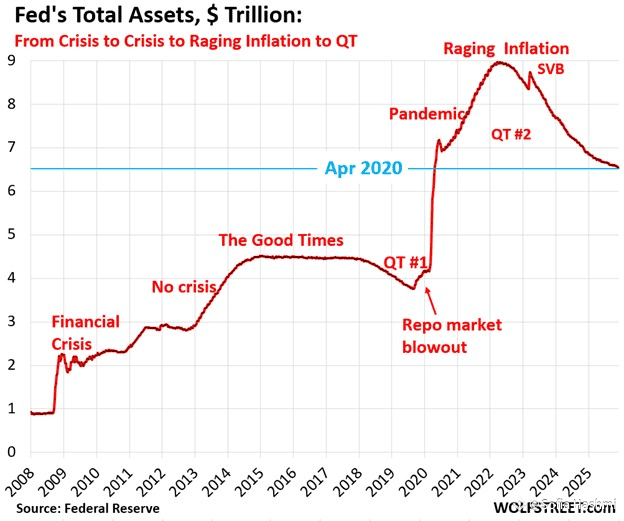
The Federal Reserve’s balance sheet dropped by $37 billion in November, falling to $6.53 trillion, its lowest level since April 2020. Over the past three years and five months, the Fed has been reducing its assets through a process called quantitative tightening (QT). In total, it has cut $2.43 trillion, which is about 27%, and this basically unwound half of the $4.81 trillion that was added during the pandemic stimulus period.
Treasury securities also continued to shrink, dropping by $4 billion in November to $4.19 trillion, another low not seen since mid-2020. Since the peak in June 2022, the Fed has reduced these securities by $1.58 trillion about 27.4%. Mortgage-backed securities saw a big drop too, falling by $16 billion last month to $2.05 trillion, the lowest since late 2020. Altogether, the Fed is clearly winding down its crisis-era support, and now QT is officially over.
With QT ending, many people are watching President Donald Trump’s next move. Trump has been vocal about reshaping U.S. monetary policy and pushing for stronger economic growth. Analysts expect him to pressure the Fed for lower rates or faster action to boost markets, especially now that QT has stopped. His response could influence how quickly the U.S. shifts from tightening to a new phase of economic strategy. $MDT $GLMR $2Z