
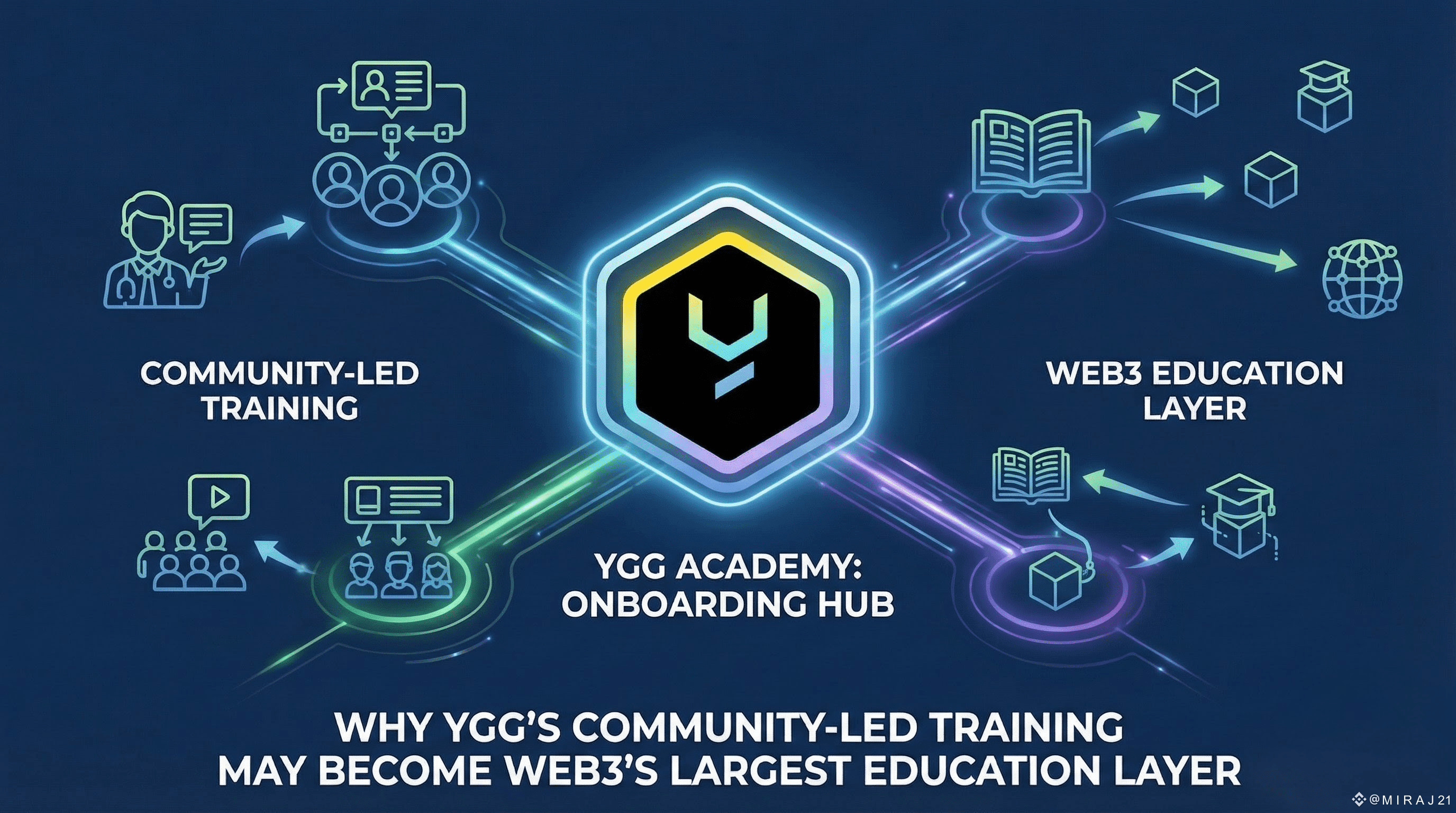
 Each technological transformation generates educational needs. And the main obstacle, for Web3 is not the infrastructure but the process of onboarding.
Blockchains, wallets, on-chain identity, GameFi economies and decentralized governance all demand a degree of literacy that countless newcomers have yet to attain. Education is the limiting factor. In its absence adoption stalls.
Yield Guild Games (YGG) has discreetly developed one of the educational frameworks in Web3: a community-driven training and onboarding platform that converts players into economically engaged, on-chain users on an international level.
While most ecosystems focus on educating via documentation YGG emphasizes learning through involvement.
Than offering static tutorials or passive learning resources YGG employs experiential training:
guided gameplay
community mentorship
quest-based progression
peer-to-peer knowledge sharing
hands-on experimentation with Web3 tools
This forms a cycle of learning where users gain hands-on blockchain expertise as they actively engage in the tasks they are studying.
The guild framework inherently develops into a structure as it brings individuals together through intentional cooperation.
Guilds, in gaming have consistently functioned as groups that exchange tactics, educate players and organize team quests. YGG carries on this legacy within the realm of Web3:
teaching wallet security
demonstrating how to earn on-chain rewards
explaining governance structures
guiding users through new games and economies
coaching them to become productive participants
The outcome is a learning setting that comes across as natural, interactive and highly captivating. Than scholarly.
SubDAOs expand this grassroots education model into a global, localized network.
Each YGG SubDAO functions like a regional learning hub tailored to its community:
language-specific guides
culturally relevant mentorship
onboarding events
skill-based training programs
regionally adapted quest designs
This distributed framework guarantees that Web3 education is not confined solely to English-speaking or dominant areas.
It is culturally reachable, on a scale.
Questing transforms into a framework. Converting learning into a quantifiable blockchain-based advancement system.
YGG’s questing infrastructure is not just a gameplay mechanic. It is an education protocol:
quests instruct players, on how to engage with a game
complex missions strengthen expertise
achievement badges indicate advancement
completion information serves as evidence of ability
Credentials gathered across games combine to form the players identity
This establishes an educational trajectory spanning various ecosystems something that Web3 has not experienced until now.
Training driven by the community surpasses instruction since it reflects the behavior of real users.
The majority of beginners acquire knowledge not through manuals. Through:
mentors
streamers
community leaders
guild captains
peer groups
collaborative missions
YGG transforms this action into an expandable peer education framework allowing large-scale onboarding without the need, for hierarchical oversight.
YGG’s training program also serves as a workforce development initiative, for the growing labor market.
With the advancement of GameFi and on-chain economies there is a need, for:
skilled players
community moderators
strategy leaders
content creators
event organizers
economic contributors
YGG is currently developing this talent stream. Essentially transforming into a training framework, for Web3.
Standardization enables YGG’s framework to be duplicated throughout different ecosystems.
Developers obtain access, to:
modular onboarding templates
quest-based teaching modules
scalable player funnels
unified training logic
analytics showing user progress
data signals for retention and skill mastery
This enables games and dApps to connect directly with YGG’s framework minimizing the obstacles and expenses involved in recruiting new users.
Education can be quantified when instruction is conducted on-chain.
YGG’s platform generates data including:
completion rates
time-to-competency
user retention curves
performance tiers
contribution scores
cross-ecosystem mobility
This generates a graph that no centralized learning platform can rival. One grounded not in examinations but in economic and gameplay actions.
The impact of scaling is enormous: as YGG educates players its learning network grows more robust.
Each novice student has the potential to be a mentor, down the line.
Each SubDAO transforms into a training center.
Each quest transforms into an instructional unit.
Each game incorporated into the platform broadens the curriculum.
This is the cycle of community-driven education. Where the ability to teach grows, alongside the community.
As Web3 approaches adoption the pace of onboarding will decide which ecosystems succeed.
Projects featuring the learning curves will draw the largest number of users.
Games supported by the well-prepared communities will keep the highest number of players.
Networks comprising the skilled contributors will produce the most robust economies.
YGG is developing the framework to speed up all three.
In the end, YGG’s greatest product may not be guilds or players but knowledge.
Knowledge that is:
accessible
peer-delivered
rewarded
measurable
verifiable
globally distributed
In a future where billions are set to join Web3 within the ten years the greatest edge, in competition isn't funding, technology or media. It is knowledge.
YGG is set to evolve into the decentralized education framework, within the whole sector.
Adoption doesn’t happen when technology matures it happens when education scales. Community-led learning is the engine that turns innovation into global participation.
