The recently popular smart money leader, Teacher Cat, after reading Teacher Cat's article about 'retail investors being part of a structural scam,' I found it very similar to my style, both being conservative players.
What he wrote is not a strategy, but a bloody truth. Especially that sentence:
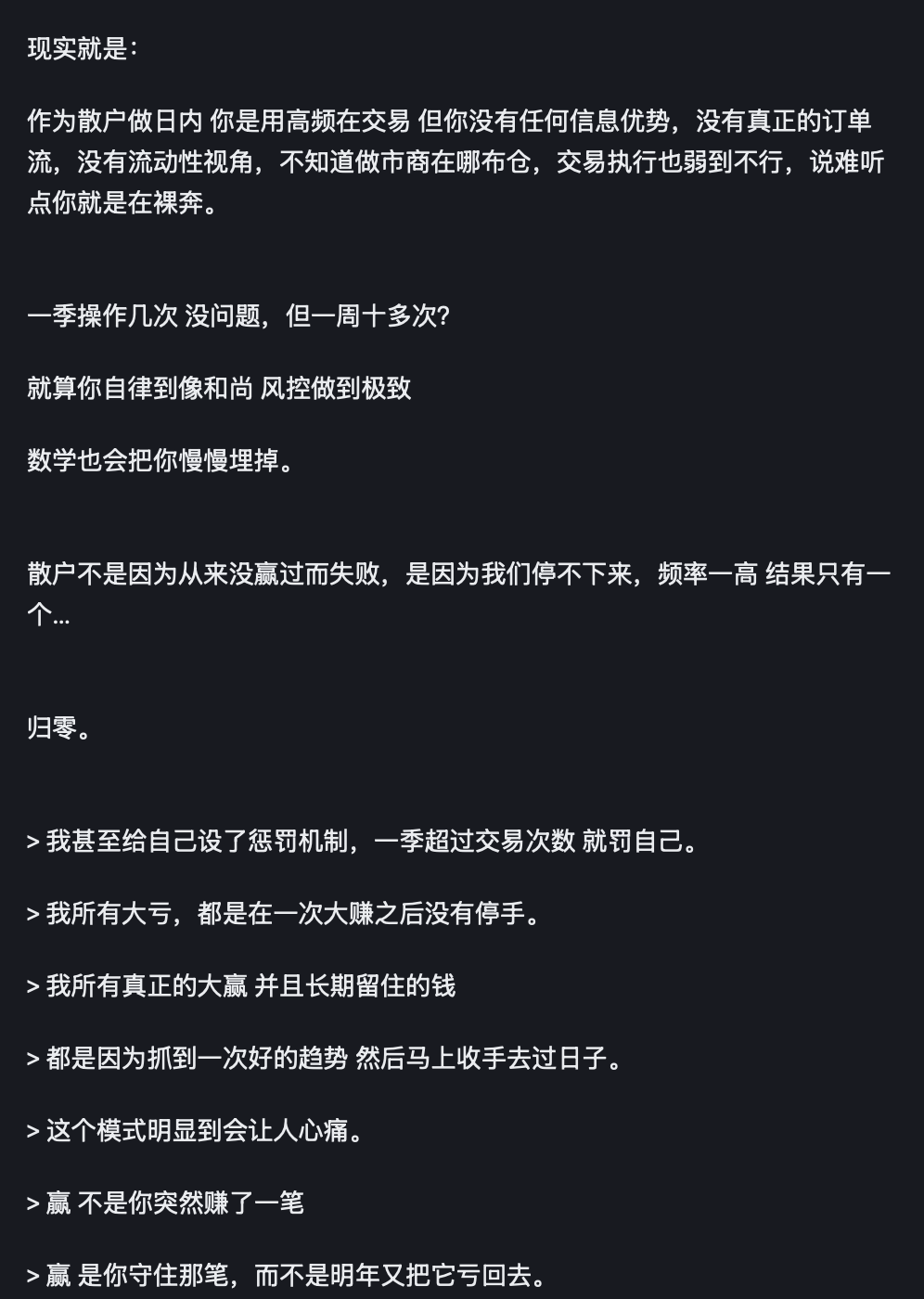
"Retail investors do not fail because they have never won, but because we cannot stop."
I reviewed my own experiences and those of people around me and discovered a terrifying pattern:
All the money made quickly will almost always be lost back even faster. Not because of poor skills, but precisely because after 'winning once,' the illusion of 'I can control the market' reaches its peak, leading to frequent operations until profits are given back or even principal losses occur.
The "big money" that truly changes lives comes from "seizing an opportunity once and then completely leaving". It could be a trend waited for a month or two, or a target that has been lurking for a long time, but after earning it, immediately withdraw part to improve life, rather than thinking about "compounding to double".
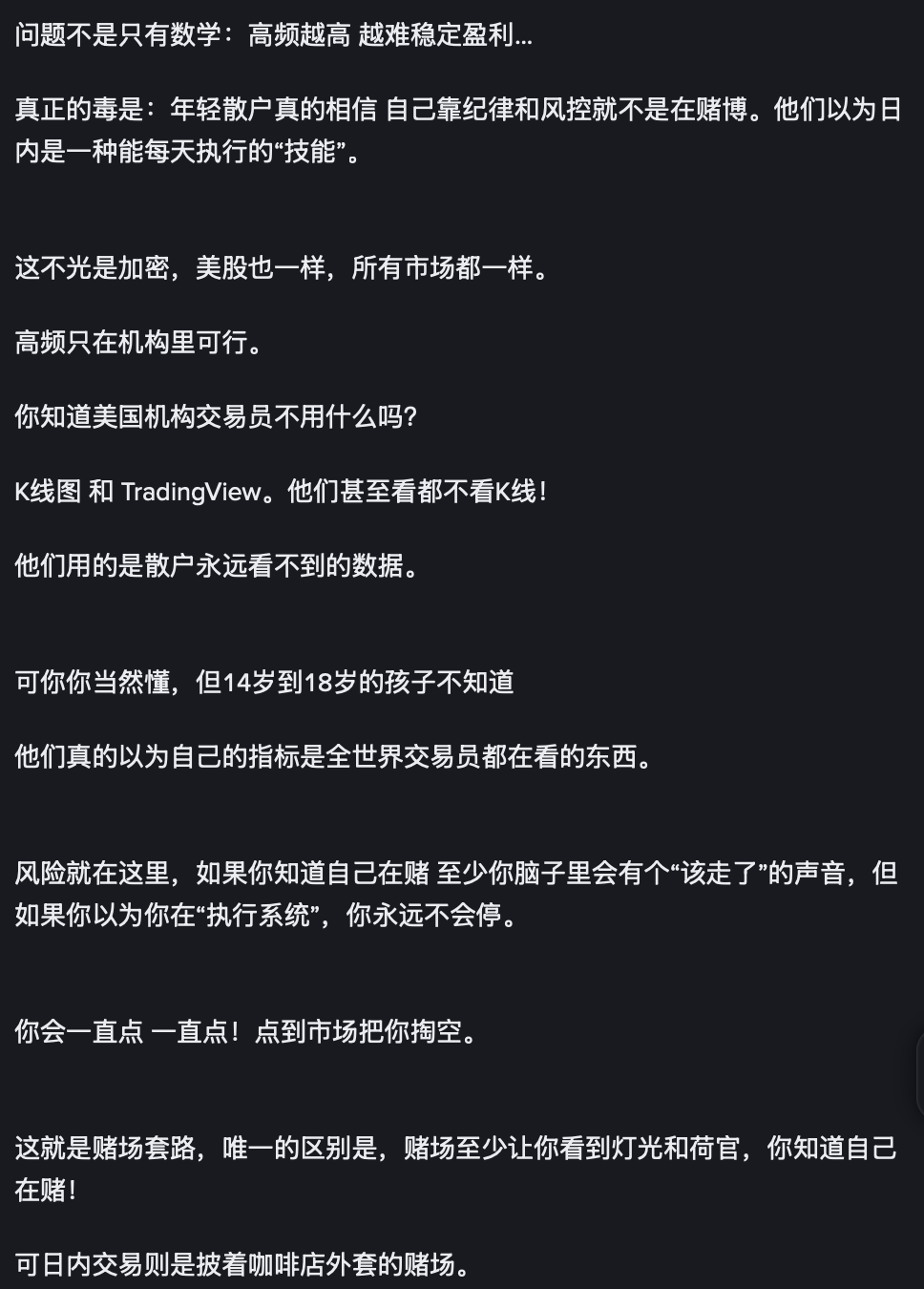
What we think is "technology" may just be a "bait" that the market temporarily hasn't harvested. Looking at candlesticks, drawing trend lines, using various indicators, we feel we are analyzing. But institutions see order flows and liquidity distributions that we can never see. It's like at the poker table, you think you are counting cards, but your opponent can directly see your hole cards.
What chills me the most is what he called the "skill illusion".
Gambler knows they are gambling, so when they win, they want to leave.
But retail investors, after learning some "techniques", think they have mastered a system that can make stable profits every day, so they keep trading until the system completely fails—and by then, they have already been severely injured.
This is not unique to crypto; it's a common problem in all markets.
US stocks, futures, foreign exchange... as long as it is a place with high volatility and high liquidity, the same script is being played out.
The antidote given by Teacher Cat is actually just one sentence: Be a sniper with extremely low frequency, not high-frequency cannon fodder.
Treat the market as an opportunity that only occasionally appears and is worth going all out for. Most of the time, you should stay away from the screen, read books, exercise, and live well.
Making money is for living, but being addicted to trading will ruin your life.
I suggest all friends who are still frequently trading, especially doing day trading and high-frequency trading, to calm down and read this three times.
It may not help you in an emergency, but it might save your life.
Of course, I know most people will say they have little capital and can only make small bets.
A core and realistic dilemma—having little capital, thus craving to double it quickly.
This mentality of "wanting to make small bets for big gains" is not wrong; it is even the driving force that propels many people into the market. But the problem is that this choice determines the outcome for the vast majority.
Let's analyze this dilemma:
1. Why do "small bets for big gains" often choose "day trading/high frequency"?
Psychologically: With little capital, you feel that "long-term investment" is too slow and you can't wait. You believe there are opportunities every day and compounding happens quickly.
Cognitively: Misunderstanding that "trading frequency" equals "speed of profit". Thinking that the harder you work (the more frequently you trade), the higher the returns.
On the threshold: It seems the easiest to get started—open an account, have some capital, and just click a few times with the mouse.
2. The cruel reality: The less capital you have, the less likely it is to succeed in "high-frequency battles".
Mathematical pressure: Having little capital means a very low margin for error. The frictional costs (transaction fees, slippage) generated by high-frequency trading will consume a higher percentage of your capital. You may need to trade many times consecutively to cover the cost of one mistake, and one big mistake could wipe you out.
Resource pressure: As mentioned earlier, high-frequency trading is the battlefield of institutions. You look at free candlestick charts on a mobile app, while your opponents use satellites, server clusters, and paid data. This is not a competition in the same dimension.
Distorted mentality: When you have little capital, every penny's fluctuation affects your emotions. The pain of losses is amplified, and the greed from profits is more intense. Under the pressure of "must make money quickly", discipline and rationality are the first things to be abandoned.
3. So where is the real way out for retail investors with less capital? (possibly counterintuitive)
The answer is: Give up "quickness" and embrace a "slow but certain" model, using limited bullets on the knife's edge.
This sounds contradictory, but please think:
Path One: Extreme focus and waiting (a mini version of Teacher Cat's path)
Strategy: Give up all small opportunities. Only study a few macro trends that you truly understand (for example: the cycle of a certain industry, a certain favorable policy, or the extreme undervaluation of a leading asset).
Action: Invest your precious and limited capital like a sniper, putting it all on the most certain moment (for example, when the market is extremely fearful, and prices drop to unbelievable levels).
Core: Use "time" and "depth of research" to make up for the lack of capital. You cannot outperform institutions in capital and information, but you can outperform 99% of retail investors in patience and focus.
Path Two: Completely transform "trading" into "incremental accumulation"
Cognitive shift: Acknowledge your current capital and that the probability of quickly turning it around through market games is very low. The primary goal is not to "double in the market" but to "how to enlarge the capital."
Action:
Increase main income: Use the time you spend studying candlesticks to improve your work skills and earn more cash flow.
Forced savings/regular investments: Allocate part of your new income to long-term upward assets like Bitcoin or index funds with a "throw away the keys" mindset. Your grandmother's way is, after all, the simplest path.
Only take action during extreme bubbles: After a bull market or a major crash that occurs once every few years, invest the accumulated capital and then wait for the next cycle.
Core: Treat the market as a "magnifier" of wealth, not a "creator". First, create a sufficiently large "base" through off-market efforts, and then the market can help you amplify it.
Path Three: Set clear "bet limits" and "exit mechanisms"
If you can't control the impulse to "take a gamble", then please institutionalize it:
Set entertainment funds: For example, always use only 5% of your total assets for day trading or high-risk speculation. Psychologically, consider this money already lost.
Set goals and bottom lines: This 5% capital should immediately withdraw profits after doubling; continue playing with the principal; if it loses 50%, stop for 3 months.
Accept the outcome: Understand that this is the "ticket" paid for dopamine and possibilities. Winning is a surprise, losing is expected.
Finally, the most critical mindset reshaping
"Having little capital" is an objective fact, but it should not be a reason for you to choose a "suicidal strategy".
Precisely because you have less capital and cannot afford to lose, you should choose strategies with high win rates and long cycles, even if they seem slow.
The real "small bets for big gains" is not about the fluctuations in a few days, but about:
Use your understanding of cycles to strive for a trend over the next few years.
Use your ability to make money off-market to strive for exponential growth after capital accumulation.
Use your extraordinary patience to strive for opportunities that the vast majority of people miss due to impatience.
This path is not sexy, there’s no thrill of clicking the mouse every day, but it is the only way to gradually grow "small capital" into "large capital" while avoiding being completely harvested.
Remember: The market is never short of opportunities; what is lacking is players who live long enough and can recognize the truly suitable opportunities for themselves. First, survive, and your capital will naturally grow slowly.
In conclusion, one last sentence:
"Winning is not about suddenly making a profit. Winning is about keeping that profit and not losing it back next year."
Let’s encourage each other.