

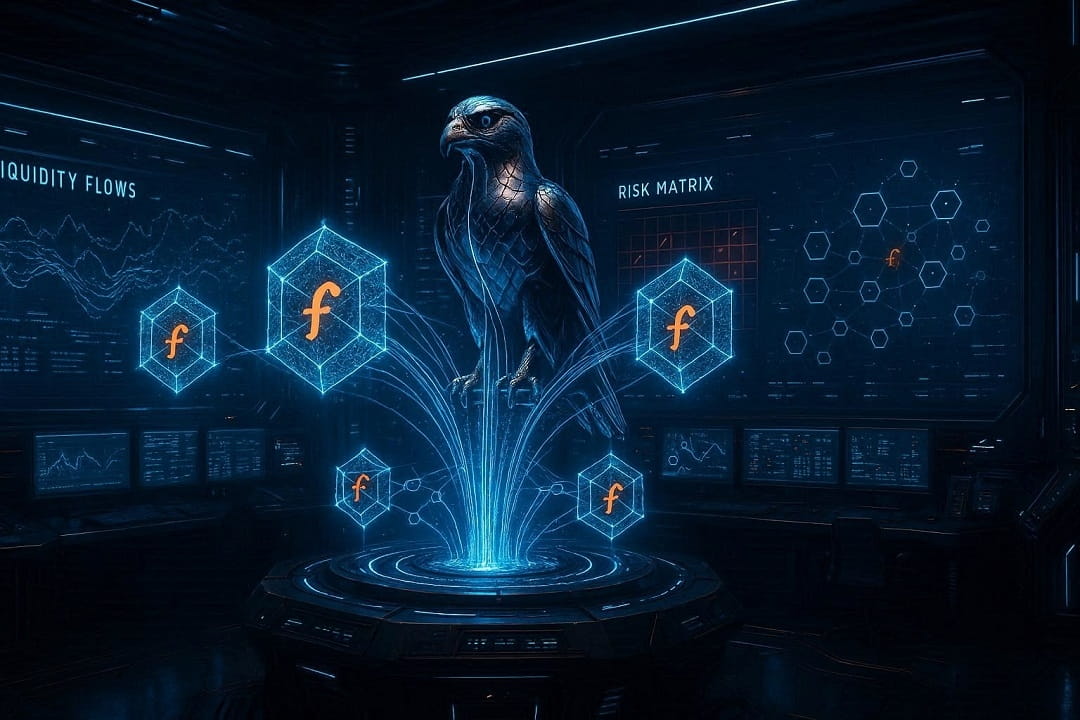
In a market where speed surpasses verification and systems become more complex than their own users, Falcon Finance emerges as an algorithmic trust layer designed to uphold the new DeFi security standard.
In 2025, the DeFi ecosystem does not face its greatest problem in rates, liquidity, or competition between chains. The real dilemma is the erosion of trust. Every hack, every compromised bridge, every protocol that collapses due to an oracle failure or a low-probability exploit reshapes the perception of risk. It is no longer enough to offer yield. It is no longer sufficient to build a new market. What users seek today is a system that does not fail when the market fails.
In this context, Falcon Finance emerges with a clear and compelling thesis:
The next generation of protocols will not be measured by TVL, but by the ability to sustain algorithmic trust in volatile environments.
This article explores why Falcon Finance positions itself as a key player in this transition, how its architecture minimizes single points of failure, and why its design directly addresses the systemic risk dominating current DeFi.
The silent collapse of trust in DeFi
Unlike previous cycles, the deterioration of trust in 2025 is not linked to price bubbles. It arises from accumulated technical complexity.
Factors deepening current distrust include:
Vulnerable multisig bridges, still responsible for 45% of losses in cross-chain exploits.
Excessive dependence on isolated oracles, where a seconds' error can liquidate millions.
Saturated L2 networks, generating delays and temporal divergences in prices.
Rigid economic models, incapable of adjusting to sudden liquidity shocks.
The user no longer fears a bear market: they fear being liquidated by a bug, affected by malicious MEV, or trapped in a chain with unforeseen congestion.
In this scenario, security ceased to be a technical attribute and became an emotional value. Users want protocols that think for them, that anticipate risks and operate as if every second were an extreme scenario.
Falcon Finance's approach: security as architecture, not as a promise
Unlike most protocols that add security modules on top of already existing structures, Falcon Finance was built under a structural principle:
“Every system is as secure as its cross-chain coordination layer.”
Its design pillars include:
Orchestration between chains with redundant monitoring to avoid discrepancies between states.
Automatic liquidity redistribution mechanisms when a network shows anomalies or congestion.
Predictive models based on market signals that adjust risk before an event becomes systemic.
Continuous self-verification, reducing dependence on third parties even in oracles.
This approach defines something that few projects understand well: security is not added; it is designed from the ground up.
Predictive risk: the tool that separates Falcon Finance from the rest
If 2020–2023 were years of expansion and experimentation, 2024–2025 mark the era of quantified risk.
Falcon Finance's innovation lies in its ability to detect fragility before fragility translates into losses.
The system monitors:
Inter-chain volatility in micro-intervals.
Liquidity tensions between competing rollups.
Accumulated risk in specific oracles.
Early signs of price manipulation.
Deviations between execution and available liquidity.
This enables the activation of algorithmic responses in real-time, such as:
Automatic exposure adjustments.
Temporary liquidity redirection.
Preventive freezes in manipulation environments.
Reallocation between execution routes.
It is not about reacting faster.
It is about reacting before the risk exists from the user's perspective.
“Algorithmic trust” as the new industry standard
Decentralized finance faces a dilemma: how to maintain a global and permissionless ecosystem where risks multiply as innovation multiplies?
Falcon Finance proposes a response: automated trust models that operate as a metacognitive layer of the system.
This implies:
making data-driven decisions, not based on emotional cycles of the market.
Apply universal rules without favoritism or exceptions.
Protect the user even if they do not understand all the technical complexity.
Maintain cross-chain coherence even when chains are not coherent with each other.
Advantages over the traditional model:
Less likelihood of erroneous liquidations.
Lower exposure to structural exploits.
Better coverage in high volatility environments.
Higher risk-adjusted returns (RAR).
A long-term vision: DeFi as infrastructure, not as an experiment
Falcon Finance understands that real competition is not against other DeFi protocols.
The real competition is against the uncertainty of the average user, against the feeling that “everything can break at any moment.”
That is why its systemic vision is built on three pillars:
Stable and verifiable interoperability.
Risk as a dynamic variable, not as a fixed rate.
Liquidity that moves like a living organism, not like a static balance.
And its roadmap aims at:
Integration with new specific-purpose L2s.
Improvements in predictive monitoring.
Deepening of the cross-chain liquidity engine.
Expansion of tools for institutions.
Conclusion
The future of DeFi will not be written in terms of TVL, APY, or hype.
It will be written in terms of trust, technical coherence, and architectures capable of sustaining real-time global markets.
Falcon Finance is not just another protocol: it is a proposal to redefine the user-risk relationship, an infrastructure designed to withstand stressful environments, and a security model that does not depend on human guardians but on algorithmic principles.
In an ecosystem where fragility is the norm, Falcon Finance proposes a rare alternative: stability based on design, not on luck.
@Falcon Finance $FF #FalconFinance #falconfinance
⚠️ Disclaimer: This content is for educational and informational purposes only. It does not constitute financial advice. Do your own research (DYOR).

