
The essence of finance is the cross-temporal allocation of value, and its core foundation is trust. Traditional finance establishes this trust through centralized intermediaries such as banks, exchanges, and rating agencies. The birth of blockchain has, for the first time, replaced some intermediaries with technology (cryptography, consensus mechanisms), achieving decentralized and trustable transfer of value.
However, we quickly discovered a paradox: a system that can ensure ledger consistency without relying on intermediaries, yet is extremely dependent on intermediaries to obtain information outside of the ledger (real-world data). This is the 'oracle problem.' It has become the biggest bottleneck for blockchain to transition from a 'value transfer network' to a 'global trusted computing platform.'
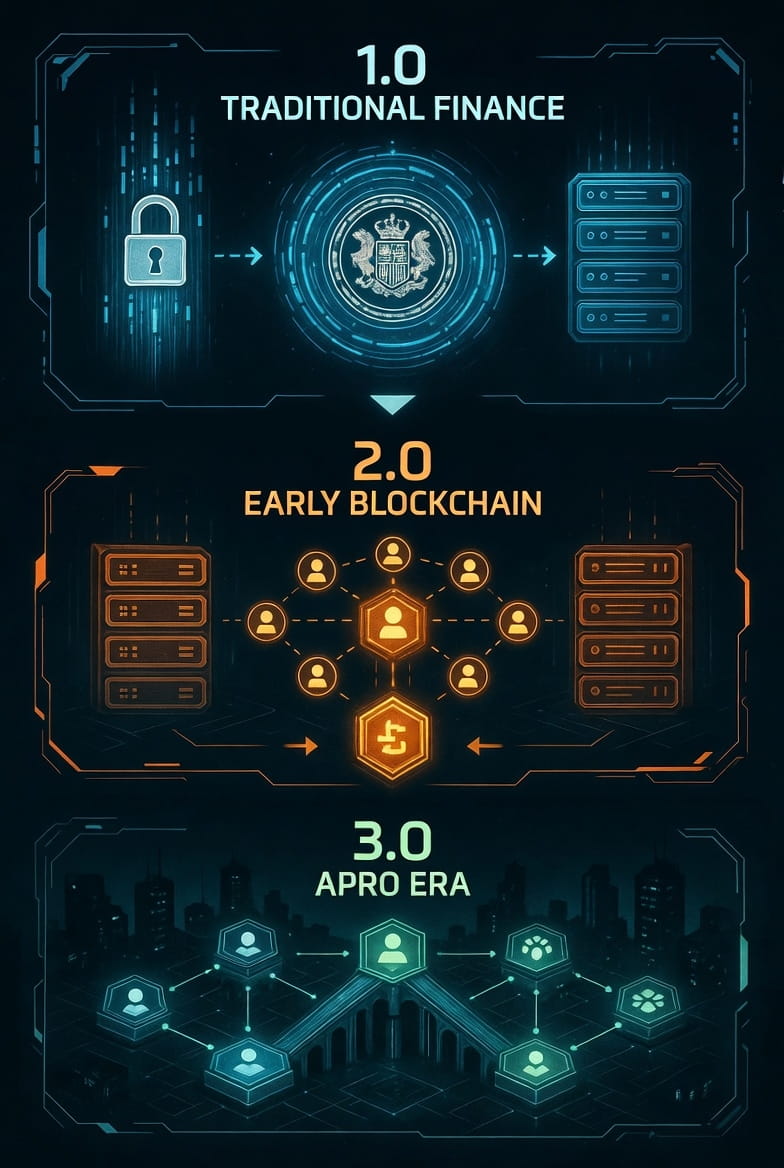
The shortcomings of early solutions are obvious:
Centralized oracle: single point of failure, contradicting the spirit of blockchain.
Simple multi-node oracle: vulnerable to witch attacks or collusion among nodes.
Data latency and cost: storing and processing large amounts of data on-chain is expensive and inefficient.
#APRO represents a systematic engineering-level solution to this core bottleneck. What it attempts to build is not a simple data transporter, but an underlying network of 'verifiable facts'.
Its breakthrough point lies in:
Addressing 'How to trust'? - Dual-layer network and verifiable randomness. The first layer executes, the second layer verifies, forming a balance. Introducing verifiable randomness (VRF) to randomly assign tasks and select nodes makes it difficult for attackers to predict and target, greatly increasing the cost of wrongdoing. This applies the wisdom of blockchain consensus to the data layer.
Addressing 'What to trust'? - AI-enhanced data integrity. Traditional oracles assume data sources are 'true' and only handle transportation. APRO takes a step forward by using AI to conduct behavioral analysis on the data sources themselves and the transmission process, attempting to identify and filter out fraud and anomalies. This adds a layer of active defense before the data is on-chain.
Addressing 'Where to use' and 'Cost'? - Full-chain coverage and deep integration. Supports over 40 chains, which is not only about quantity, but also provides a 'unified language' for a fragmented ecosystem. Deep collaboration with blockchain infrastructure to optimize performance and cost indicates that it considers the feasibility of large-scale commercial use from the system design perspective, not just as a laboratory product.
From a more macro perspective, $AT projects are doing is extending 'trust' from the value level (Token) to the information level (Data). It aims to ensure that smart contracts not only have 'immutable hands' but also 'keen eyes'.
When stock prices, IoT sensor readings, commercial contract execution statuses... all these 'facts' can be trusted by the blockchain world in a decentralized and anti-fraud manner, DeFi will truly evolve into an open finance for all categories, games will have fair logic that cannot be cheated, and supply chain traceability will achieve dynamically trustworthy automation.
Therefore, the competition of @APRO Oracle goes far beyond the oracle track. It competes for the interface standards between the future blockchain world and the real world, which is a key puzzle piece in building the next-generation trusted internet. Its evolution is worth the continuous attention of every industry observer.


