
$XRP The possibility of a major structural shift within the U.S. financial system has become a focal point among digital-asset observers, including XRP enthusiasts.
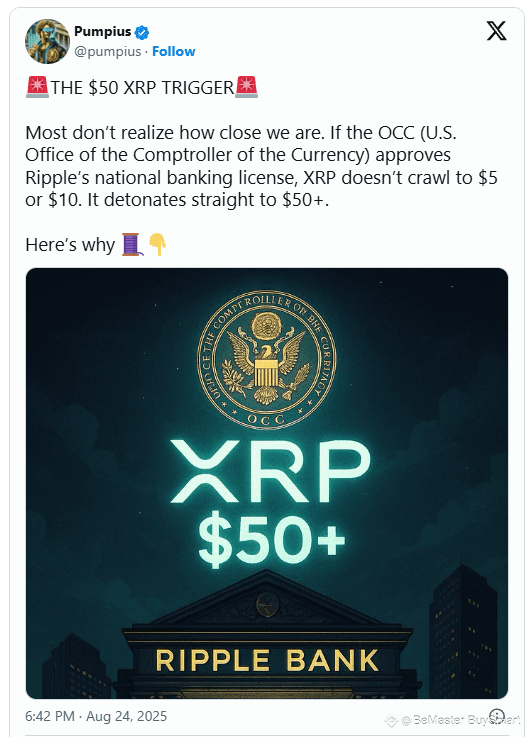
A recent analysis from crypto commentator Pumpius presents a detailed view of how Ripple’s pursuit of a national banking license could influence market dynamics, particularly for XRP.
Rather than offering broad speculation, the commentary outlines a regulatory and operational framework that, if approved, would position Ripple in alignment with some of the most established financial institutions in the United States.
👉Ripple’s Banking Ambition and Its Regulatory Weight
Pumpius highlights that Ripple is seeking a full national trust bank charter through the Office of the Comptroller of the Currency. This license is significant because it places an organization under the same regulatory authority that oversees major institutions such as JPMorgan, BNY Mellon, and Citi.
By pursuing this path, Ripple aims to operate with the same custody capabilities and institutional clearance mechanisms used by these large banks. The commentary highlights that this application is not limited to expanding its existing fintech activity; it represents an effort to enter the core of U.S. banking infrastructure.
👉Expanded Powers Under an OCC Charter
According to Pumpius, approval of the charter would permit Ripple to execute functions that extend far beyond standard fintech operations. These include direct access to Federal Reserve systems, the authority to custody digital and tokenized assets, and the capacity to issue stablecoins and facilitate settlement of securities.
The analysis emphasizes that a charter of this type would allow Ripple to operate without relying on intermediaries. In practical terms, this would enable financial institutions, investment firms, and other market participants to interact with Ripple as a primary channel into tokenized markets, rather than depending on multiple service providers.
👉XRP’s Role in Settlement and Liquidity
The commentary places strong emphasis on XRP’s position within this potential structure. Pumpius describes XRP as the settlement asset within the broader operational design, portraying it as the bridge that enables transactions across tokenized financial systems.
The discussion includes a quantitative point: global bank settlements amount to approximately six trillion dollars daily. Pumpius argues that even limited use of XRP within this volume could generate substantial demand relative to its fixed supply. This forms the basis of the claim that a price level of $50 would not be excessive but would adequately meet liquidity requirements.
👉Regulatory Context and Long-Term Positioning
Pumpius’s commentary suggests that the SEC lawsuit functioned as a delaying mechanism rather than an existential threat, ultimately concluding with the case closed and regulatory positioning improved. With this context in place, the analysis frames Ripple’s alignment with U.S. regulators as intentional preparation for deeper integration into the financial system.
Pumpius ultimately characterizes the potential approval of the OCC charter as a transformational step, marking a shift from Ripple’s role in the digital-asset sector to a position within the operational framework of U.S. finance.
🚀🚀🚀 FOLLOW BE_MASTER BUY_SMART 💰💰💰
Appreciate the work. 😍 Thank You. 👍 FOLLOW BeMaster BuySmart 🚀 TO FIND OUT MORE $$$$$ 🤩 BE MASTER BUY SMART 💰🤩
🚀🚀🚀 PLEASE CLICK FOLLOW BE MASTER BUY SMART - Thank You.
