
Under the global spotlight, the Trump administration in the United States recently released its latest National Security Strategy (NSS) report. This programmatic document aims to outline America's core interests and strategic priorities on the global stage in the future. However, what surprised and even shocked the entire cryptocurrency industry is that in this lengthy report, cryptocurrency and blockchain technology, which have been mentioned multiple times by the President himself, encountered a complete 'digital silence'—not mentioned at all.
This silence forms a stark contrast to the 'cryptocurrency-friendly' stance previously exhibited by President Trump and his administration, sparking widespread discussion in the crypto community and directly leading to fluctuations in market sentiment, with Bitcoin prices falling in response. What does the 'blank space' in this strategic document actually mean? Is it an unintentional oversight, or a well-considered strategic choice? This reveals the true views of Washington's decision-makers on this emerging field, as well as the subtle position of crypto assets in the global macroeconomic chessboard.
Slogans and reality
Looking back at Trump's various measures since taking office, he seems to have been trying to shape his image as the 'crypto president.' Part of the reason he may win the 2024 election is attributed to gaining the support of voters who expect a 'crypto-friendly government.' After taking office, the Trump administration indeed fulfilled a series of promises:
Policy push: He signed an executive order that revoked some of the previous administration's stringent regulatory policies and assisted in promoting the first federal-level stablecoin regulatory bill (GENIUS Act).
Institution establishment and bans: Established the 'Presidential Digital Asset Market Working Group' aimed at coordinating various departments' regulation of the crypto market, and explicitly signed an executive order banning the issuance of any form of U.S. central bank digital currency (CBDC).
Enforcement shift: Federal agencies changed their past approach, withdrawing multiple enforcement lawsuits against cryptocurrency companies, signaling a relatively relaxed atmosphere for industry development.
National reserves: The Trump administration announced the establishment of a 'Bitcoin National Strategic Reserve' with great fanfare, although its source is government-seized assets rather than newly purchased ones, the symbolic significance of this move is self-evident.
Not only that, Trump himself has repeatedly 'stood up' for cryptocurrency in public. He stated during an interview with CBS's (60 Minutes) that he does not want 'China to become the number one player in the crypto world' and boldly hopes to keep all Bitcoin mining activities within the U.S. Even Michael Ellis, the Deputy Director of the Central Intelligence Agency (CIA), emphasized this May that 'cryptocurrency is another area of technological competition, and we must ensure that the U.S. maintains an advantageous position over China and other adversaries.'
However, when everyone expects these statements and actions to be integrated into the national top-level strategy, the latest (National Security Strategy) report gives a silent answer. This disconnect between words and actions inevitably raises the question: what is the true positioning of cryptocurrency in the White House?
New strategic focus
In stark contrast to its silence in the crypto field, the NSS report explicitly lists artificial intelligence (AI), biotechnology (biotech), and quantum computing (quantum computing) as 'core and vital national interests' to maintain U.S. technological leadership.
The report clearly states: 'We hope to ensure that American technology and American standards—especially in the fields of artificial intelligence, biotechnology, and quantum computing—can lead the world forward.'
This statement clearly shows that, in the grand narrative of national security, the aforementioned three technologies are seen as strategic tools capable of reshaping the future global power structure, their importance can even be compared to nuclear deterrence. In contrast, cryptocurrency and blockchain technology are obviously not placed at the same strategic height. This may imply that, in the eyes of the senior Trump administration, cryptocurrency is more viewed as a financial asset or innovative tool, rather than a strategic technology that can directly enhance national core competitiveness.
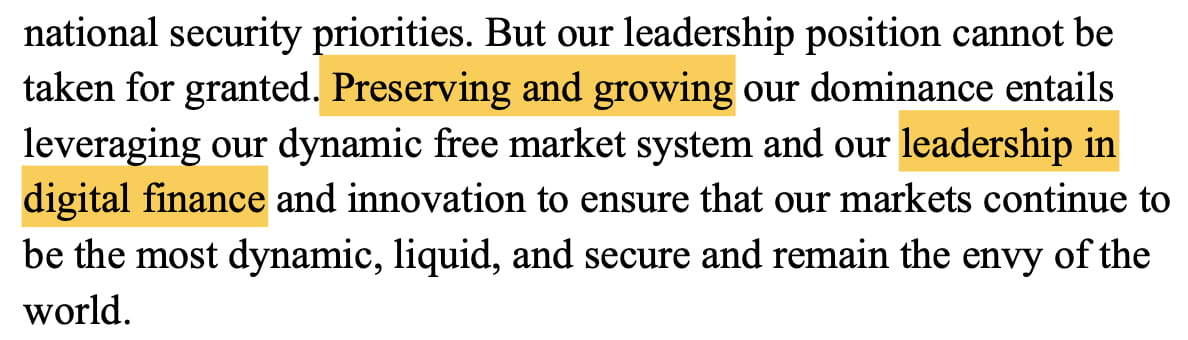
Of course, the report is not without clues. In one section, the document mentions that Trump hopes to maintain and grow 'America's dominance in the financial sector' by leveraging the US's 'leadership in digital finance and innovation' to ensure market liquidity and security. This ambiguous statement can be interpreted as an indirect hint towards cryptocurrency. However, this shift in wording is extremely crucial: it firmly confines the ownership of cryptocurrency within the 'financial' domain, managed by economic departments like the Treasury, rather than elevating it to the 'national security' level led by the Department of Defense and intelligence systems.
Is it a blessing or a curse
(National Security Strategy) release is like a giant stone thrown into a lake, immediately creating ripples in the financial market, with the crypto market being the first to bear the brunt. Bitcoin's price dropped sharply over the weekend following the document's release, breaking below the $90,000 mark at one point. The market's panic is mainly sourced from two levels:
Pessimistic interpretation of policy signals: The strategic document's 'disregard' for cryptocurrency has been interpreted by the market as a negative signal. This means that cryptocurrency has yet to gain strategic endorsement from the highest decision-making level in the U.S., and its future policy direction is filled with uncertainty. For a market highly dependent on policy expectations, this uncertainty itself is the biggest negative factor.
Deep-seated worries in the macro economy: The deeper reason lies in a seemingly unrelated request in the report. The NSS document calls for NATO allies to raise their defense spending as a percentage of GDP from the current 2% to 5%. Wall Street analysts quickly interpreted the chain reactions behind this: if allies want to achieve this goal, they will inevitably need to substantially increase government borrowing. This will raise the level of government debt globally, bringing sustained inflationary pressure.
For the crypto market closely watching the Fed's movements, this is undoubtedly bad news. The market had originally widely expected the Fed to announce an interest rate cut in this week's policy meeting (the CME's FedWatch tool shows that the market predicts an 88.5% probability of a 25 basis point rate cut), as rate cuts typically encourage funds to flow into high-risk assets like Bitcoin. However, if long-term military spending expansion leads to persistently high inflation, the Fed's room for rate cuts will be severely squeezed, potentially even forced to maintain high rates for a longer time. This macroeconomic pressure is the fundamental reason for the Bitcoin price correction.
Interestingly, some commentators have pointed out that excluding cryptocurrency from the core of national security may not be entirely a bad thing, and could even reflect a form of 'strategic ambiguity.'
Imagine if Bitcoin is officially classified as a 'national security asset,' then what follows may very well be military-level scrutiny and regulation. At that time, the free flow of crypto assets and their decentralized nature may be subjected to strong constraints from the Pentagon and intelligence agencies, which would be a disaster for a domain that advocates free markets.
Therefore, the current state of 'blank space' has allowed cryptocurrency to continue evolving on Wall Street's stage as a financial innovation product, rather than being dragged into the center of the geopolitical vortex, subject to the tight control of state machinery. From this perspective, the silence of the NSS may have preserved a valuable buffer zone for the wild growth of the crypto industry.
Conclusion
In summary, the Trump administration's latest (National Security Strategy) 'utterly ignores' cryptocurrency, which is a complex event filled with signals. It reveals the temperature difference between political slogans and actual strategies, indicating that despite cryptocurrency gaining unprecedented attention in the financial realm, it has yet to enter the 'core circle' of U.S. national security.
For investors, this undoubtedly sounds an alarm. This means the era of solely relying on a political figure's campaign slogans or verbal commitments to judge market trends may be over. The fate of crypto assets is increasingly synchronized with the pulse of the global macroeconomy—whether it is NATO's military spending bills, the Fed's interest rate decisions, or inflation data from major economies.
As the arms race and fiscal deficit heat up simultaneously, every instance of 'blank space' in national strategic documents adds a heavy invisible cost in the minds of market participants. In the future, understanding the grand chessboard of the macro economy may be more important than interpreting any political slogan. This silent report, in the loudest way, announces the arrival of this new reality.
