What is INJ / Injective
$INJ is the native token of the Injective blockchain, a Layer 1 network focused on decentralized finance (DeFi), decentralized exchanges (DEX), derivatives, and a modular model for building financial applications.
With $INJ, you can stake (to secure the network), participate in governance (vote on proposals), pay transaction fees, and receive liquidity rewards/incentives.
One of the most attractive aspects is its deflationary model: part of the protocol fees is used to buy back and burn INJ, reducing the supply over time.
Furthermore, Injective stands out for enabling cross-chain interoperability: with integration to protocols like IBC (from the Cosmos ecosystem) and compatibility with Ethereum-like environments, it offers versatility for developers and users operating across different blockchains.
Recently, with its most important update, Injective incorporated a native EVM, allowing the execution of Ethereum-style smart contracts directly on the network, enhancing performance, compatibility, and attracting more developers.
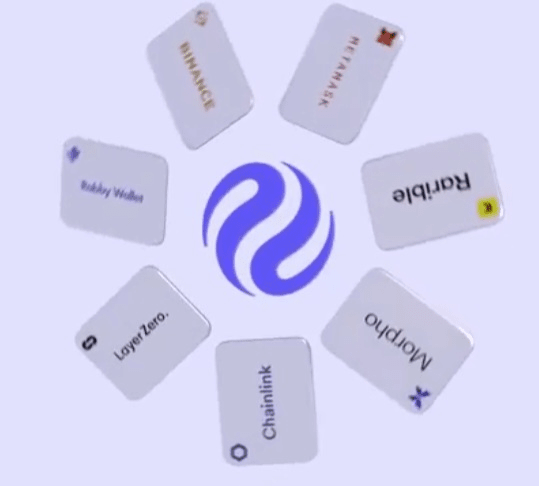
Relation with Chainlink
Chainlink (LINK) is one of the best-known oracle platforms: it provides reliable external data (prices, indices, events) for smart contracts. Recently, Injective announced that Chainlink is active on the network as its preferred oracle solution.
This means that dApps built on Injective — exchanges, derivatives markets, DeFi platforms, or even tokenized asset markets — can use secure and reliable price feeds, which increases robustness and attractiveness.
In practice: if Injective launches a futures market or a collateral lending protocol, Chainlink ensures that the data (such as ETH, BTC, stablecoin prices, etc.) comes from established oracles — reducing risks and increasing trust.
And Morpho?
Morpho is a DeFi lending and credit protocol based on Ethereum/EVM, which seeks capital efficiency by connecting lenders and borrowers more directly and cheaply.
To this day, there is no public evidence of integration between Morpho and Injective, nor that INJ functions as a token within the Morpho protocol — Morpho uses its own native token (MORPHO) for governance.
Therefore, any 'relationship' between INJ and Morpho would be hypothetical: they coexist in the DeFi space, but there is currently no official connection.
MetaMask, Binance… practical part for users
If you buy INJ on an exchange like Binance, you can use wallets like MetaMask to store it. But be careful: there are reports of confusion about networks — some bought INJ on Binance via BSC (BEP20) and then had problems staking on Injective's native network.
The ideal, to use INJ 'for real' (staking, governance, DEX within Injective), is to have INJ on the native version / Injective network, and not just ERC-20 or BEP20.
Binance facilitates entry, but managing tokens requires attention to network, wallet, and destination choices.
What could LayerZero bring to the INJ ecosystem?
LayerZero is an omnichain interoperability protocol: it is not a blockchain, but an infrastructure for different blockchains to communicate — sharing data, tokens, and messages — securely and in a decentralized manner.
If in the future a developer builds a dApp that combines assets from various blockchains — for example, Ethereum tokens, stablecoins, assets on Injective — they could use LayerZero to create cross-chain bridges. This would allow Injective users to interact with other networks without losing security, liquidity, or functionality.
For INJ, this could increase its value: more interoperability means more possibilities for use, liquidity, and adoption.
Conclusion — the imagined future
INJ, as a token of a modern DeFi network, has solid foundations: a network designed for finance, interoperability, staking, governance, deflationary model, EVM compatibility… With Chainlink, Injective adds reliability to data, essential for serious apps.
Morpho operates in parallel, but in the DeFi space one can never rule out future integrations — especially with interoperability via LayerZero.
For the real user: INJ is an interesting bet if you believe in the growth of cross-chain DeFi, but it requires caution with networks, wallets, and token versions.