

Main Takeaways
Around 700 million women globally remain unbanked, while millions more face barriers to financial education and wealth-building opportunities.
Crypto lowers many of the traditional barriers to participation, creating new pathways to financial services, careers, and communities.
We spoke with four women from across the crypto industry to explore what those opportunities look like in practice – and what it actually takes to get started.
The conversation around crypto rarely strays far from markets or technology. Yet for millions of people around the world, what crypto represents goes beyond investment: access to financial tools and networks that have historically been out of reach.
Many of these people are women. Millions around the world continue to face barriers when it comes to banking services, investing, financial education, and long-term wealth creation. Crypto has the potential to lower some of those barriers by making financial tools more accessible and opening new pathways to participation in the digital economy.
At the same time, crypto itself is still often viewed as a heavily male-dominated industry.
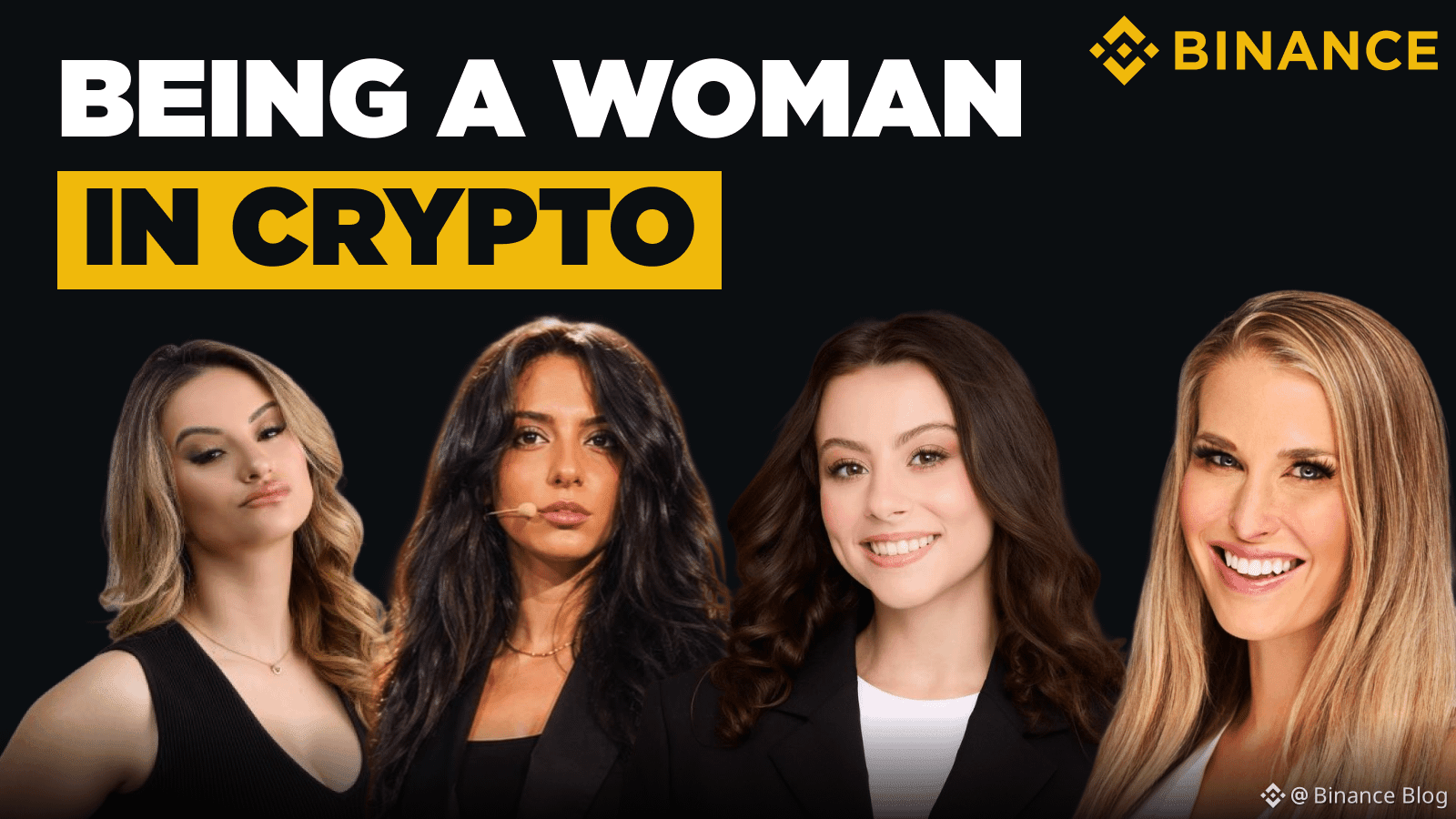
To explore that reality, we spoke with Randi Hipper, founder of Miss Teen Crypto; community builder JanaCryptoQueen; trader Hadir Gaber; and podcast host CryptoMegan. Each of these women has built a career in the Web3 space, and now share a perspective on the opportunities it offers and the challenges that come with entering it.
There Isn't One Path Into Crypto
The four women we spoke with all work in crypto today, yet their journeys into the industry could hardly have been more different.
Randi first encountered Bitcoin through her father when she was thirteen. Three years later, they completed their first Bitcoin transaction together. “I saw how easy it was,” she says. “Scan a QR code and send money anywhere in the world.”
That experience ultimately led her to launch Miss Teen Crypto at the age of seventeen and begin educating other young people about the space.
Jana's starting point looked very different. Before crypto, she was a mining engineer in Brazil. Then, she discovered NFT communities online and found herself drawn in: “It wasn't Bitcoin. It wasn't Ethereum. It wasn't the money. It was the people.”
That sense of belonging eventually became the foundation of a full-time content career serving both Brazilian and international audiences.
Hadir arrived from a different angle entirely. Her path into crypto ran through forex trading – and a growing frustration with the centralized banking systems it depended on. “I never liked banks,” she says. “Crypto felt like a gateway to a new solution.”
The deeper she explored blockchain technology, the more she wanted to understand how it was built.
CryptoMegan's introduction into Web3 came through a university reunion where blockchain developers were invited to speak, and she felt immediately drawn to what she’d heard.
The more she explored the space, the more convinced she became that people needed help navigating it. From there, she built a career in education, consulting, speaking engagements, and her own podcast.
What Is It Like Being a Woman in Crypto?
Working in crypto as a woman, all four found, meant navigating challenges that rarely came with the territory for their male peers.
For Megan, the challenge came in the form of a consistent undertone in conversations with men, particularly those from traditional finance, who questioned whether she belonged in the space.
“There was always this undertone of: who are you, and what do you know?” she says. Over time, she developed resilience and learned to hold her ground in public crypto spaces.
She also became involved with early NFT communities that were actively trying to shift that culture. One group organized events under the name “Not a Plus One” – a pointed response to the reality that many women showing up to crypto events were there as partners rather than participants in their own right.
Jana had already spent years as one of very few women in mining engineering, so the dynamic felt familiar. “When I see myself as the minority, I see it as an opportunity to highlight myself,” she says.
That reframe didn't make the experience frictionless. She describes a recurring and frustrating assumption: “People think women grow because they use their face, not because they use their brain.”
For Hadir, the skepticism was more direct. As an Arabic woman building publicly in crypto, she faced rejection from spaces that dismissed her before she even had the chance to speak.
“Some Twitter Spaces rejected me because I was a female,” she says. Others told her to focus on content unrelated to crypto entirely. “I'm here to show my brain,” she fought back.
Randi faced a different challenge: age. Launching Miss Teen Crypto at seventeen meant constantly proving she was serious – including to other women in the space who questioned whether she was a genuine creator at all. “People thought I wasn't real,” she says.
“The world is one big high school,” she adds. “You just have to keep proving yourself and ignore the hate.”
More Than Money
For all four women, what crypto changed went well beyond their income.
Web3 transformed nearly every aspect of Jana’s life. Before entering the space, she had only travelled outside of Brazil once in her life. Since then, she has traveled to more than ten countries, relocated to Australia, and built a career that would have been unimaginable during her years as an engineer.
She now focuses on showing women – particularly in Brazil, where English-language barriers and limited access to global networks remain real obstacles – that the same path is available to them. “You don't know English. You don't have the access others have,” she says. "But you can conquer. You just need to put yourself out there.”
Crypto changed how Randi thinks about money itself. Growing up, she was taught that keeping savings in a bank account meant building wealth over time. Instead, she watched purchasing power decline while the digital economy accelerated around her.
Randi sees crypto through the lens of control. “Women are looking at Bitcoin as a way they could actually own something that can't be taken from them,” she says. “Bitcoin is not just money. It's property.”
For Megan, the change manifested itself in the world that opened up around her: “I get to travel. I get to meet brilliant people. I don't think we could do this in any other industry.”
The space also transformed how Hadir relates to technology. She began as a trader and found herself drawn progressively deeper into how it actually worked. “I never imagined I would love learning about Python or how smart contracts are built,” she says.
Can Crypto Create More Opportunities for Women?
All four speakers see real potential in crypto for women. But effort is required from both sides – from an industry that still has work to do, and from women willing to step into the space.
For Randi, one of crypto's greatest strengths is that participation is open by default.
“Code isn't biased,” she says. “When you open a Bitcoin wallet, it's not like you're filling out an application – who you are, how old you are, or where you come from.”
Megan sees the current moment as a rare window. Retail investors today have access to financial tools that were previously available only to institutions – and the space is still early.
“We're only four percent adoption worldwide,” she says. “The opportunities are endless – not only in investing, but in getting a job here.”
Hadir points to institutional and regulatory support as the foundation that makes broader participation possible. In markets where authorities have actively enabled crypto – providing legal clarity and public legitimacy – communities engage with it very differently. The UAE, she notes, has been a model for this kind of enabling environment.
Yet all four agree that the industry still has work to do before those opportunities are equally visible and accessible to women.
Megan noticed during a global lecture tour that women often became interested in crypto after meeting other women already working in the space. Men, she says, are more comfortable finding their way in through digital channels alone – but women tend to need a real-life point of entry. “They get inspired and onboarded in person,” she says.
As for where to start, Hadir's approach is practical. Crypto spans trading, development, content creation, community building, marketing, tokenization, payments, and more – and whatever a person's background, there is likely a part of the industry that connects to it. “Match your experience with crypto,” she says. “And people are so lucky to have AI now – it can make the basics easy and simple.”
Randi's advice is more direct: “Stay strong, do your research, and take self-custody.”
Final Thoughts
Randi, Jana, Hadir, and Megan each had their own journey in this space. What it gave them had more in common: new careers, new communities, a different mindset, and possibilities none of them had fully anticipated. And each one began with the same decision: to take the first step.
The path wasn't without its challenges – and crypto alone will not solve every barrier to financial inclusion. But for all four, it opened doors that might otherwise have remained closed.
In a recent letter, Binance co-founder and co-CEO Yi He – named this year one of Fortune's Most Powerful Women in Business – shared her take: “I don't like the phrase ‘empowering women.’ It sounds like someone is holding the key, deciding whether to let you in. What I would rather do is break the door down, so more people can walk through it.”
As the space continues to develop and more women join, the stories in this article become part of something larger: a growing body of proof that crypto can deliver on its promise of open access. Binance is here as part of that effort, offering the support, community, and platform for women from all over the world to find their own freedom of money.
Further Reading
The Challenger Yi He: Since We're Here, Let's Build Something Bigger
Payroll, Savings, and Two iPhones: Stablecoins in Emerging Markets
Expanding Access Where It Matters Most: Binance’s Approach to Driving a More Inclusive Financial Future
Disclaimer: Content may include third party comments and opinions. Please note that: (a) all content is presented on an "as is" basis for general information purposes only, without representation or warranty of any kind; (b) such comments and opinions belong to these third parties, and do not purport to reflect the views, comments or opinions of Binance; and (c) correspondingly, their comments and opinions as expressed on our platform is not intended to be and shall not be construed as an endorsement by Binance. We shall not be liable or responsible for any errors or omissions, or for the results obtained from your use of such information. The content above shall not be construed as financial advice.
Digital asset prices are subject to high market risk and price volatility. The value of your investment may go down or up, and you may not get back the amount invested. You are solely responsible for your investment decisions and Binance is not liable for any losses you may incur. Past performance is not a reliable predictor of future performance. You should only invest in products you are familiar with and where you understand the risks. You should carefully consider your investment experience, financial situation, investment objectives and risk tolerance and consult an independent financial adviser prior to making any investment. This material should not be construed as financial advice. For more information, see our Terms of Use and Risk Warning.