

For most people, virtual worlds are still a place to escape. For @Yield Guild Games , they became a place to start over.
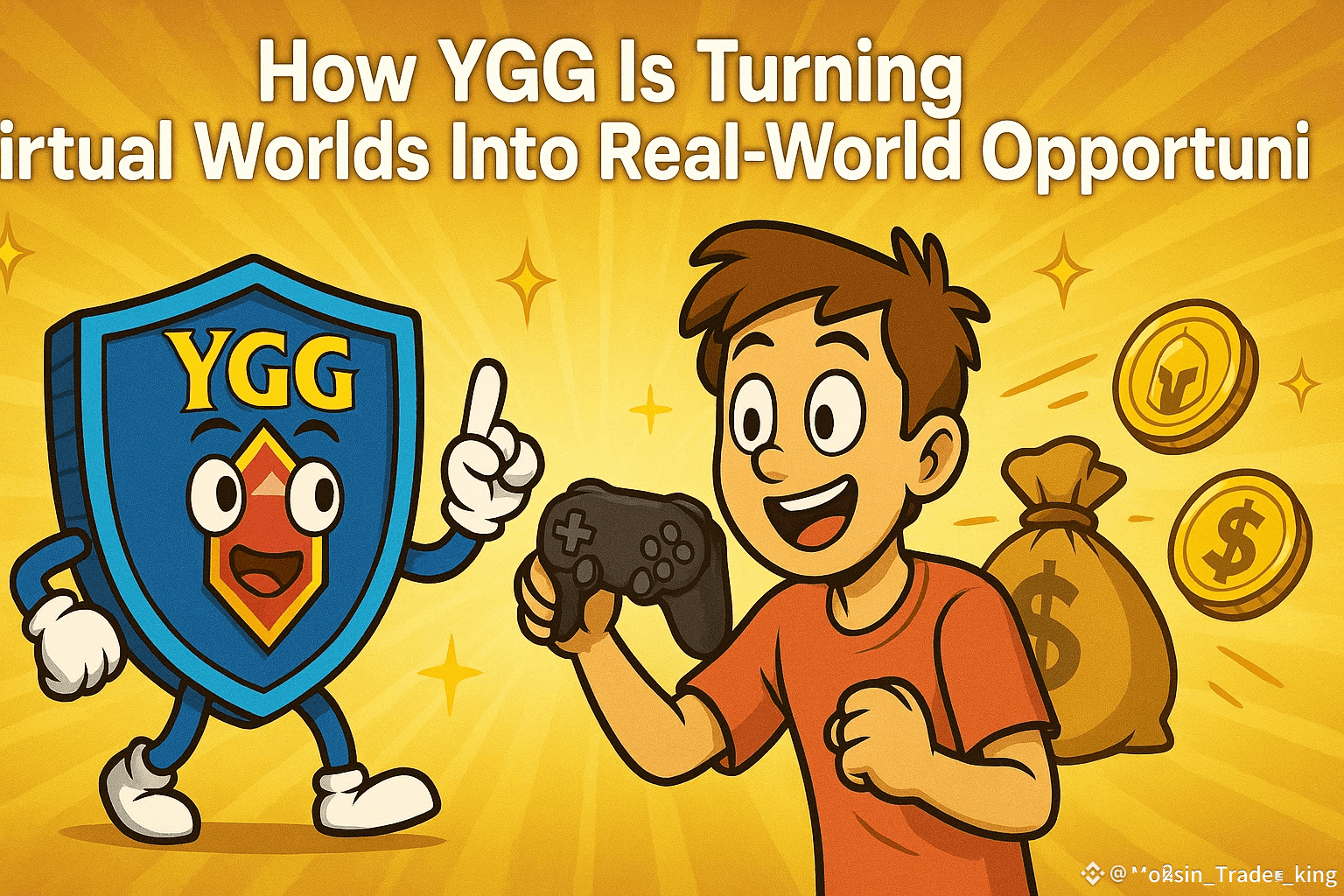
#YGGPlay began with a simple, almost improvised experiment during the pandemic: lend expensive Axie Infinity NFTs to people who couldn’t afford them, let them play, and split the earnings. In the Philippines, where lockdowns hit incomes hard, that experiment turned into a lifeline. Players who had never owned a gaming PC were suddenly earning from a mobile phone and a patchy internet connection, using assets owned by a global guild they had never met in person.
From that starting point, YGG evolved into a decentralized autonomous organization that invests in virtual land, characters, and in-game items across multiple blockchain games, with the explicit goal of building a massive virtual economy and sharing value back with its community. The mechanism that made this work is deceptively simple. YGG acquires NFTs that are required to play or compete. Instead of hoarding them, the guild lends them out through “scholarships”: a player uses guild-owned assets, earns in-game tokens, and then shares a portion of that income with the guild and the manager who onboarded them.
On paper, that sounds like a clever yield strategy. On the ground, it looked like something closer to a vocational bridge. Scholars didn’t just receive access to NFTs. They weren’t left on their own. People helped each other every day, answering questions, giving tips, and checking in. Community guide them how the game worked, warned about big risks, explained when to take profits, and even helped them use a crypto wallet for the first time. Over time, that steady support changed everything: good players turned into team leaders, some leaders became managers, and the most committed managers grew into recruiters running their own small, tight-knit communities.
This is where the virtual-to-real loop starts to get interesting. When you strip away the crypto jargon, what YGG actually built was a global apprenticeship network disguised as a gaming guild. The “curriculum” just happened to live inside Axie Infinity, The Sandbox, and other Web3 titles. The skills, however, were fully transferrable: digital collaboration across time zones, basic financial literacy, data-driven decision-making, community moderation, content creation. For many players, especially in emerging markets, it was their first taste of remote work.
At its peak, that model supported tens of thousands of players and became a reference point for how Web3 gaming could deliver real economic mobility, even if only for a period of time. In some communities, in-game earnings covered rent, school fees, or emergency expenses that traditional systems weren’t reaching quickly enough. Stories emerged of families paying off debt or financing education with tokens earned by battling cartoon creatures. The symbolism was hard to ignore: a guild of gamers doing, in practice, what development programs and microfinance often struggle to do at scale meet people where they already are.
But YGG’s story is not a straight upward line. When the play-to-earn bubble cooled and token prices dropped, scholar incomes shrank just as fast as they had risen. That volatility exposed the fragility of any model tied too tightly to a handful of game economies. It also highlighted uneven revenue-sharing structures across the broader industry and the psychological toll of treating a volatile game economy like a stable paycheck.
To its credit, $YGG didn’t respond by pretending nothing had changed. The guild began to talk openly about an evolution from “YGG 1.0” to “YGG 2.0”: a shift from pure play-to-earn access towards a broader Web3 gaming network focused on skills, reputation, and long-term opportunity. In the early days, the mission was mostly about lowering the cost of entry to expensive games. Now, it is increasingly about helping players build durable value around their time and talent, not just their ability to farm tokens during a bull market.
That shift shows up in small but important design choices. Guild advancement programs help players move from scholar to leader to ecosystem contributor, not just grind out daily quests. Regional sub-guilds give communities in different countries more autonomy to shape what opportunity looks like locally. A player in Indonesia might lean into esports competition; someone in the Philippines might transition into community management or content creation around new games; another might end up working with a Web3 studio that first discovered them through guild performance data.
There is also a quieter infrastructure story unfolding in the background. Partnerships with financial and tech players have explored how to connect gaming income to real-world banking rails in safer, more compliant ways, recognizing that “earn in tokens, cash out to fiat” is not as simple as early narratives suggested. The challenge is not just giving someone income; it’s helping them integrate that income into their broader life without exposing them to unnecessary risk.
All of this raises a bigger question: what exactly is the opportunity that #YGGPlay is turning virtual worlds into? It’s tempting to answer with numbers how many players, how much volume, how many tokens earned but that misses the deeper point. The real opportunity is optionality.
For a teenager in a small town, joining $YGG could be the first time their gaming skills are seen as real work, not just a “waste of time.” For someone who just lost their job, a scholarship could act like a safety net, giving them a bit of income and breathing room while they learn new skills and figure out their next step. For a parent who always loved games but never had the hardware, a guild-provided NFT and a borrowed smartphone might open a door into a global digital labor market. And for developers and investors, YGG acts as a kind of demand-engine and feedback loop, stress-testing which game economies can actually support human livelihoods instead of just speculation.
None of this is guaranteed. Sustainability remains the hard problem. Most play-to-earn economies have struggled to maintain long-term value once growth slows and incentives normalize. YGG’s own model will continue to be tested every time the market cycles, every time a popular game fades, every time regulators shift their stance on digital assets and income.
Yet that uncertainty is precisely why YGG’s experiment matters. It is forcing a conversation that goes beyond hype: if people can earn from virtual worlds, what responsibilities do platforms, guilds, and investors have to those players? How do you design systems where opportunity doesn’t disappear the moment token prices fall? What does a “good job” look like when your workplace is a fantasy arena on a blockchain?
@Yield Guild Games doesn’t have all the answers, but it has done something concrete and hard: it turned a speculative idea the notion that time spent in virtual worlds could translate into real-world progress into a lived reality for thousands of people. The next phase will be less about proving that this bridge can exist, and more about making sure the bridge is safe, fair, and worth crossing for the long haul.
@Yield Guild Games #YGGPlay $YGG
