

The slow and often hesitant movement of institutional capital into DeFi has always rested on the same unresolved issues: unclear regulation, smart contract risk, and the rigid internal policies large organizations must follow. Injective is gradually reshaping that entry point by offering infrastructure that doesn’t simply “work” for institutions but quietly makes their participation in decentralized systems feel inevitable.
The first spark of interest appears where skepticism usually begins — at the security layer. Institutions can’t treat protocols as experiments; they need predictability and minimal exposure to uncontrollable failures. Injective relies on its own Layer 1 built on CometBFT with a classic Proof-of-Stake design, where resilience matters more than raw speed. Key financial modules, including the decentralized order book, undergo regular audits by international teams, yet the more important element is the ability to build isolated applications with their own access rules and security contours. This isn’t a generic multi-tenant setup — it’s a closed environment inside an open ecosystem, a compromise perfectly aligned with institutional risk frameworks.
But even flawless code isn’t enough. The real gatekeeper is compliance: KYC, KYB, source-of-funds checks, permissioning. Injective doesn’t hide these requirements behind decentralization narratives. Instead, it integrates them through partners like Pyxis Network, which develops flexible identity modules for creating segmented markets or permissioned asset pools limited to verified participants. For applications dealing with tokenized real-world assets, this isn’t an optional feature — it is the defining constraint.
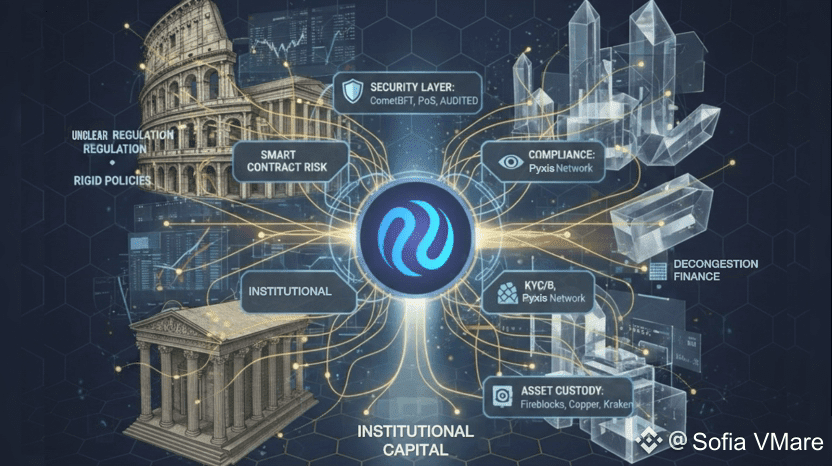
The final barrier is asset custody. Large financial players won’t rely on typical wallets or unregulated services; they need certified custodians with insurance, granular access control, and traceable procedures. Injective’s integrations with platforms like Fireblocks, Copper, FalconX, and Kraken eliminate this friction. When a bank or fund can interact with a protocol without abandoning its established custody stack, psychological resistance drops much faster than anyone expects.
Ultimately, Injective’s appeal is not built on promises of yield. Its value lies in creating an environment where traditional financial mechanisms don’t feel like visitors from another world, but part of the architecture itself. The technology adjusts to the language institutions already speak rather than pushing them to abandon what they consider critical. That is why the development around Injective feels less like speculative hype and more like the maturation of an infrastructure layer that can support far larger financial systems. When rules, security, and operational clarity converge, institutional capital no longer sees DeFi as an experiment — it sees a working model.
