

Every on-chain action costs money. And in Web3, that cost can stop developers cold. High fees and slow networks aren’t just annoying—they block innovation and slow mass adoption. APRO isn’t just another tool. It’s a rethink of how blockchain infrastructure should work.
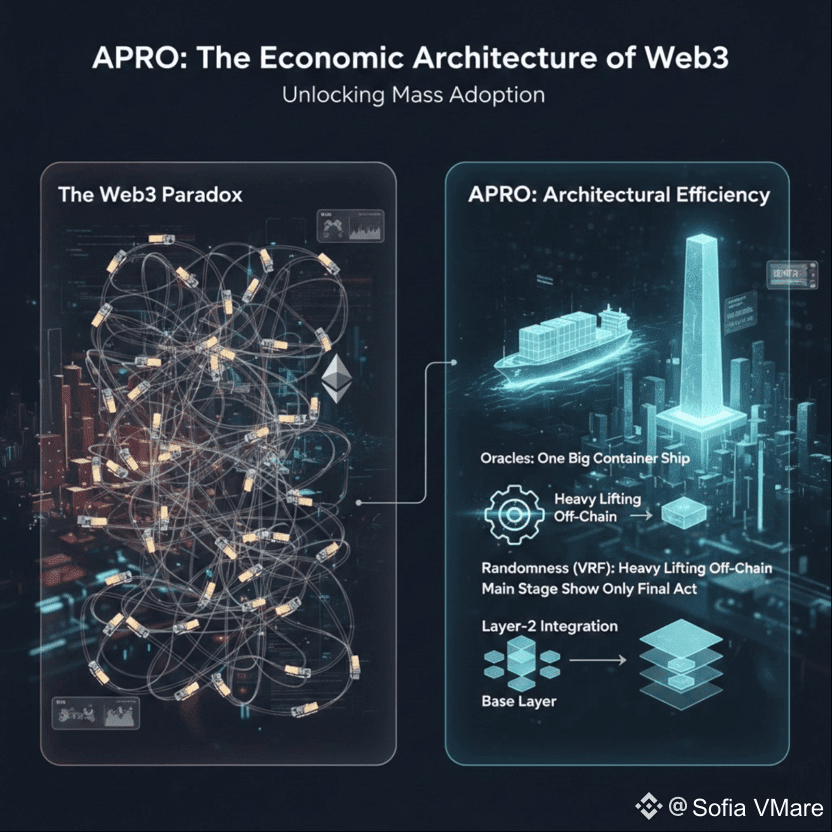
The Web3 Paradox
We talk about accessibility and democratization, but in practice? Using Ethereum for microtransactions often feels like burning money. Building your own infrastructure—like oracles or randomness generators—requires resources that could fund a mini-startup.
And yet, people still try. APRO shows there’s a smarter way.
How APRO Cuts Costs
APRO’s magic isn’t lowering prices—it’s architectural efficiency.
Oracles? APRO handles this cleverly: data is collected off-chain, and only one verified package hits the blockchain. Imagine this: not dozens of tiny trucks, but one big container ship. Pretty neat, right?
Randomness (VRF). Usually, generating verifiable randomness is expensive and heavy for the chain. APRO does all the “heavy lifting” off-chain, leaving only lightweight verification on-chain. Games, NFTs, lotteries — finally affordable.
Layer-2 Integration. Most transactions happen off-chain, on sidechains or rollups, while the base layer only records the final result. Think of it like doing all the heavy lifting backstage and letting the main stage show only the final act—fast, cheap, and secure. Seriously, it works.
Why It Feels Different
Apps using APRO respond faster. Games don’t freeze. Financial protocols update quotes instantly. User experience finally feels smooth. And predictable fees? That’s the real game-changer.
Big Picture
APRO isn’t just a toolkit. It’s a systemic approach to Web3 economics. Every decision—data aggregation, L2 use, randomness handling—is about cutting friction. In a world where scalability = cost, this isn’t a bonus. It’s survival.
So, here’s a question: which infrastructure tweaks will actually push Web3 from niche experiments to mainstream adoption?

