

YGG Play made a loud entrance — a flashy launch, lots of energy, the vibe of a cinematic teaser for a much bigger world. But the longer you look, the more one question stands out: what’s the actual gameplay under the surface?
YGG has already stepped beyond the “guild-investor” identity and is now trying to build a sovereign gaming ecosystem: a unified profile, transferable assets, and an internal economy. Ambitious? Yes. Risky? Even more. Building a platform is one thing. Creating a network where value emerges between games is something entirely different. If they miscalculate, YGG Play becomes exactly what Web3 tried to escape — another walled garden, only with a blockchain label.
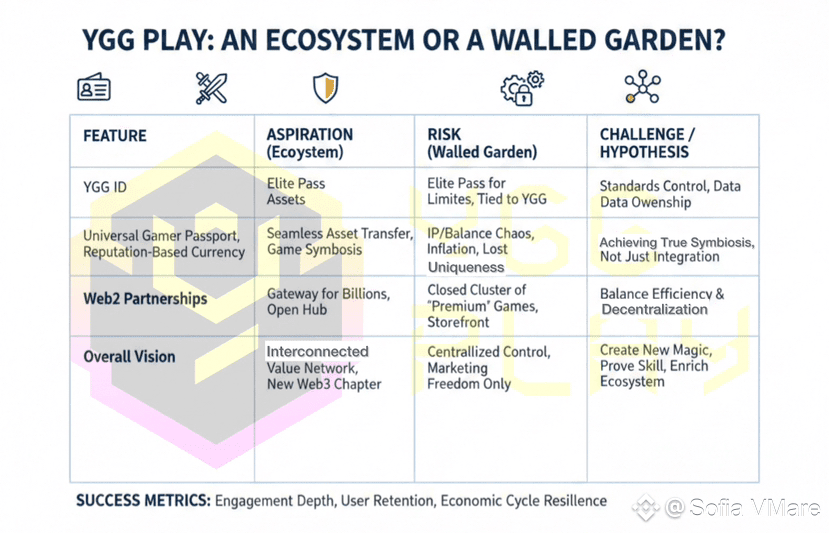
YGG ID: A Passport to Web3 or Just a Membership Badge?
The centerpiece of their plan is the YGG ID.
The idea makes sense: reputation as the new currency. It mirrors the broader trend of “restaking, but for people” — the more you play, the more opportunities you unlock.
But here comes the first contradiction.
For YGG ID to function as a universal gamer passport, it has to be… universal.
Right now, it’s tightly tied to the YGG Play ecosystem.
Can it become the “Steam account of Web3”?
Or will it end up as an elite pass for a limited set of games willing to play by YGG’s rules?
And the tech side is the easy part.
The real battle will be over standards, and over who controls the activity history of players. Web2 developers don’t like sharing power. Web3 isn’t much different.
Cross-Game Assets & NFT Interoperability: A Gamer’s Dream, a Lawyer’s Nightmare
The fantasy of carrying a sword from one universe into another is poetic.
But every step toward it is a minefield:
IP and licensing conflicts between studios
chaos in game balance when an external item suddenly enters
inflation and devaluation when economies collide
To make this work, you don’t need integration — you need symbiosis.
And the industry is still only poking that ice. Loud successes? Almost none.
YGG could become the force that finally moves this forward.
But mistakes here are painful: losing each game’s uniqueness and upsetting their core communities.
Web2 Partnerships: A Bridge — or a New Wall?
The most paradoxical part of the strategy is YGG’s push toward big Web2 studios.
On one hand — a perfect gateway for billions of potential users.
On the other — a risk of forming a closed cluster of “premium” games with light blockchain elements, barely connected to the more experimental native Web3 titles.
And then the picture shifts:
instead of an open hub, YGG Play begins to resemble another storefront — competing not with guilds anymore, but with Immutable and Gala Games.
This is where the decentralization narrative starts to crack.
Negotiations with corporations don’t happen through open community debates.
Product iterations require speed, not a long DAO voting cycle.
Finding balance between efficiency and decentralization may be the toughest “boss fight” on their map.
So What Are We Really Testing Here?
YGG Play isn’t building features — they’re testing hypotheses:
can cross-gameplay create a new kind of magic that Web2 never could?
will YGG ID evolve into an actual proof of skill and reputation, not just another profile?
will Web2 partners enrich the ecosystem instead of turning it into a carefully fenced-off reservation?
The answers won’t come from announcements — they’ll show up in daily metrics: engagement depth, user retention, and the economic cycle’s resilience.
If YGG succeeds in building a real network of value, it could mark a new chapter for Web3 gaming.
If not, we get a polished but familiar scenario: a closed ecosystem where freedom lives more in the marketing than in the mechanics.
@Yield Guild Games #YGGPlay $YGG

