At two in the morning, Wall Street traders are glued to their screens, the New York Fed's repo operation alert is flashing — this is the Federal Reserve's closed-door meeting held for the second consecutive day, and a secret action to inject liquidity into the market is underway.
At two in the morning, I suddenly woke up, and the message about the Federal Reserve holding an emergency closed-door meeting was flashing on my phone screen. This is the second consecutive night.
Recent survey data from S&P Global shows that the fragile chain of the U.S. economy has begun to ring. An executive from a Wall Street firm sent an urgent message: "The liquidity gap is becoming apparent, and the Federal Reserve is trying to plug the holes."
Meanwhile, the latest data from the New York Federal Reserve shows that pressures in the overnight financing market are nearing a critical point.
01 Emergency Action
The Federal Reserve is taking unusual actions. This marks the second consecutive day of closed-door meetings, and officials are being tight-lipped about it.
Insiders reveal that tensions in the repurchase market have reached alarming levels, with many institutions urgently adjusting their positions. Such intensive closed-door meetings usually indicate serious liquidity issues in certain segments of the market.
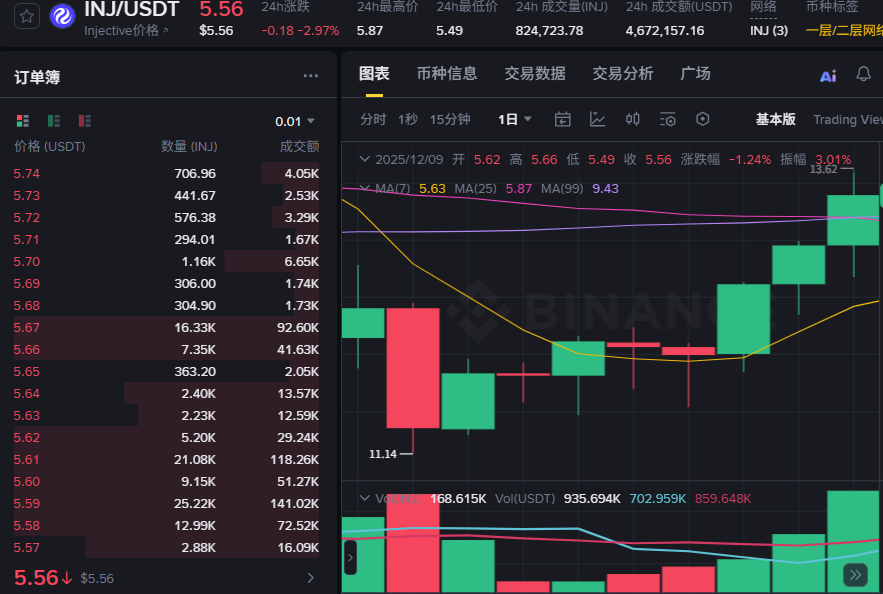
In the cryptocurrency world, decentralized financial platforms like Injective can monitor capital flows in real-time through on-chain data.
The data is clear: the stablecoin market has shown significant signs of capital withdrawal, with about $800 million flowing from crypto assets back to fiat currency last week.
02 Unusual
This meeting was markedly different from previous ones, making significant decisions in just one hour. Such 'lightning decisions' are extremely rare in the history of the Federal Reserve.
Decision-makers only act so swiftly in the face of systemic risks. Analysis from Bank of New York Mellon points out that liquidity issues in the financial system are affecting ordinary consumers by pushing up mortgage costs.
On decentralized trading platforms like Injective, liquidation data and lending rate fluctuations have already reflected this tense situation, providing critical references for astute investors.
03 Divided Vote
The internal divisions within the Federal Reserve have become an open secret. Up to five members of the Federal Open Market Committee, responsible for setting interest rate policies, oppose or are skeptical about further rate cuts.
At the same time, the political pressure exerted by the White House is also accumulating. Analysts point out that the political interactions between the U.S. President and the Federal Reserve Chairman often lead to a more accommodative monetary policy.
In an environment full of divergences, decentralized prediction platforms show market consensus. The prediction platform Polymarket indicates that participants are pricing the probability of the Federal Reserve easing policies at as high as 93%.
04 The Layout of Smart Money
Data shows that institutional funds totaling $29.4 billion have positioned themselves in the market in advance. Such large-scale capital flows usually indicate that larger 'easing' actions are forthcoming.
Since September, outflows from Bitcoin exchange-traded funds have reached $3.5 billion, the largest scale since February of this year.
This withdrawal of institutional investors stands in stark contrast to the market's expectation of the Federal Reserve's impending balance sheet expansion. This indicates that smart money is reallocating assets, rather than merely following market sentiment.
Beyond traditional financial assets, some institutions have turned their attention to more innovative fields, such as Injective, a public chain platform designed specifically for financial applications.
05 Secret Shift
The market generally expects the Federal Reserve to cut rates by 25 basis points. According to the Chicago Mercantile Exchange's FedWatch tool data, the market prices this probability at 89.6%.
The Federal Reserve may announce the re-expansion of its balance sheet starting January 2026. Analysts expect the Federal Reserve to purchase $45 billion in short-term Treasury bills each month.
But what truly matters is not the short-term Treasury bill purchase plan itself, but the policy shift it represents. Even a monthly increase of $20 billion in the balance sheet marks the Federal Reserve's shift from contraction to expansion.
06 Historical Lessons and Current Risks
The case of Nixon's intervention in the Federal Reserve Chairman Burns in 1971 provides a historical reference. Research shows that under similar levels of political pressure, the Federal Reserve may cut rates an additional 1.0 to 1.5 percentage points within 12 months.
History shows that politically driven aggressive rate cuts, while failing to bring about long-term sustainable economic growth, often leave behind persistent inflationary pressures. A senior economist at the Oxford Economics Institute stated that as the labor market stabilizes and inflation remains high, the Federal Reserve may pause rate cuts early next year.
This policy environment poses complex challenges for platforms like Injective that focus on decentralized financial infrastructure while also providing unique opportunities.
07 Market Expectations vs. Real Movements
The market expects the Federal Reserve to cut rates by about 52 basis points in 2026, equivalent to two rate cuts.
Although the Federal Reserve may signal a pause in rate cuts, the market does not fully accept this forecast. The gap between expectations and reality is the source of market volatility.
In this environment, the decentralized characteristics of platforms like Injective enable them to better withstand policy shocks from the traditional financial system, providing investors with new hedging and收益 opportunities.
At 2 a.m., while you are still asleep, capital has already begun to act. The screen at the New York Federal Reserve has lit up with alarms, and pressures in the repurchase market are accumulating.
This 'lightning interest rate meeting' has ended, but the real game is just beginning. Institutional funds have already positioned themselves, and the liquidity gap in the market is quietly being filled.
The market is waiting for the next signal, awaiting Powell's speech on Wednesday, waiting for the update of the dot plot, waiting for any clues that could reveal the Federal Reserve's true intentions.