
As a full-time cryptocurrency trader, I always remember the 10 super rules of the crypto world. These rules are worth studying repeatedly, and must be deeply engraved in my heart!
Looking back on my investment career, it has been 10 years so far. I remember that in the first three years, I entered the crypto world with a principal of 1 million, but painfully ended up with only 120,000. Friends and family urged me to give up, believing that my obsession with trading cryptocurrencies was simply foolish, neglecting my family, lacking ambition, and similar accusations flooded in.
Those harsh words are like sharp blades, piercing my heart again and again. At that time, I was really on the verge of surrendering, filled with self-doubt to the extreme.
However, the fire of discontent in my heart has never been extinguished. I made a vow to my husband to use this last 120,000 to fight for one more chance to turn things around! Thus, I once again immersed myself in research and finally, over these three years, with the remaining 120,000 capital, I miraculously earned over 80 million in wealth!
This is no exaggeration! When you truly explore a trading strategy that suits you and execute it steadfastly, you will definitely rise again and write your own glorious chapter!

In addition to solid pattern techniques, I strictly adhere to the following 10 iron rules of combat:
1. In a poor market, cash is king; improve cash utilization. (Liquidity is king)
2. The value of crypto projects is based on: sentiment + consensus.
3. The most scarce thing is capital; preserving capital is very important.
4. With little capital, never bet on low win-rate high rewards.
5. There is no absolute valuation in the crypto circle, only relative valuation.
6. Don't be misled by absolute amounts; pay more attention to percentages.
7. Every project has a signal of 'hotspot achievement'; when it reaches 'hotspot achievement', it is highly likely to be at a peak. For example, Jay Chou's 'hotspot achievement' is: it has reached in front of OC. Identify this signal.
8. Assess the situation before investing:
① How long will the bull market last?
② How long will the funds last in that track?
③ How many stories can the project tell (time machine investment method, model innovation, celebrities & meme)
④ Which level of the information chain you are in
⑤ Whether there is a valuation ceiling that can anchor
9. How to assess the situation of a coin: Bitcoin halving cycle time points, the number of mainstream coin price fluctuations, whether there are major rises or falls in the US stock market, exchange balances, fear and greed index, funding rates, Google search information highs and lows, the number of app downloads for a certain app...
10. Zero-sum thinking: After a rise, think about whether you would recommend this price to others for entry. If not, then exit; when at a loss, think about whether you would enter at this price if it were zero. If not, then sell. (Ask yourself this when FOMO strikes)
A trader who knows how to discover, understand, and trade chart patterns can effectively navigate the financial market. Chart patterns are the root of all major price fluctuations; they are the connecting links between trends and one of the most important market phenomena.
In this article, you will learn everything about chart patterns and how to master them in trading. Trading based on chart patterns can become an independent trading strategy. Furthermore, this article will help you understand chart patterns in a 'non-textbook' real environment, unlike most trading resources that focus only on memorization and template thinking. The financial market is complex and ever-changing, and trading methods should adapt to its evolving characteristics. The goal of this article is to provide you with a framework for reading any market without having to memorize fixed patterns from textbooks.
Chart patterns are connection points
When we observe any price chart, you will see the following market stages:
◑ Upward trend
◑ Downward trend
◑ Range / Sideways market
Of course, these stages will appear with different intensities, forms, and sequences. But regardless, price charts are always inseparable from these three basic stages.
Chart patterns are the 'bridge' connecting different market stages.
When an upward trend turns into a downward trend, there is usually some chart pattern connecting these two trends. In this case, traders refer to it as a 'reversal pattern'. The following figure illustrates such an example. We will introduce various reversal patterns and continuation patterns in this article.

When the trend pauses temporarily and then continues in the original direction, the chart pattern usually describes this 'pause' (consolidation). In this situation, traders refer to it as a 'continuation pattern'. The screenshot below shows a major downward trend, while a certain chart pattern connects the two stages of that downward trend.

Break down chart patterns
In the following sections of this article, we will delve into some of the most common chart patterns. However, before understanding them, we need to learn how to decompose patterns into their basic components. Doing so will help us more effectively identify and trade various chart patterns.
1. The outline of chart patterns
To more easily find the highest quality patterns, we first start with the 'pattern outline'. Any chart pattern can be described using horizontal support/resistance or trend lines. Focus solely on those patterns that can clearly outline the contours, significantly enhancing your ability to trade chart patterns. The best chart patterns always possess these characteristics.
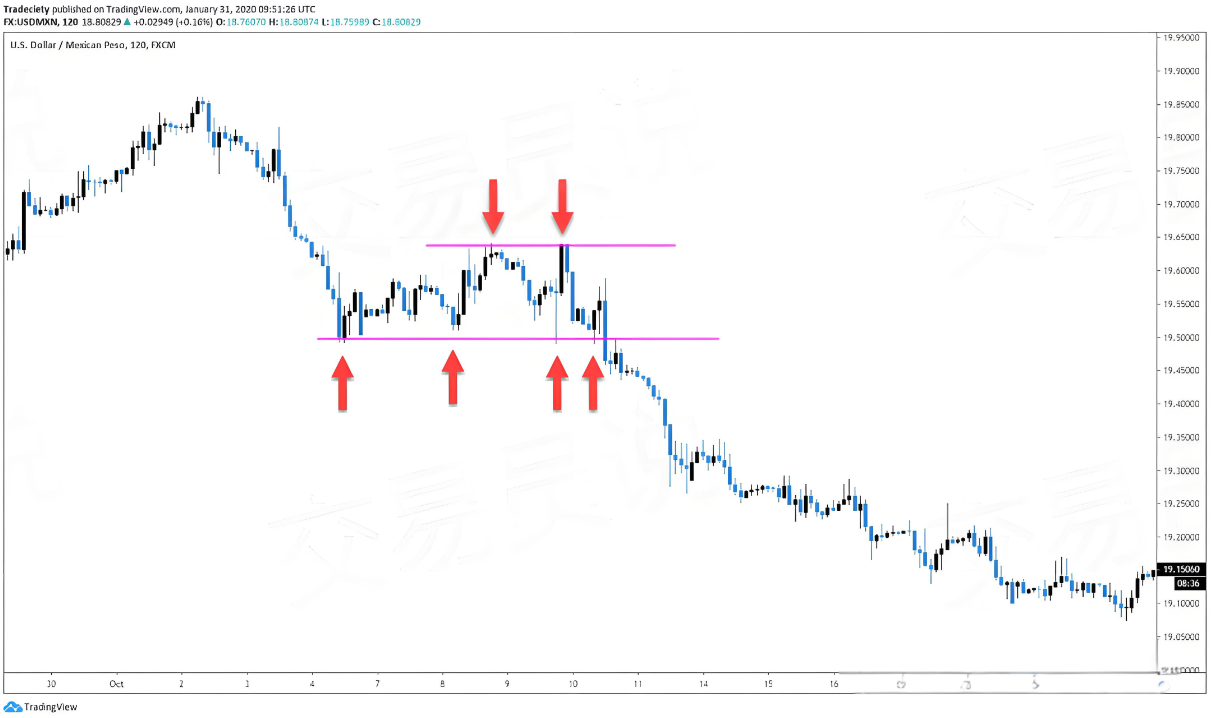
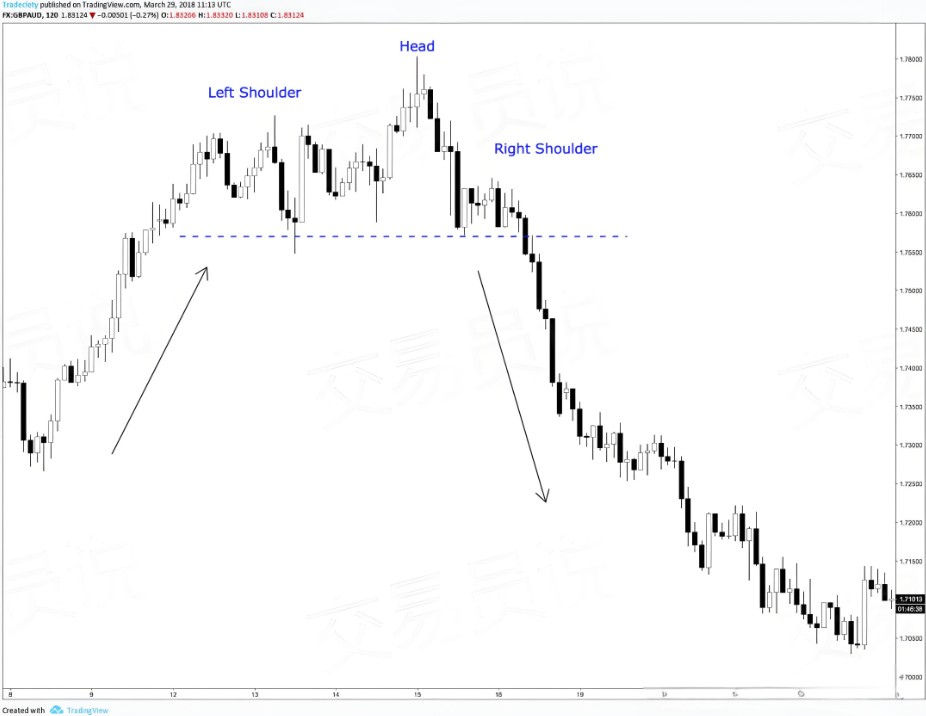
In the example below, we can describe this reversal pattern with a horizontal support level. This horizontal level has at least four confirmation points, and each touch weakens this level.

The continuation pattern below connects two stages of a downward trend, and its outline is made up of two horizontal range lines. Trading this pattern is very simple; when you restrict trades to these obvious patterns, trading becomes easier.
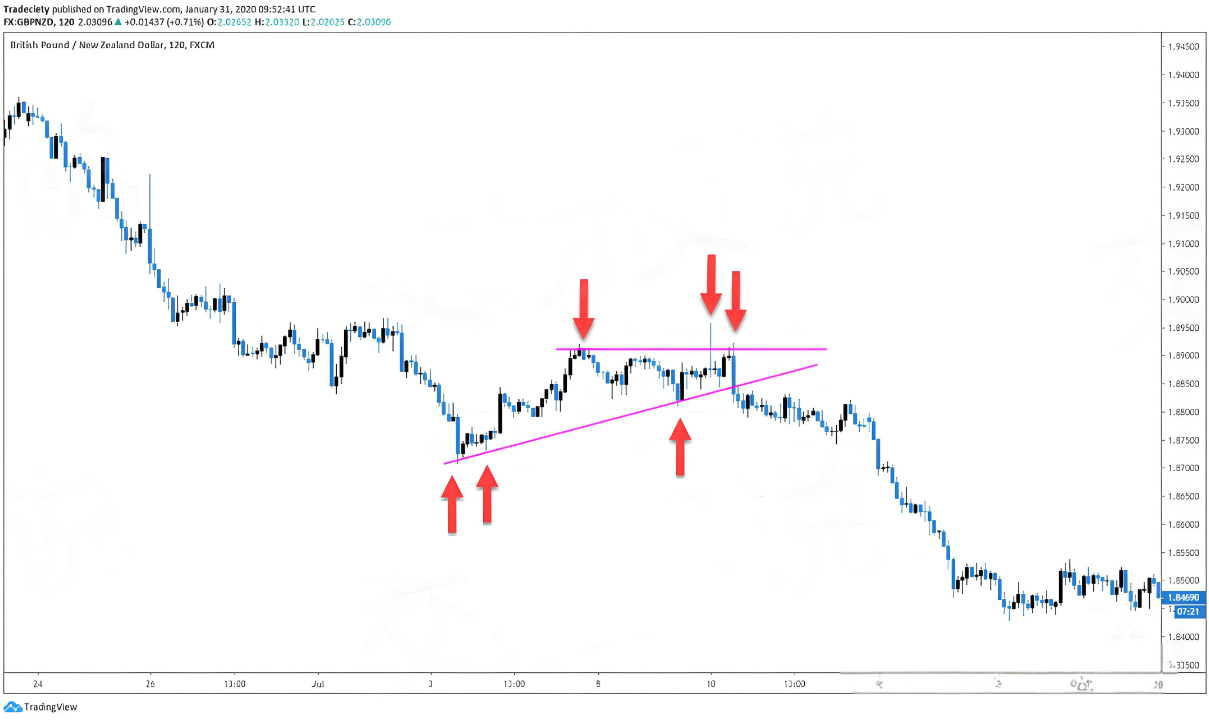
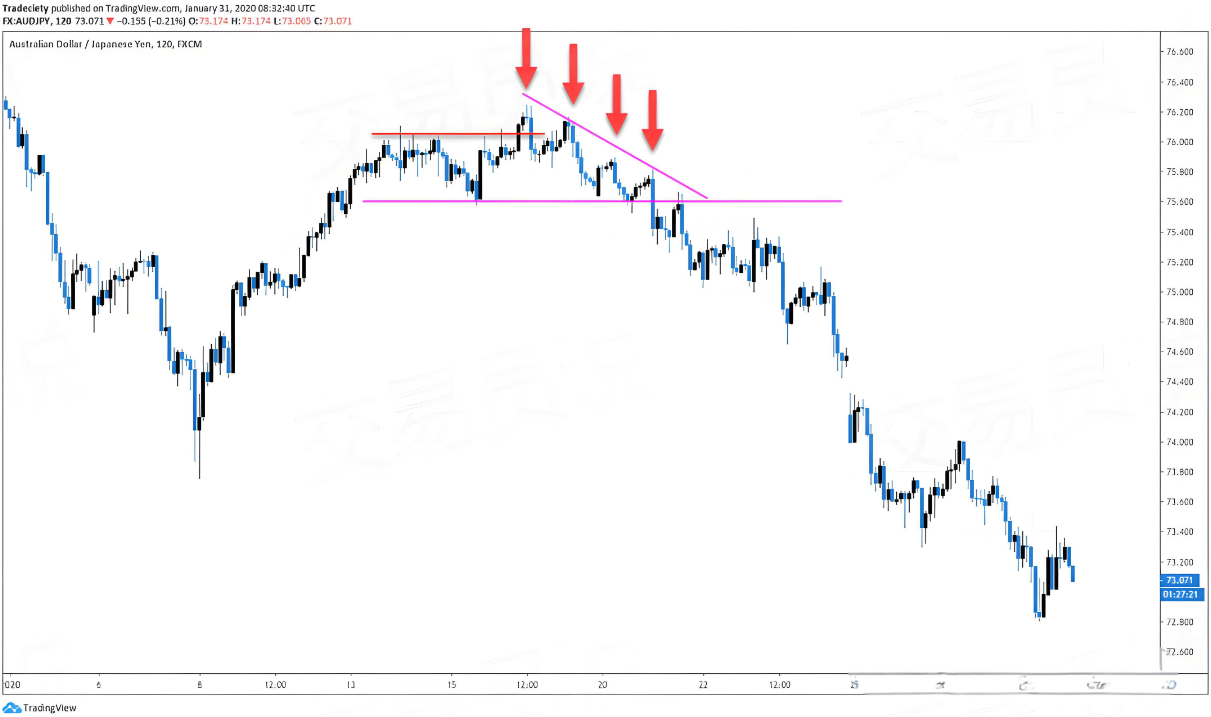
The top of this continuation pattern is horizontal resistance, while the bottom is a trend line. If the price breaks through the top horizontal resistance, it may also evolve into a reversal pattern. However, ultimately the price broke down through the trend line, thereby continuing the original downward trend.
2. The market environment of chart patterns - trend background
Trend background is an important criterion for selecting and filtering patterns. Many traders make the mistake of searching for patterns everywhere, which often leads to entering in a low win-rate environment.
The best trading opportunities exist in trending markets, where the market has momentum and prices usually move in longer one-sided movements. This way, you won't get stuck in low-volatility sideways areas.
The best reversal patterns usually appear after an extended trend. When a chart pattern appears after/during a long trend, the probability of price reversing and producing a strong trend increases, especially in markets like Forex, known for their mean-reversion characteristics. Looking back at the previous examples in this article, you will notice that all reversal patterns appeared after significant extended trends.
Continuation patterns also follow the same principles. First, identify a strong ongoing trend; once the pattern is recognized, you can begin to focus on it.
Be sure to avoid trading in choppy markets with sideways fluctuations or high volatility.
3. The 'entry method' of trading pattern outlines
This is one of my favorite concepts of chart patterns: how the price 'enters' the pattern outline tells you a lot about the underlying information in the market.
When you have clarified the outline of the pattern and see the price starting to 'stick' to this level, it often means that a high probability breakout is about to occur. In the example below, the price is first in an upward trend, then enters sideways consolidation. This consolidation area has a clear horizontal outline, and before the breakout occurs, the price remains close to that level (see the arrow).
This indicates that buyers have exited the market and are no longer able to push prices higher. Previously, every time the price hit that outline level, it could easily bounce back, but before the final breakout, bullish strength had clearly weakened.
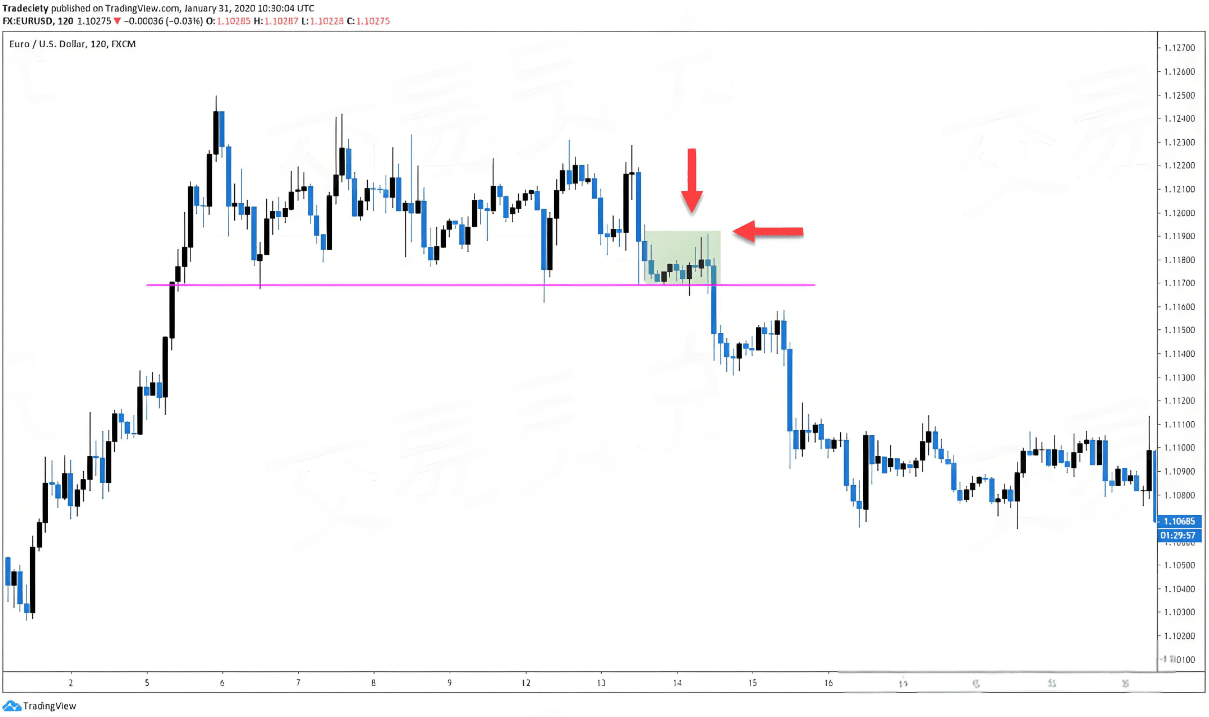
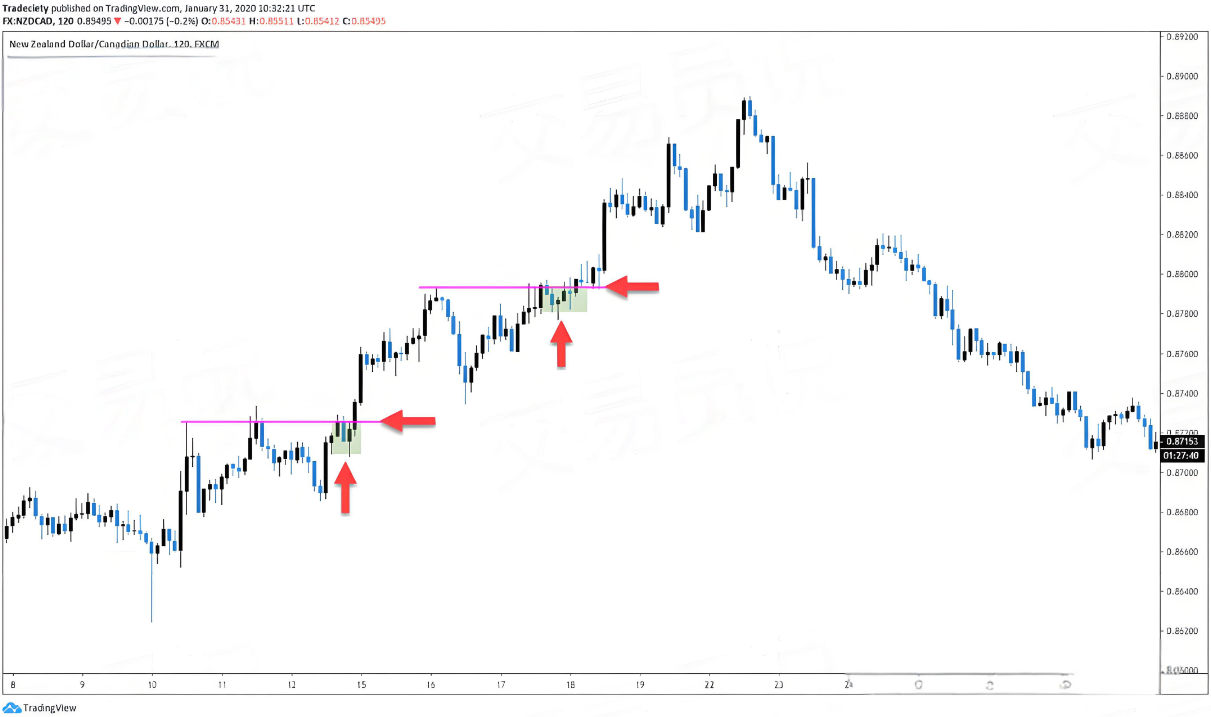
You can also apply this principle to continuation patterns. When you see this 'weak rebound' structure in chart patterns, it often indicates that a high probability breakout situation is brewing. The logic behind this is that the opposing force has exited the market, and the price is completely unable to reverse from the position of the pattern outline.
4. Resonance of fluctuation structures
Price fluctuations are the basic building blocks of all price charts, and they can also help us understand chart patterns on a deeper level.
When studying reversal patterns, the key is to look for signs of exhaustion, which are signals that the trend is beginning to lose strength.
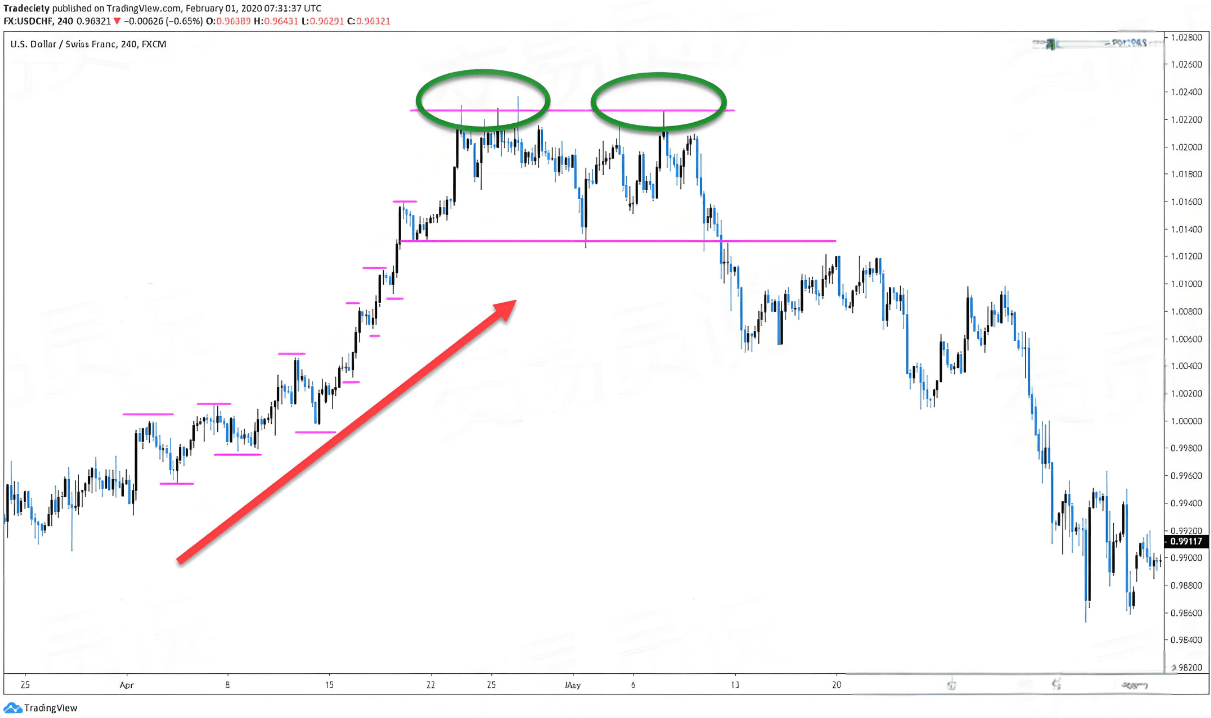
In the example below, the left side of the market is in a strong upward trend, and the price easily creates higher highs and higher lows. As the trend continues, the price begins to show signs of exhaustion: it can no longer break upwards. The circled area shows that the market has formed a 'triple top', and it can no longer create new higher highs.
Of course, this alone is not enough to immediately short, but it is an important part of the analysis. If you observe closely, you will find that the price had a weak rebound before breaking the support level of the pattern outline, further strengthening the context of the pattern and boosting our confidence in the entire pattern.
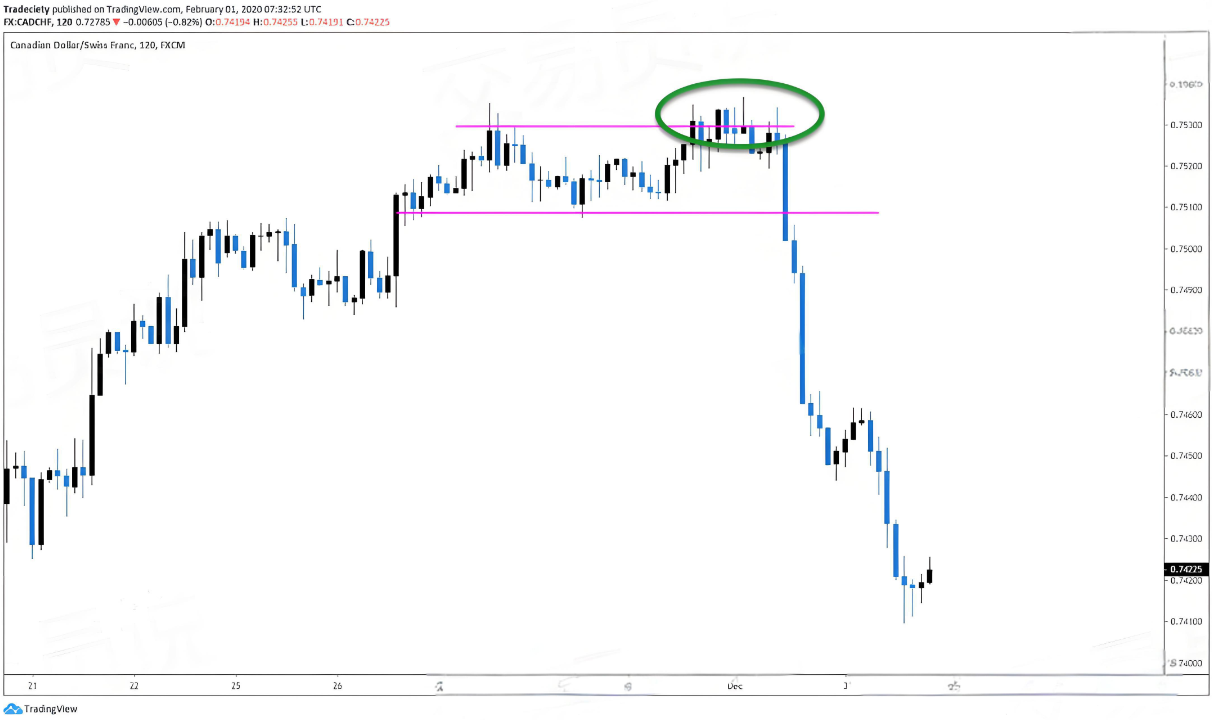
The circled area in the figure below also shows signs of exhaustion. Although the price attempts to continue breaking upwards, the upward movement is clearly weak, barely creating a slightly higher high. When you see the price unable to create 'significantly higher highs', it usually indicates insufficient buying support.
After this failed attempt at trend continuation, the price quickly collapsed. When the price broke below the key support level of the pattern, the downward trend officially began.
In continuation patterns, we also need to observe the fluctuation structure within the consolidation area.
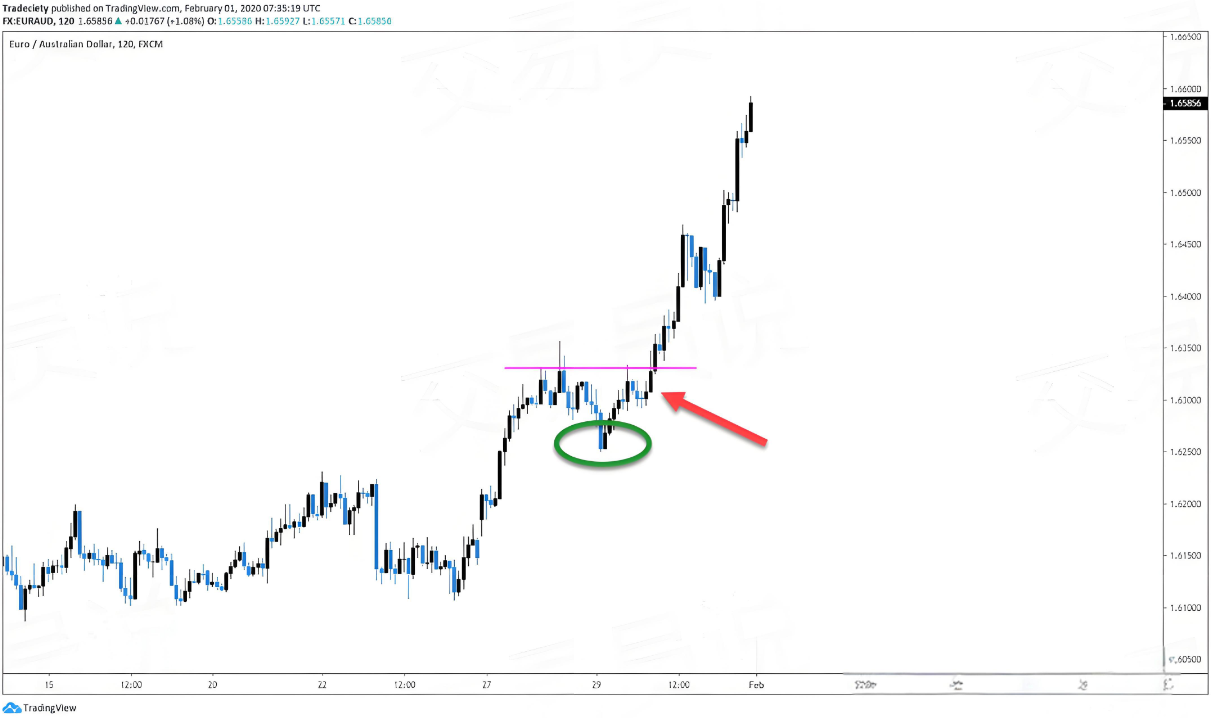
In the example below, the price attempted to break down, and we circled the area where the price tries to drop. However, the price was quickly pushed back above the pink resistance level. Subsequently, the market showed a weak rebound, and the rebound position hit exactly at the pink resistance, indicating that buyers regained control and no longer allowed the price to drop again.
These are clear signals of 'buying power still prevailing', and the eventual upward breakout of the pink resistance level also confirms the continuation of the upward trend.
5. The trigger point of the pattern
Traders often fear that the market will 'run away', leading them to enter too early. However, in the long run, waiting for confirmation after a breakout is more beneficial for improving win rates. Indeed, sometimes you may miss a trade because the breakout happened too quickly, but at the same time, you will avoid many false breakouts/failed breakouts.
The first principle of chart pattern trading is: entry is only allowed when the breakout candlestick 'fully closes' outside the pattern. Never make decisions during the formation of a candlestick!
In the example below, the trigger point of the pattern is very clear: the first candlestick that 'fully closes below the outline level' is the trigger point. Previously, the price had pierced that level multiple times; many traders would enter prematurely before the candlestick had closed. You must restrain this impulse and insist on making decisions only after the candlestick has closed.
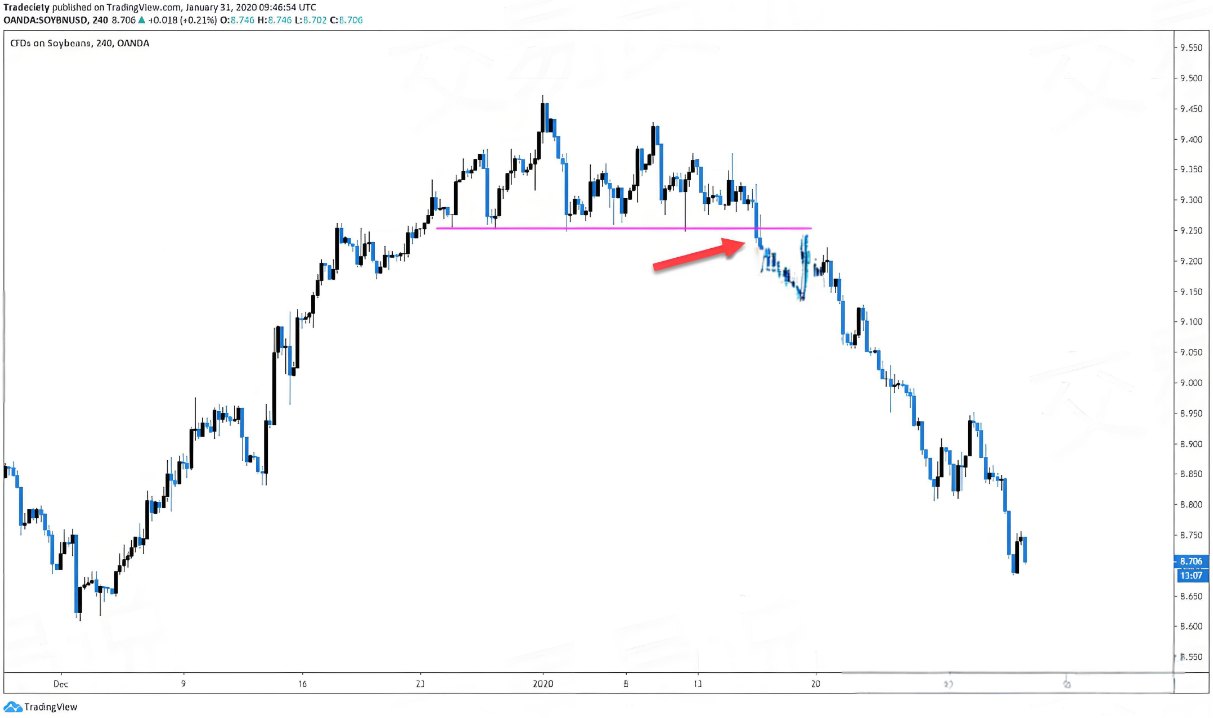
In continuation patterns, the trigger point is also very clear. The strong momentum candlestick closing down below the outline triggers the breakout, and the subsequent downward trend continues to unfold.
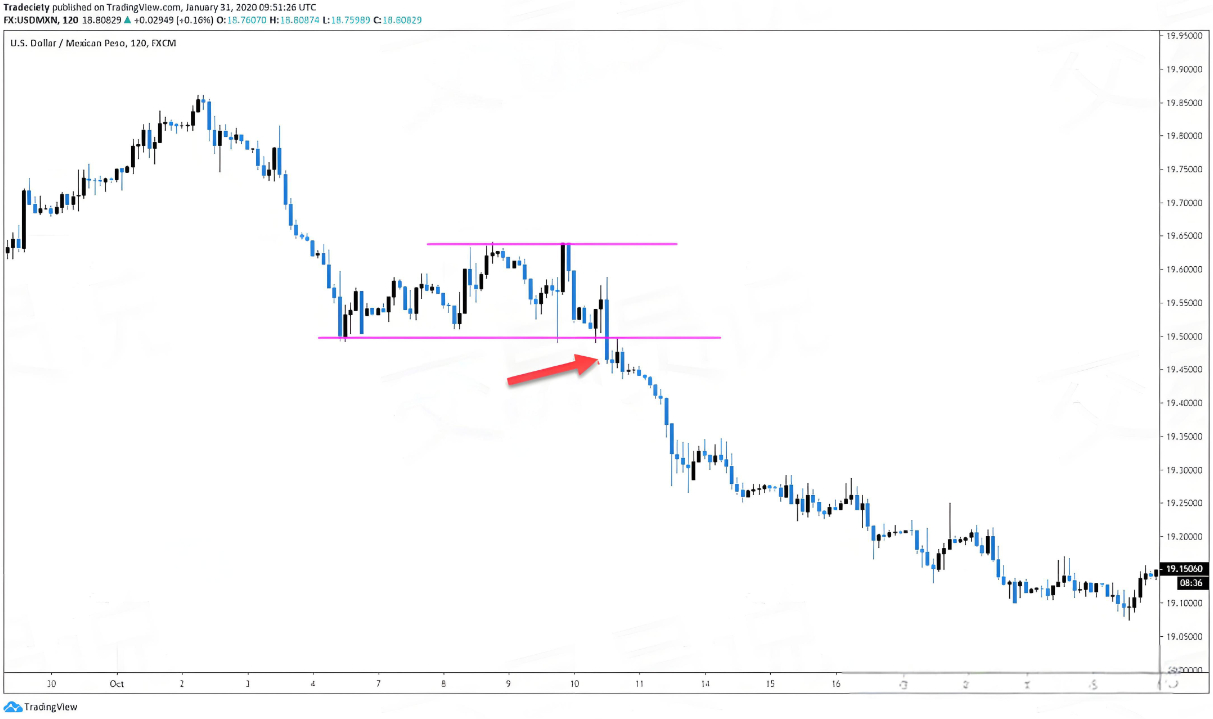
Chart pattern examples
Now, let’s apply everything we have learned to classic chart patterns and see how we can understand these patterns in a more in-depth way.
Head and Shoulders
The head and shoulders (Head and Shoulders) is a perfect example to validate all the knowledge we discussed earlier, as you can see the practical application of all key concepts within it:
✍ The head and shoulders pattern usually appears between an upward trend and a downward trend, serving as a 'connector'; thus, it is a reversal pattern.
✍ The best head and shoulders patterns often appear after an extended trend, at which point the market shows signs of exhaustion.
✍ Its pattern outline is very clear, and clear horizontal lines can usually be drawn.
✍ The left shoulder shows a long period of sideways consolidation. Typically, in an upward trend, the price easily creates higher highs, while the 'delay of the left shoulder' itself is a signal: the price has begun to struggle to push higher. The final upward move from the left shoulder to the head is also very short, showing insufficient strength at the new high.
✍ The right shoulder often resembles a 'weak rebound' structure, as the price can no longer truly depart from the position of the pattern outline.
✍ The trigger point is very clear; once the price breaks down and closes below the pattern outline, the new trend officially begins.
As you can see, we can smoothly apply all the previous principles to the head and shoulders. This structure and logic-based approach allows you to understand and trade any chart pattern without relying solely on typical templates found in textbooks, as you have understood the operational logic behind market structure.
Triangle
Now let's look at a triangle pattern and break down the key elements within it:
✍ This triangle appears after a long trend, thus it is a reversal pattern.
✍ At the red resistance level at the top, the price attempts a final trend continuation but is immediately rejected, indicating that buying power is clearly insufficient.
✍ The subsequent highs are all lower highs, further proving that the market is entering a state of exhaustion.
✍ The pattern outline is very clear; we can draw straight horizontal lines.
✍ The final breakout is completed with a strong candlestick, providing a clear signal.
Flag
Flags belong to very strong continuation patterns; the example below showcases its typical performance:
✍ The flag pattern appears after a long period of strong upward trend.
✍ Although the flag pattern seems to indicate that the price is preparing to initiate a new downward trend, if you observe closely, you will find that the lows have hardly moved down at all. This is a sign of weakness in the downtrend, indicating that the bears have never truly taken control.
✍ The last low point in the flag pattern shows a clear strong reversal candlestick, indicating a failed downward attempt, while also showing insufficient selling pressure.#加密市场观察
✍ When you connect the highs of the flag pattern, you get a clear trend line as the outline of the pattern.
✍ When the price breaks above the upper trend line of the flag pattern, the upward trend continues.
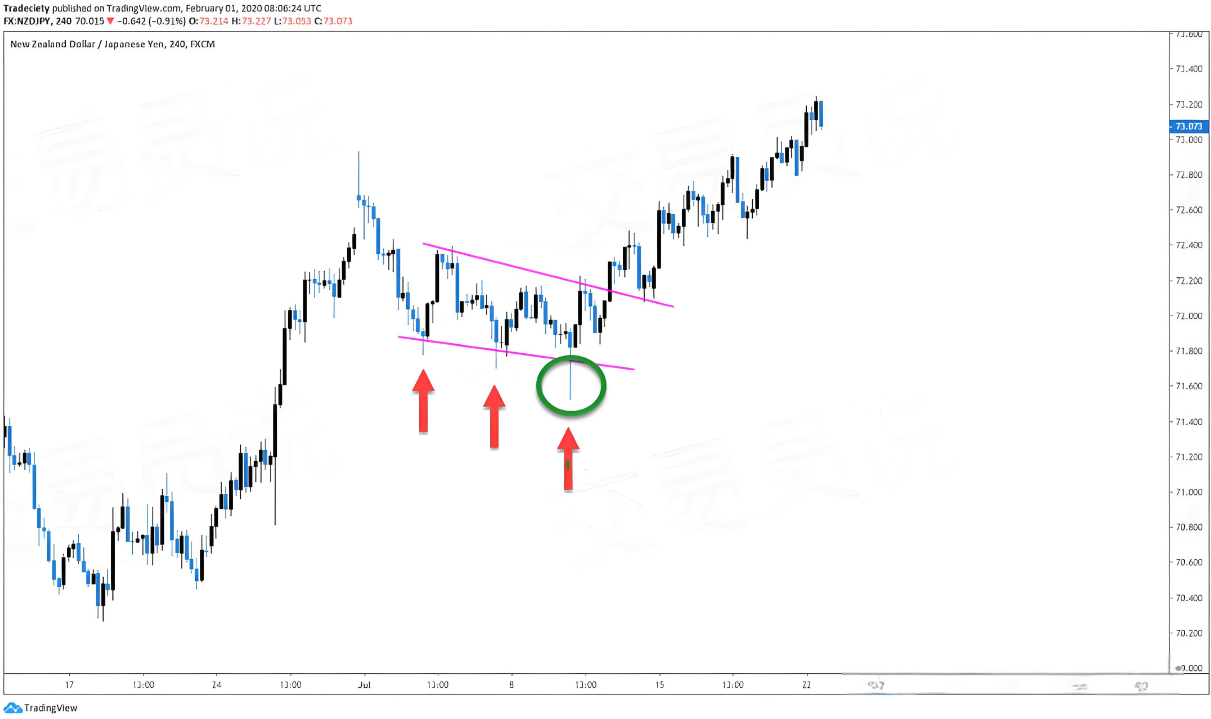
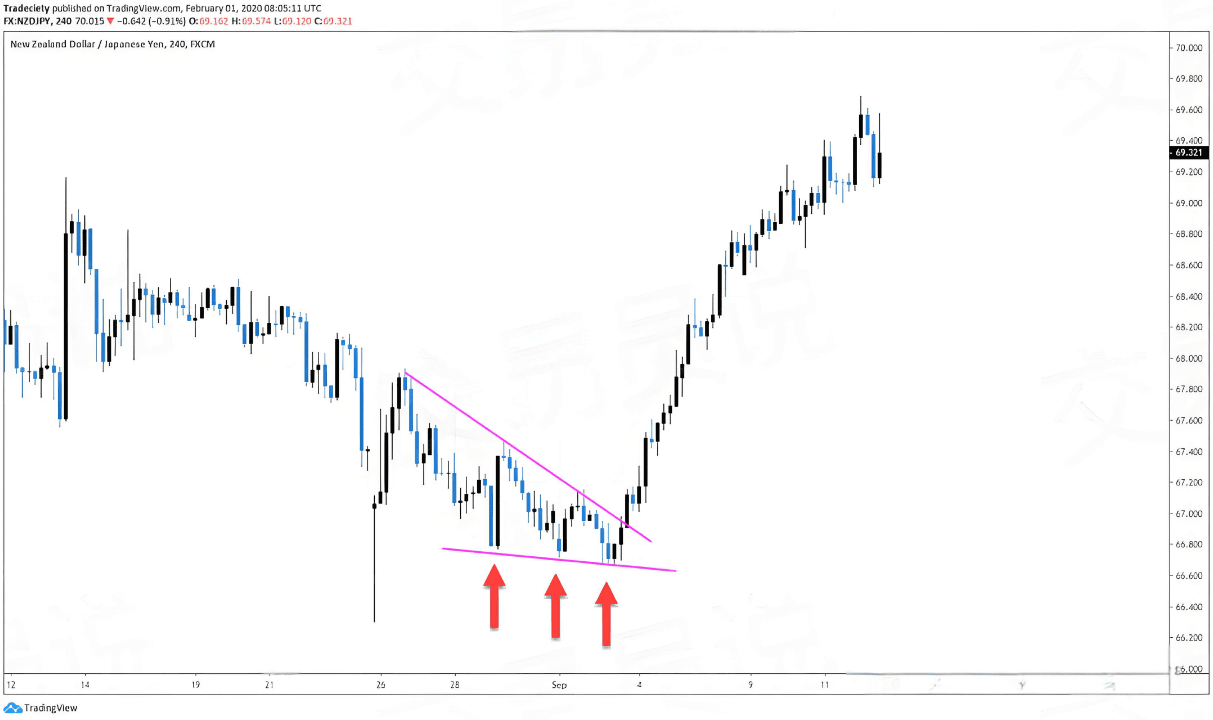
Wedge
Wedge belongs to reversal patterns, and it tells a very clear market story:
✍ The downward trend on the left side indicates that the wedge is a transitional pattern connecting the downward trend with the subsequent upward trend.
✍ When we observe the lows in the wedge, we can clearly see that the price is struggling to create lower lows. The three arrows in the figure indicate that each downward test of new lows has very weak strength, which is a typical signal of trend exhaustion.
✍ The outline of the pattern is composed of a trend line that comes from connecting the highs in the wedge.
✍ The final upward breakout is accompanied by a strong bullish candlestick, triggering a new upward trend.
Add technical indicators
If you wish to incorporate technical indicators into chart pattern trading, the following two categories of indicators are the most complementary to pattern analysis, making them a 'golden pair'.
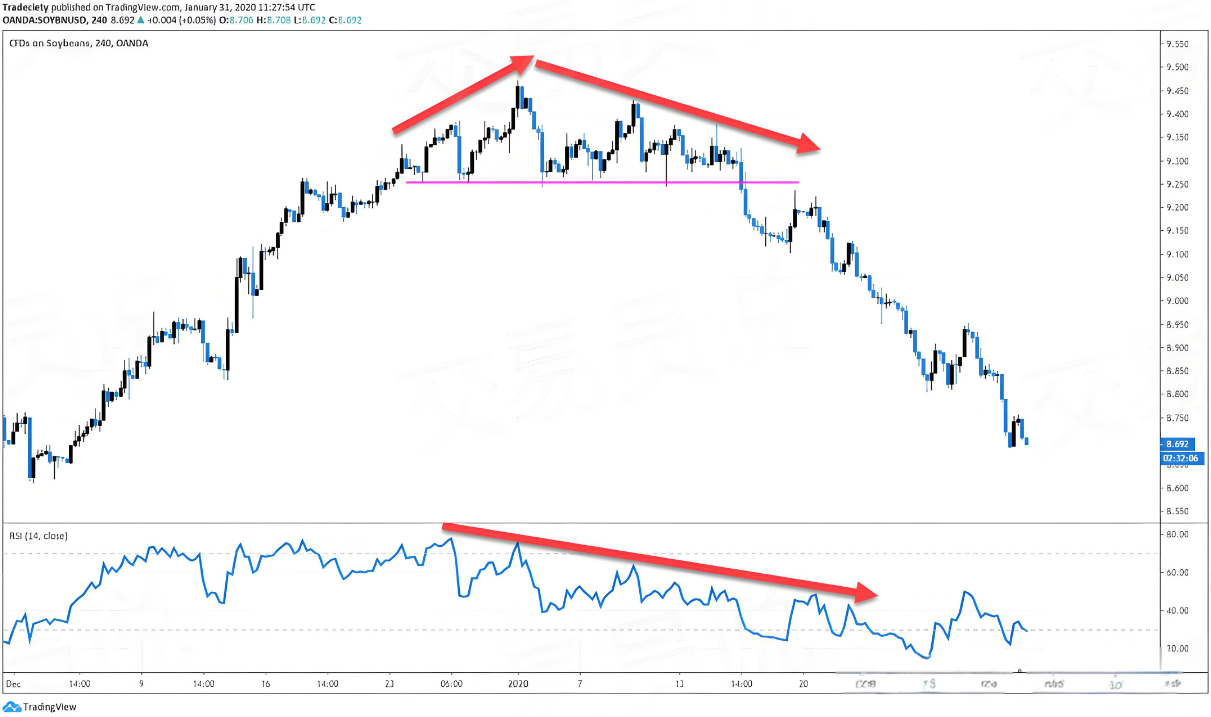
1. Divergence
Divergence indicates that the trend is slowing down, especially in trend reversal patterns, where divergence is an excellent resonance factor.
In the example below, the first arrow in the price section clearly demonstrates divergence: prices are continuously making higher highs, while the indicator shows that momentum is weakening. As the chart pattern evolves, RSI further confirms that selling pressure is increasing, and the bears begin to take the initiative. RSI continues to decline, validating the strengthening of bearish strength.
2. Trend strength
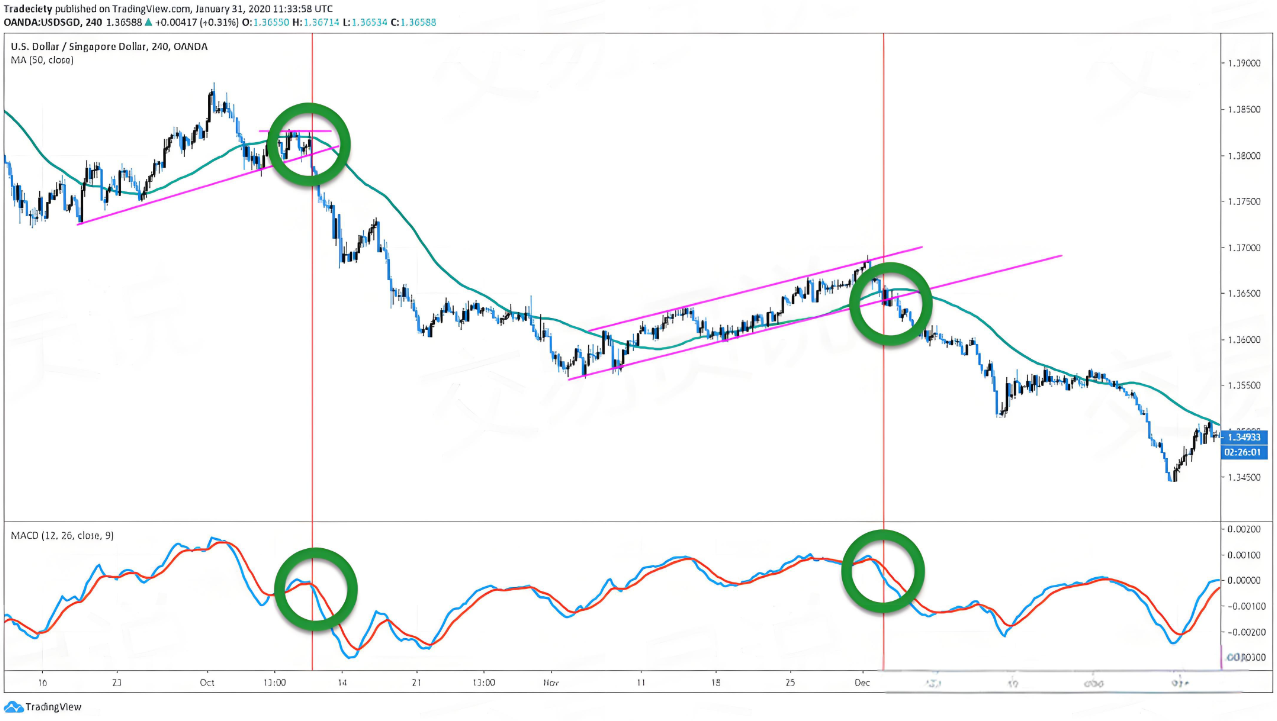
Moving averages (MA) and MACD are ideal tools for trading trend continuation patterns.
At each time a pattern is triggered based on the trend line, MACD shows a synchronous bearish crossover. The price also operates below the 50-period moving average, further confirming the effectiveness of the downward trend.
Moving averages are very suitable as trend indicators, especially for continuation patterns. In particular, long-term moving averages (50 or 100 periods) are very suitable as trend direction filters.
Final small suggestion
Next, it’s your turn to apply this knowledge to your own charts.
At the beginning, we recommend that you flip through charts, find patterns, and try to identify whether they meet all the conditions and backgrounds mentioned in this article. Save the chart screenshots you discover to build your own pattern library; this will be very helpful. Ultimately, technical analysis is a form of 'pattern recognition'; the more you see, the more naturally you can recognize these structures.
In addition, conduct market scans every weekend or every morning (depending on the cycle you choose) to look for current chart patterns forming. Don't rush to trade immediately; first observe how they develop and learn from how patterns and structures perform. In a few weeks, these judgments will become your second nature.
The above is the trading experience that Yan An shared today. Many times, you lose many money-making opportunities because of your doubts. If you don't dare to boldly try, touch, and understand, how will you know the pros and cons? You will only know how to take the next step after you take the first step. A warm cup of tea and a piece of advice; I am both a teacher and a friend you can talk to.
Meeting is fate; knowing each other is separation. I firmly believe that those destined to meet will eventually meet, and those who brush past each other are simply fate. The journey of investment is long; temporary gains and losses are just the tip of the iceberg. Remember that even the wisest can have their oversights, and even the foolish can have their gains. Regardless of emotions, time will not halt for you. Pick up the frustrations in your heart, stand up again, and move forward.
The martial arts secret has been given to everyone; whether you can become famous in the Jianghu depends on yourself.
Everyone must collect these methods and review them multiple times. Friends who find them useful can share them with more people in the crypto circle. Follow me to learn more valuable insights in the crypto space. After the rain, I am willing to hold an umbrella for the retail investors! Follow me, and let's move forward together in the crypto journey!