


The data officer of the cryptocurrency venture capital firm Paradigm, Storm, recently pointed out in a post that there is an issue with the on-chain data structure of the prediction market Polymarket, where "trading volume is being double-counted," leading to an exaggerated transaction volume displayed on many data dashboards in the past. This research quickly sparked heated debates in the community, involving not only the design of on-chain events and the interpretation of data but also the competitive sensitivity between the two major prediction platforms, Polymarket and Kalshi.
Does Polymarket have a fake trading volume issue?
Storm pointed out in the report that for each transaction on Polymarket, a set of OrderFilled events is issued for both the maker and the taker, representing different aspects of the same transaction. However, most industry data dashboards sum up all OrderFilled events directly when calculating trading volume, resulting in the same transaction amount being "double-counted," leading to a situation where the trading volume is inflated by two times or even more.
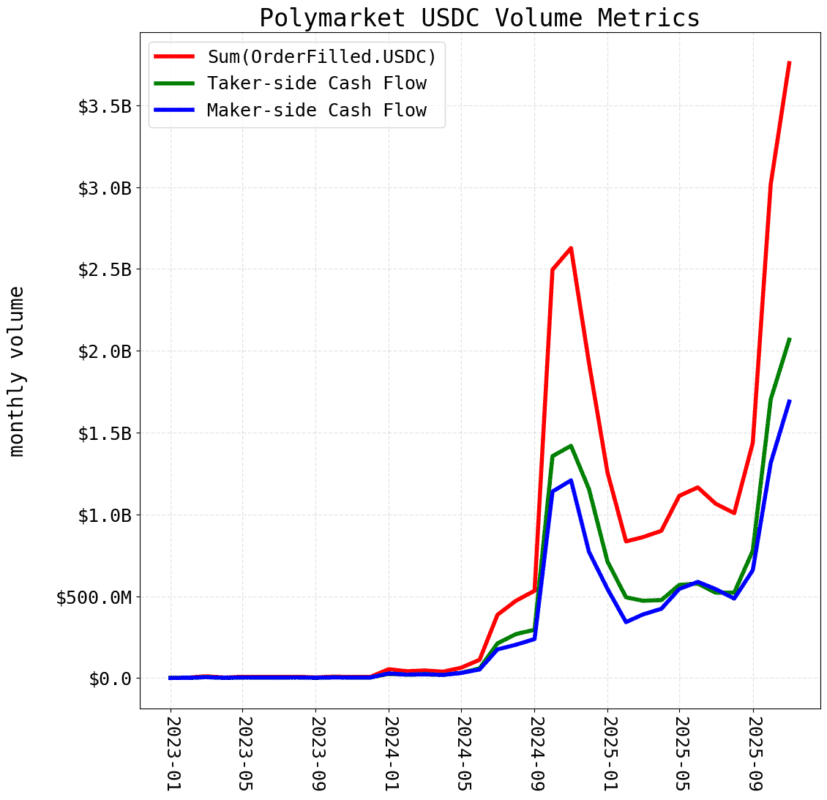
Storm stated that after checking the Polymarket contracts, analyzing event records, and building a trading simulator, he confirmed that this type of event structure would have the same effect across various trading types. Paradigm indicated that this observation has been confirmed by several data service providers, including Allium, DefiLlama, and Blockworks Research, all of which have started to correct their data dashboards to avoid double counting.
However, since Paradigm is an investor in Kalshi, Polymarket's competitor, this report has also embroiled Paradigm in a controversy over motives.
The Polymarket team responded.
Primo Data, an executive responsible for handling data at Polymarket, responded that the data on Polymarket's official website does not double count trading volume. The team simply uses 'taker notional volume' and emphasizes that this practice is the same as Kalshi's. Moreover, many primary data dashboards that track both Polymarket and Kalshi also base their figures on taker notional volume, so there is no issue of double counting.
This is not how prediction markets report volume, including your portfolio company Kalshi. To be clear: 1. Our site does not double count volume. We show notional taker volume (same as Kalshi). 2. The primary dashboards that show both Polymarket & Kalshi show notional volume… pic.twitter.com/9Bu0zm0DS0
— Primo Data (@primo_data) December 8, 2025
In response, Storm emphasized that the research he published is not accusing the Polymarket team of intentionally washing trading volume, but rather that the complex data structure can easily lead to misinterpretations by external data dashboards. Storm stated that most third-party data dashboards used to track Polymarket trading volume have this issue.
Deliberately amplifying the problem?
Although both sides' claims are reasonable, Storm has also stressed that there is no fundamental error in Polymarket's original trading volume records; the problem lies in external analytical tools 'misreading the data.' However, there are still critics in the community who argue that Storm's negative interpretation is intentionally amplifying the data controversy to influence public opinion.
Hildobby, head of data at Dragonfly, pointed out that this kind of double counting is not a new problem. Hildobby stated that since 2024, all major data dashboards have been corrected, and the currently mentioned phenomenon of 'data inflation' mainly exists in third-party dashboards that are outdated or lack research capabilities, rather than being a widespread consensus in the industry. It seems to imply that this issue is not as serious as Storm described.
Source
