
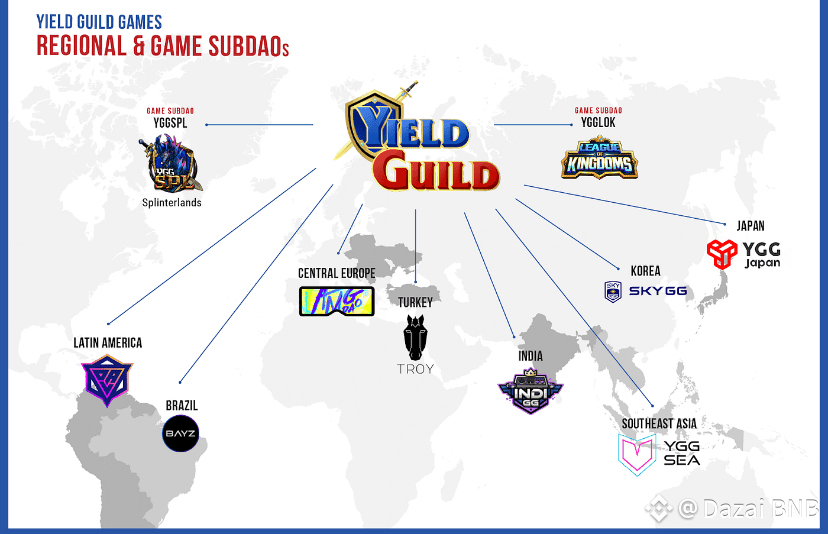
Dazai remembers when game guilds were small, cozy clans swapping tips in Discord channels. What started as a handful of players pooling NFTs to help each other play-to-earn has, over the last few years, ballooned into an audacious experiment: can one token, one DAO, and one global community actually knit together wildly different game worlds so that assets, players, and attention flow between them? Yield Guild Games — and its governance token, YGG — is trying to answer that question out loud, with treasury moves, publishing bets, and cross-chain plumbing that read like the work of a scrappy studio and a central bank at once.
If you squint, the strategy is elegant. Instead of hoarding tokens in a cold wallet, YGG began deploying capital into an “Ecosystem Pool” designed to seed liquidity, underwrite partner launches, and build incentives that make playing across games feel less like hopping between islands and more like exploring districts of one sprawling metaverse. That shift from passive treasury to active builder changes how interoperability gets paid for: it’s not only about bridges and technical APIs, it’s about incentives that make devs want to let players carry value between worlds.
This is where YGG’s publishing arm, YGG Play and the more recent YGG Studios, becomes interesting. Rather than simply sponsoring guild players in established titles, YGG started co-building and publishing games — bringing developer relationships and revenue-sharing models into the same orbit as its guild network. When a game launches with YGG’s support, that title can tap into a ready-made community, and YGG can negotiate tokenomics that favor cross-game movement, shared questing frameworks, or composable NFT utilities. The result is less siloed experiences and more composable gameplay loops.
Interoperability isn’t just a tech problem; it’s a discovery and retention problem. Dazai thinks about players who try a new web3 game, earn an NFT, and then never return because the onboarding felt too clunky. YGG’s approach has been to make the first touchpoint easier — launchpads, creator programs, guild-supported onboarding — so that the moment a player owns an item, there are clear pathways to use it elsewhere or cash it into the ecosystem. That’s not pure bridge engineering; it’s product design plus community mechanics working together.
On the tech side, YGG has experimented with specialized chains and infrastructure — Studio Chain and partnerships with L2s and game-friendly layers — to reduce friction. Low-latency, high-throughput chains that support custom gas tokens and faster settlements make it feasible for assets to migrate or be wrapped across environments without the user paying a land tax every time. Those infrastructure plays make cross-game composability technically plausible in ways that simply weren’t affordable a few years ago.
Partnerships tell the practical story. When YGG plugs into projects like Warp Chain, Gigaverse, or newer studio partners, it’s not just logos on a press release: it’s player funnels, shared incentive programs, and often bespoke deals to make in-game economies talk to each other. These alliances work like inter-guild accords — they align token incentives so that a player’s investment in time or NFTs in one project has meaningful upside when they migrate to another. That social contract is critical for real, durable interoperability.
There are trade-offs. Building bridges introduces counterparty risk, and pushing liquidity into launchpads or ecosystem pools can create short-term volatility for YGG holders. Dazai doesn’t pretend the roadmap is risk-free; it’s an aggressive market-making experiment where success depends on sustained player adoption and developer cooperation. But the upside is compelling: if multiple popular titles adopt interoperable mechanics and YGG’s guild network reliably seeds players into those titles, the token becomes a utility that captures real cross-game activity rather than speculative air.
What does success look like? Imagine a casual player discovering a YGG-backed title on a launchpad, earning an item that doubles as a key in another YGG-published game, and then using that cross-game reputation to unlock creator monetization or guild quests. The flow — discover, earn, redeploy — is how a single token can start to feel like a travel pass across experiences, rather than a loyalty card for one garden. YGG’s recent creator roundtables and community-driven programs aim to surface the exact incentives that will make that loop sticky.
For skeptics, the question is whether any single DAO should have that much influence over an emergent economy. Dazai hears that objection and also sees how YGG is attempting to decentralize governance and spread grants, creator funds, and on-chain guild tools to other builders. The experiment is to bootstrap interoperability with a strong organizer — and then ideally make the rails open enough that many hands can build on top. That’s the messy middle of web3: centralized enough to act fast, decentralized enough to survive.
At the end of the day, the interoperability story isn’t just about bridges or liquidity pools; it’s a human story about communities, creators, and the small moments when one game hands meaning to another. Dazai will be watching how YGG’s incentives, studio plays, and partnerships evolve, because if the guild succeeds, the sentence “take your items with you” will stop sounding like a futuristic promise and start feeling like a natural part of gaming. That’s when real virality happens: when millions of players move between worlds and bring their stories — and their tokens — along.
@Yield Guild Games #YGGPlay $YGG
