
👋 If this is your first time encountering the concept of 'issuing a token', please relax — after reading this, you can transform from a 'crypto novice' to a 'token issuance expert'.
1. Preparation and introductory concepts before issuing a token
Want to issue a token smoothly? Start with understanding. The logic of blockchain is like building a house; if the foundation is not well laid, the rest will be full of pitfalls. The following steps are the basics of issuing tokens that every beginner must understand.
🔹 What is 'issuing a token'?
Issuing a token (Create Token) means: deploying a contract for your token on an existing blockchain. You define the name, symbol, total supply, and functions — you are its creator.💥
🧠 For example: Bitcoin is an independent public chain (mining output), while you are creating a 'token' deployed on a certain chain, such as generating your own Token on BSC or Solana.
🔹 Choose chain: On which chain to issue?
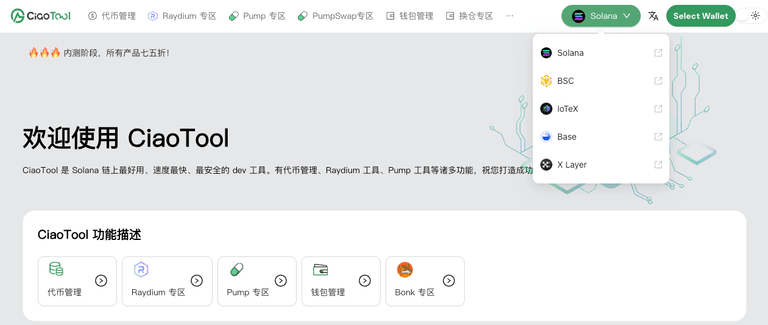
Currently mainstream options are as follows:
BSC (Binance Chain): Mature and stable, low transaction costs, suitable for beginners/projects
Solana: Fast speed, active ecosystem, suitable for users who want to create Meme or light projects
Base / X Layer / IoTeX: Emerging chains, flexible operations, suitable for developers who want to play with new ecosystems
🛠️CiaoTool supports multi-chain token creation, you can freely choose what suits you.
🔹 How much does it cost to issue coins?
Fees vary by chain, generally paid with the native token of that chain:
BSC ➜ Use BNB
Solana ➜ Use SOL
👉 You can refer to the official fee documentation for real-time data.
🔹 What can be done after sending coins?
✅ You can: transfer or airdrop to others, create liquidity pools for trading, view token trends on DEX platforms
⚠️ Note: To ensure your tokens can be traded, have a price, and display on GMGN, DexScreener, a liquidity pool must be created.
🔹 Difference between in-house and one-click issuance?
In-house issuance: no liquidity pool, tokens need to be purchased, project control is weak, suitable for lightweight applications
One-click issuance: tokens arrive directly, self-add pool, fully configurable project parties completely control token logic
💡 Supports two modes: can both do 'one-click coin issuance' and connect to PumpFun, BonkFun, Fourmeme, Flap and other in-house ecosystems to create and buy.
⚙️ Pre-issuance preparation checklist
💻 Computer/phone: It is recommended to operate on a computer (more stable and convenient)
🌐 Scientific Internet tools: Access chain resources and tutorials
💰 Wallet (MetaMask/Phantom/OKX): Store on-chain assets
🪙 Asset preparation: Wallet must have tokens such as BNB, SOL to pay for Gas
💬 Telegram: Join CiaoTool official group for help
⚠️ Important reminder:
Don't know how to use a wallet ❌ Not recommended to issue coins
No assets in the wallet ❌ Not recommended to issue coins
Don't understand basic concepts ❌ Not recommended to issue coins
Two, practical guide to issuing coins
Step 1: Fill in basic information
Name (Name) full name of the token, can be in Chinese and English, example: SolDog, MeowCoin
Symbol (Symbol) abbreviation, usually 3-5 letters example: DOG, MEOW
Total supply (Supply) maximum number of tokens suggested integers, not decimals
Precision (Decimals) minimum divisibility unit defaults to 6 or 9
Avatar (Logo) Solana chain supports uploads, other chains may not display even if uploaded, Solana chain can be replaced by itself, others need to contact the corresponding official customer service
Step 2: Optional feature configuration
Burning: Destroy part of the tokens, driving up the price, suitable for projects looking to implement deflationary models
Blacklist: Freeze specific addresses to defend against malicious wallets
Increased issuance: dynamically increase supply, for testing purposes
Standard tokens: no permissions, recommended for beginners, fully green detection
It is recommended for beginners to create 'standard tokens'—the most straightforward functionality, highest security, and most user-friendly risk control detection.
Step 3: Choose a blockchain
EVM systems (BSC/Base/X Layer): Powerful features, high compatibility, slightly higher costs
Solana: Fast speed, avatar display friendly, relatively simple functionality
Step 4: Payment and creation: After confirming parameters, the system will prompt payment for coin issuance fees. Once payment is completed, the tokens will be automatically generated and sent to the currently bound wallet.
Three, management and maintenance after issuing coins
Congratulations! By now, you officially own your tokens. But the next part is even more critical—how to operate and maintain the token ecosystem.
💡 Common questions quick reference
Q1: Where are the tokens? Why can't I see them in my wallet? 👉 All tokens are in the wallet you are connected to. If not displayed, please manually add the token address.
Q2: How to trade? 👉 Create a liquidity pool, such as:
BSC: PancakeSwap
Solana: Raydium
Q3: How is the token price determined? 👉 Price = ratio of two assets in the liquidity pool. For example: 100 USDT + 100 TOKEN = initial price 1 USDT/TOKEN.
Q4: Why does the risk detection show red? 👉 If features like 'increased issuance' or 'blacklist' are added, detection will be deemed high risk. It is recommended to use 'standard tokens' to maintain a green label.
Q5: When someone buys my tokens, where does the money go? 👉 The buying funds enter the liquidity pool. To withdraw profits, you can perform 'remove liquidity' operations.
🧠 Key points of liquidity pool knowledge
Anyone can create a liquidity pool: as long as there are tokens and assets
How much investment is appropriate?: There is no fixed threshold, even tens of dollars can build a pool
Will the pool tokens be bought out?: Theoretically, they won't; prices will rise until approaching 0
How to stabilize the price?: Using CLMM or single coin addition to the pool can enhance stability
Does Solana need a market ID?: Only AMM mode needs to create Market ID
Four, practical tool recommendations after issuing coins
Issuing coins is just the starting point; to operate well, tools must be used. CiaoTool provides a complete set of supporting features:
💸 Batch transfer: airdrop to hundreds of addresses at once, can upload forms or import files
📊 Snapshot export: Export the list of token holders for airdrops, governance, rewards
🧩 Market Management: Multi-address trading operation, controlling price curves
🪪 Batch generate wallets: generate hundreds of addresses at once, supporting Solana, BSC
🧮 Batch collection: multi-address asset recovery, convenient for fund management
💎 Cool wallet: Custom prefix wallet addresses, suitable for brand projects
🚀 The threshold for issuing coins is getting lower, but the threshold for operation is getting higher. The real competition is not 'who issues first', but 'who can operate well'.
May your first token on the chain become the key to your entry into the Web3 world.
https://ciaotool.io/zh-CN/token/create




