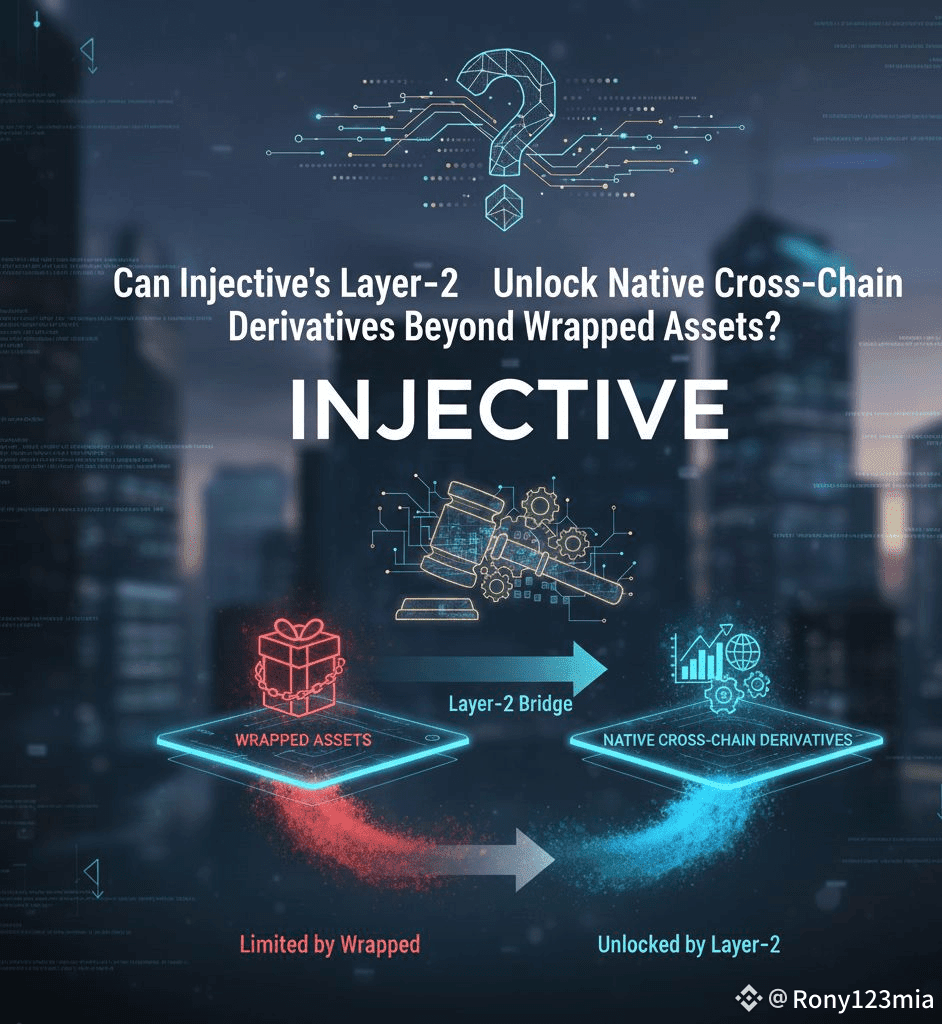
Injective’s unique Layer-2 bridge mechanism enables true cross-chain derivatives trading by directly connecting non-EVM chains like Solana and Cosmos into its decentralized order book, eliminating the need for centralized custodians or fragile wrapped assets. This architecture allows traders to move native value across ecosystems and engage in derivatives markets with speed, security, and fairness.
When most blockchains talk about interoperability, they often reduce it to a checkbox feature: deploy a bridge, mint a wrapped token, and hope liquidity follows. But Injective approaches the problem differently. Its Layer-2 bridge is not an add-on—it is woven into the very fabric of its architecture, designed to let value move without friction and liquidity breathe without borders. This matters because decentralized finance doesn’t live in one ecosystem. Ethereum may hold the deepest liquidity, Solana may push the limits of execution speed, and Cosmos may offer modular sovereignty through appchains. Yet traders want all of these strengths at once, without being forced into custodial bottlenecks or synthetic representations of assets.
At the heart of Injective’s design is its single-entry point to interchain DeFi, which connects Ethereum, Solana, and Cosmos directly. Unlike traditional bridges that rely on custodians to lock assets and issue wrapped versions, Injective leverages IBC (Inter-Blockchain Communication) channels and its own Layer-2 verification system to enable native asset transfers. This means that when a trader wants to bring Solana-based liquidity into Injective’s derivatives market, they aren’t trading a wrapped SOL token—they are interacting with the actual Solana asset, validated through decentralized consensus. The same applies to Cosmos appchains, where Injective’s bridge can pull in native tokens without intermediaries.
This mechanism unlocks a powerful new frontier: cross-chain derivatives trading with non-EVM assets. Imagine a trader who wants to hedge exposure to Solana’s ecosystem by shorting SOL futures, or a DeFi strategist who wants to combine Cosmos staking yields with Injective’s perpetual swaps. Traditionally, this would require centralized custodians or fragile wrapped tokens that introduce counterparty risk. Injective’s Layer-2 bridge removes that dependency. By directly verifying and settling cross-chain transactions, it allows derivatives markets to be built on native assets, not synthetic proxies. This is a leap forward in both security and usability.
Security is a critical dimension here. Bridges have historically been one of the most vulnerable points in crypto, with billions lost to hacks. Injective’s approach mitigates these risks by avoiding centralized custody and minimizing reliance on wrapped assets, which are often the weakest link. Instead, its Layer-2 bridge uses decentralized validators and cryptographic proofs to ensure that cross-chain transfers are final and tamper-resistant. This design not only protects traders but also builds confidence in the liquidity flowing across Injective’s markets.
Performance is another advantage. Injective supports over 10,000 transactions per second with near-zero gas fees, making it one of the fastest environments for derivatives trading. When combined with its Layer-2 bridge, this means that assets from Solana or Cosmos can be moved and deployed in derivatives markets almost instantly. Traders benefit from high throughput and low costs, while liquidity providers can deploy capital across ecosystems without delay. This speed is essential for derivatives, where timing and execution quality directly impact profitability.
The implications for DeFi are profound. By enabling native cross-chain derivatives, Injective creates a marketplace where traders can hedge, speculate, and build strategies across multiple ecosystems simultaneously. For example, a trader could long Ethereum perpetuals, short Solana futures, and stake Cosmos tokens—all within Injective’s decentralized order book. This kind of multi-chain strategy was previously only possible through centralized exchanges or complex custodial setups. Injective democratizes it, making advanced financial tools accessible to anyone with a wallet.
From a governance perspective, Injective’s design also empowers its community. The INJ token is used for staking, governance, and liquidity mining, meaning that the very users who benefit from cross-chain derivatives are also the ones shaping the protocol’s future. This creates a feedback loop where traders, liquidity providers, and developers can collectively decide how Injective evolves, ensuring that its Layer-2 bridge continues to meet the needs of a rapidly changing DeFi landscape.
For retail investors on platforms like Binance Square, the takeaway is clear: Injective’s Layer-2 bridge is not just a technical innovation—it is a practical solution to real trading pain points. It eliminates the risks of custodial bridges, avoids the inefficiencies of wrapped assets, and opens the door to native cross-chain derivatives. This means fairer markets, deeper liquidity, and more opportunities to build strategies that span ecosystems. Whether you’re hedging exposure, seeking arbitrage, or simply exploring new DeFi tools, Injective offers a secure and efficient gateway.
In essence, Injective treats interoperability not as a checkbox but as a native instinct. Its Layer-2 bridge mechanism is a quiet force that allows finance to live in motion between ecosystems, rather than being trapped within them. By connecting Ethereum’s liquidity, Solana’s speed, and Cosmos’s sovereignty, Injective creates a truly borderless derivatives marketplace. And for traders, that means one thing: the freedom to move, hedge, and build without compromise.